
Research CatalogueThematicWorkforce Mental Health & Absenteeism Cost Report, 2026
Research Report0000-00-0038 pages

Workforce Mental Health & Absenteeism Cost Report, 2026

Talenbrium Research  |  0000-00-00  |  By Diptanjan Biswas  |  Talenbrium Proprietary Intelligence
Mental health is no longer a wellbeing initiative — it is a balance sheet item.

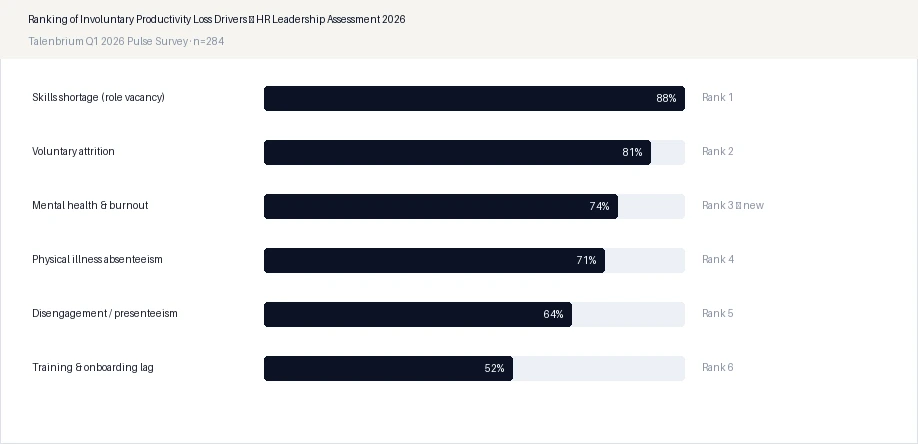
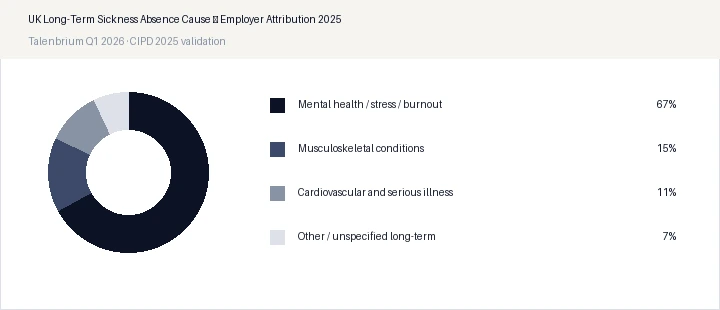
Talenbrium's Q1 2026 Workforce Pulse Survey found that HR leaders now rank employee mental health and burnout as the third most significant driver of involuntary productivity loss — behind only skills shortage and voluntary attrition, but ahead of physical illness absenteeism for the first time in Talenbrium's survey history. Among UK respondents specifically, mental health-related absence was cited as the leading cause of long-term sickness absence by 67% of respondents, consistent with the CIPD's Health and Wellbeing at Work Report 2025, which Talenbrium uses as an external validation benchmark.

Talenbrium's cost modelling — calibrated against WHO and HSE macroeconomic estimates — places the annual mental health productivity loss at approximately USD 1,685 per employee in the United States and GBP 1,340 per employee in the United Kingdom. These are conservative figures that capture documented absenteeism only. Presenteeism — attending work while experiencing mental health difficulties — is consistently estimated at two to three times the direct absenteeism cost.
USD 1,685
Annual mental health productivity loss per US employee
Talenbrium cost model · WHO calibration
GBP 1,340
Annual mental health productivity loss per UK employee
Talenbrium cost model · HSE LFS 2024–25
16.4M
UK working days lost to work-related stress, depression, anxiety 2024–25
UK HSE Labour Force Survey 2024–25
21.1 days
Average days lost per affected UK worker (mental health) 2024–25
UK HSE Labour Force Survey 2024–25
Ranking of Involuntary Productivity Loss Drivers — HR Leadership Assessment 2026
Mental health is no longer a wellbeing initiative — it is a balance sheet item.Talenbrium's Q1 2026 Workforce Pulse Survey found that HR leaders now rank employee mental health and burnout as the third most significant driver of involuntary productivity loss — behind only skills shortage and voluntary attrition, but ahead of physical illness absenteeism for the first time in Talenbrium's survey history. Among UK respondents specifically, mental health-related absence was cited as the leading cause of long-term s...
Full data available to purchasers
The hiring signal is a direct proxy for the absenteeism problem

Talenbrium's analysis of job postings data identifies a direct correlation between organisations experiencing high mental health-related absenteeism and their hiring activity patterns. Organisations in Talenbrium's employer database with above-average mental health absence rates post 23% more replacement hire requisitions, 31% more temporary and contract roles, and 18% more HR Business Partner and Employee Relations roles than sector peers with lower absence rates. The UK Health and Safety Executive's published data for 2024–25 shows 776,000 workers suffering from work-related stress, depression, or anxiety — accounting for 16.4 million working days lost.

"Mental health and burnout now rank as the third most significant driver of involuntary productivity loss — ahead of physical illness absenteeism for the first time in Talenbrium's survey tracking history." — Talenbrium Q1 2026 Workforce Pulse Survey, n=284
UK Long-Term Sickness Absence Cause — Employer Attribution 2025
The full 38-page report includes: cost modelling by organisation size (under 50, 50–249, 250–999, 1,000+) and sector (financial services, healthcare, technology, professional services, retail, public sector); presenteeism cost estimates calibrated to employer role mix; hiring activity proxy analysis showing replacement hire surges in high-absence organisations; sector-specific absenteeism rates and year-on-year trends; intervention ROI analysis for EAP, flexible working, and manager mental health training programmes; and comparative US vs. UK cost benchmarks validated against WHO and HSE macroeconomic data.
Full data available to purchasers
Table of Contents
01Executive Summary & Cost FrameworkPreview
02Mental Health as a Balance Sheet Item — The Strategic CasePreview
03Cost Modelling: US and UK Annual Productivity Loss per EmployeeGated
04Presenteeism: The Hidden MultiplierGated
05Sector-Level Absenteeism Rates and TrendsGated
06UK HSE Analysis: 776,000 Workers, 16.4 Million Days LostGated
07US Workplace Mental Health: SHRM BenchmarksGated
08Employer Size Analysis: Absence Rate by Organisation ScaleGated
09Hiring Activity as Absence Proxy: Talenbrium Postings AnalysisGated
10Intervention ROI: EAP, Flexible Working, Manager TrainingGated
11EU Comparative: France, Germany, NetherlandsGated
12Strategic Recommendations for HR LeadershipPreview
13MethodologyPreview
Report scope
Series & Price
Series A · Report 4 · USD 1,799 · 38 pages
Geography
US (primary) · UK (primary) · France, Germany, Netherlands (comparative)
Employer size
Under 50 · 50–249 · 250–999 · 1,000+
Sectors
Financial services · healthcare · technology · professional services · retail · public sector
Primary research
Talenbrium Q1 2026 Pulse Survey · n=284 · mental health & absenteeism module
Secondary validation
WHO Global Mental Health Report · UK HSE LFS 2024–25 · CIPD 2025 · Stevenson-Farmer Review 2025
Customisation
10 hours free customisation & expert consultation included
Delivery
Within 24 hours of purchase
Assigned Author
Diptanjan Biswas

Diptanjan Biswas

Principal Head, Strategic Consulting

Diptanjan Biswas leads strategic consulting at Talenbrium, bringing nine years of experience across research, risk, and workforce intelligence in banking, technology, and advisory sectors.

Workforce Strategy Labour Market Intelligence Credit Risk Recoveries Strategy
View Full Author Profile Linked to Talenbrium's public author library

Ready to access the full intelligence?

Purchase directly, or speak with our team to discuss your requirements first.

Purchase
Buy this report — USD 1,799
Enquire
Speak with our research team
Custom
Commission a bespoke engagement
Home Reports Insights Contact