
Research CatalogueItaly: AI Workforce Displacement and Labor Transition Intelligence — Collective Dismissal Law in the Age of Automation
Research Report2026-07-0954 pages

Italy: AI Workforce Displacement and Labor Transition Intelligence — Collective Dismissal Law in the Age of Automation

Talenbrium Research  |  2026-07-09  |  By Diptanjan Biswas  |  Talenbrium Proprietary Intelligence
Italy pairs union consultation depth with a fragmented regional labour market — a combination that punishes generic restructuring plans.

Collective dismissals in Italy involving 5 or more employees within 120 days at establishments with more than 15 employees trigger Law 223/1991, which requires written notification to trade unions and regional labour authorities, a mandatory consultation period of up to 75 days, and adherence to selection criteria that heavily weight seniority, family responsibilities, and technical-productive-organisational need. For AI-linked restructuring, Italian unions (CGIL, CISL, UIL and sector-specific federations) have increasingly requested detailed documentation of AI productivity claims during consultation, treating automation-driven redundancy with the same scrutiny historically reserved for plant closures.

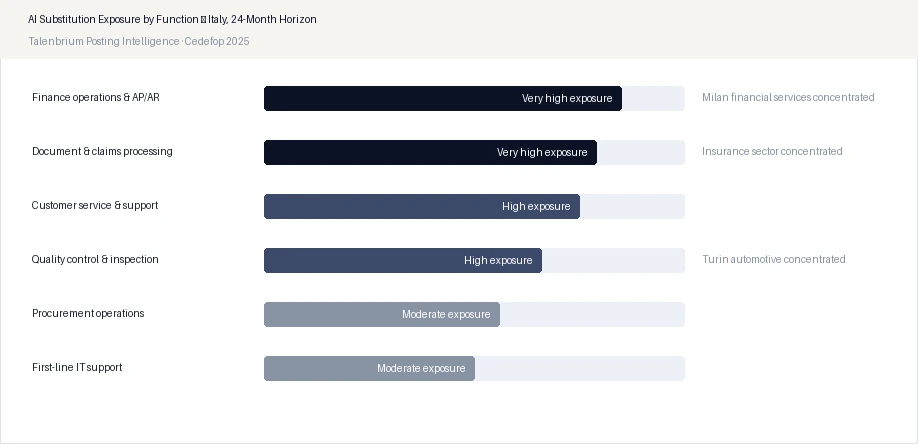
Talenbrium's posting intelligence shows Italian employers adopting AI systems at a measured pace relative to Germany and France, concentrated in Milan's financial services sector and Turin's automotive and manufacturing base. Rome shows comparatively lower AI-linked restructuring activity, reflecting the public-sector-heavy composition of its labour market, which operates under separate and more protective rules.
87/100
Talenbrium Restructuring Difficulty Index — Italy, second-highest in EU-6 comparative
Talenbrium composite · OECD EPL indicators
7-9x
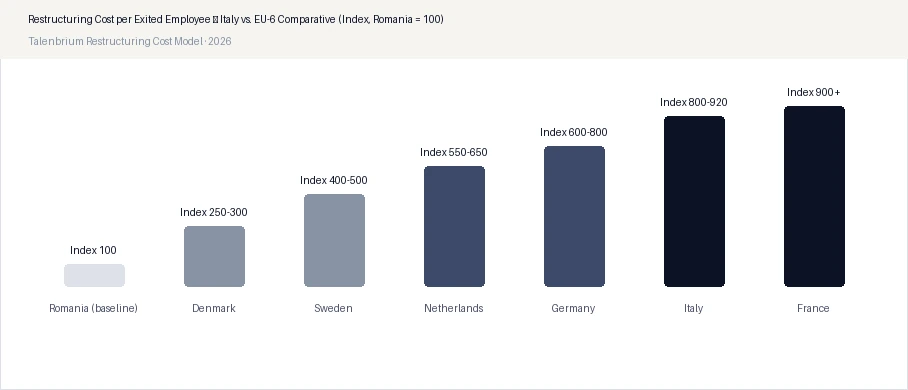
Fully-loaded exit cost multiple vs. Romania baseline, per employee
Talenbrium restructuring cost model
75 days
Maximum statutory union consultation period under Law 223/1991
Italian Labour Code · Talenbrium legal framework analysis
54%
Share of Italian AI-adopting employers reporting union requests for AI productivity documentation
Talenbrium Q1 2026 Pulse Survey · Italy sub-sample
2.7:1
Demand-push ratio — open destination-function roles per AI-displaced worker, Milan metro
Talenbrium posting intelligence · trailing 12 months
AI Substitution Exposure by Function — Italy, 24-Month Horizon
Italy pairs union consultation depth with a fragmented regional labour market — a combination that punishes generic restructuring plans.Collective dismissals in Italy involving 5 or more employees within 120 days at establishments with more than 15 employees trigger Law 223/1991, which requires written notification to trade unions and regional labour authorities, a mandatory consultation period of up to 75 days, and adherence to selection criteria that heavily weight seniority, family responsibilities, and techn...
Full data available to purchasers
Job postings prove the case both ways: declining demand for AI-exposed roles, rising demand for the roles workers could move into.

Talenbrium's proprietary posting database tracks year-over-year change in active job postings by function across the Italian market. For AI-exposed functions, posting volume has fallen consistently over the trailing 12 months as employers automate first and hire less into these roles — evidence that supports the technical-productive-organisational need test central to Law 223/1991 consultation. For destination functions, the pattern reverses: postings are rising, meaning a documented reskilling pathway into these roles is backed by live employer demand today, not aspiration.
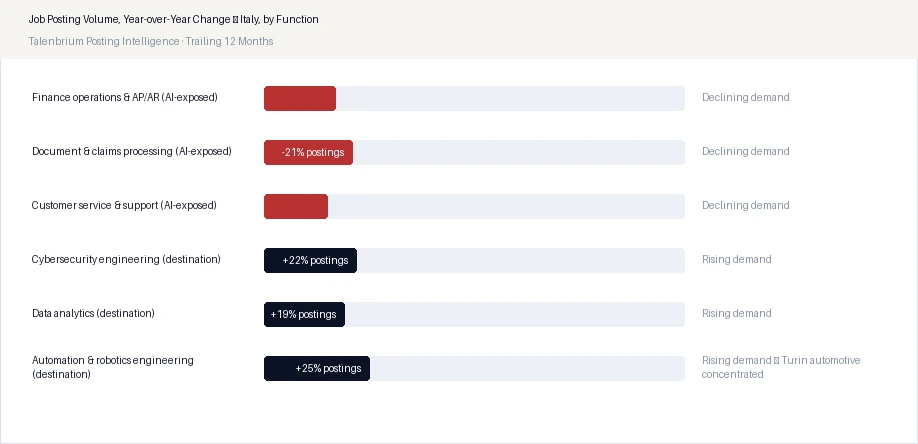
Job Posting Volume, Year-over-Year Change — Italy, by Function
Milan, Turin, and Rome are not interchangeable markets. Union density and sector composition make the restructuring path different in each.

Milan's financial and professional services base means AI-linked restructuring there most often intersects with FABI and sector-specific banking union agreements, which in several major institutions include negotiated AI deployment clauses dating to 2024-2025 collective bargaining rounds. Turin's manufacturing and automotive concentration means restructuring frequently intersects with FIOM-CGIL, historically the most restructuring-resistant Italian union federation, and with regional government interest given the strategic importance of the automotive sector to Piedmont's economy. Rome's labour market, weighted toward public administration and services, presents lower immediate AI substitution exposure but correspondingly lower redeployment absorption capacity for displaced private-sector specialists.

Talenbrium's Q1 2026 Pulse Survey found that employers who tailored union engagement strategy by city and sector federation, rather than applying a single national consultation template, completed Law 223/1991 processes an average of 22% faster than those using a uniform approach.

"Treating FABI, FIOM-CGIL, and a Rome public-sector-adjacent union as the same negotiating counterpart is the single most common and costly mistake we see in Italian AI restructuring. Each has a different institutional memory, different red lines, and a different appetite for AI-linked job content change." — Talenbrium Workforce Intelligence, Q1 2026
Restructuring Cost per Exited Employee — Italy vs. EU-6 Comparative (Index, Romania = 100)
Table of Contents
01Executive Summary: The Italian AI-Restructuring Equation
02AI Substitution Exposure by Function — National and City-Level
03Law 223/1991: Collective Dismissal Process and Union Consultation
04Union Federation Mapping: FABI, FIOM-CGIL, and Sector-Specific Bodies
05Cost Calculator: TFR and Negotiated Settlement Premiums by Seniority Tier
06City Analysis: Milan, Turin, Rome
07Redeployment Absorption Capacity by City
08Reskilling Pathways: Cost, Duration, and Viability by Function
09Salary Benchmarks: Displaced Roles vs. Destination Roles
10Union Engagement Framework by Sector and City
11Romania Relocation Comparison: When It Beats In-Country Restructuring
12Strategic Recommendations
13Methodology and Data Sources
Report scope
Geography
Italy national + Milan, Turin, Rome
Legal framework
Law 223/1991 · union consultation · NASpI transition framework
Sectors
Financial services · Automotive & manufacturing · Public administration-adjacent
Primary research
Talenbrium Q1 2026 Pulse Survey · Italy sub-sample
Cost model calibration
OECD EPL indicators · union settlement data
Secondary validation
ISTAT · Cedefop 2025 · Eurostat Structure of Earnings
Customisation
10 hours free customisation included · Regional extensions available
Delivery
Within 2–4 business days of purchase · 54 pages + cost calculator
Assigned Author
Diptanjan Biswas

Diptanjan Biswas

Principal Head, Strategic Consulting

Diptanjan Biswas leads strategic consulting at Talenbrium, bringing nine years of experience across research, risk, and workforce intelligence in banking, technology, and advisory sectors.

Workforce Strategy Labour Market Intelligence Credit Risk Recoveries Strategy
View Full Author Profile Linked to Talenbrium's public author library

Ready to access the full intelligence?

Purchase directly, or speak with our team to discuss your requirements first.

Purchase
Buy this report — USD 4,999
Enquire
Speak with our research team
Custom
Commission a bespoke engagement
Home Reports Insights Contact