
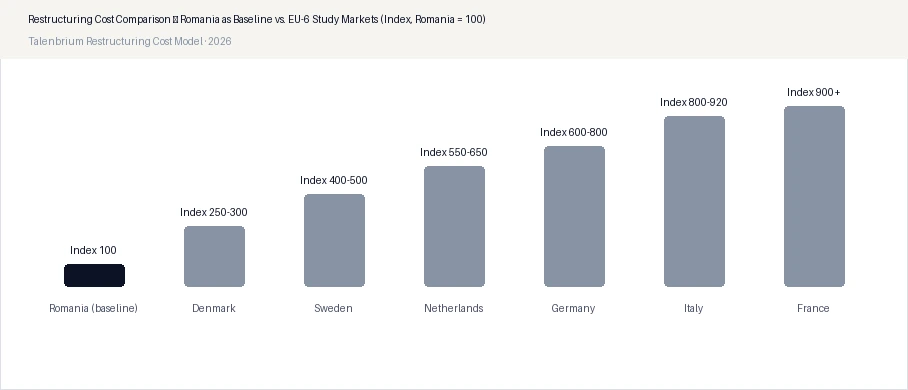
Romania's Labour Code (Law 53/2003) permits individual and collective redundancy with statutory notice periods of 20 working days, no mandatory works council co-determination equivalent to Germany's BetrVG, and severance obligations typically limited to collective bargaining agreement terms rather than the extended social plan obligations found in Western Europe. Collective redundancy notification to territorial labour authorities is required above certain thresholds, but the consultation period and procedural burden are materially lighter than the PSE process in France or Law 223/1991 in Italy. For multinationals evaluating where to locate AI-adjacent functions or where to consolidate operations displaced by AI adoption elsewhere in Europe, Romania offers full EU single market access, English-language business fluency in its major cities, and a restructuring cost base that serves as the baseline against which every other market in this study is indexed.
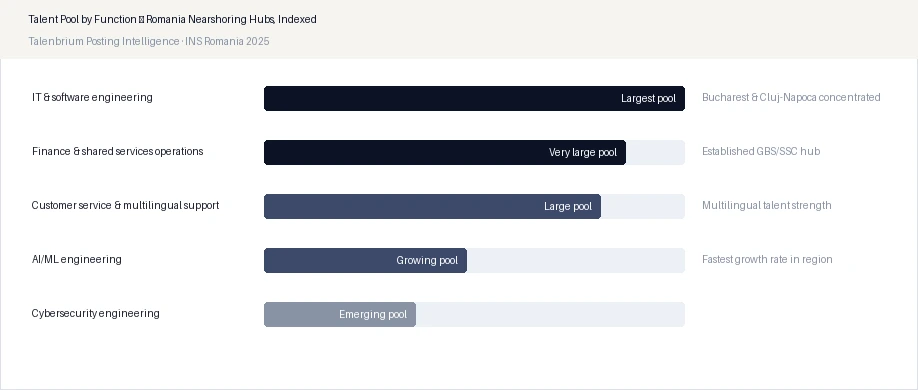
Talenbrium's posting intelligence shows Bucharest, Cluj-Napoca, and Timisoara have become established nearshoring hubs for finance operations, customer service, IT support, and increasingly AI/ML engineering roles themselves, as Western European and US employers relocate functions rather than restructure them in place. This report positions Romania not only as a comparative benchmark but as an active relocation destination assessed on its own talent supply and cost merits.
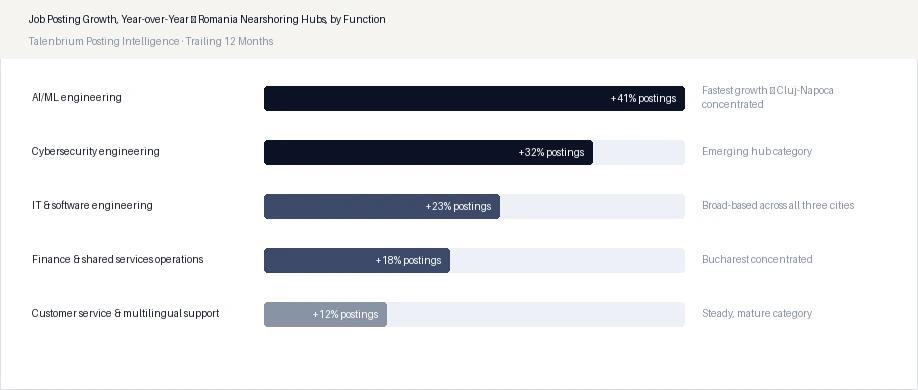
Talenbrium's proprietary posting database tracks year-over-year change in active job postings across Romania's three nearshoring hubs. Every function tracked here shows positive growth, and the functions growing fastest — AI/ML engineering and cybersecurity — are precisely the roles Western European employers are simultaneously eliminating at home under AI-driven restructuring. This is not a hypothetical arbitrage. It is measurable, current employer demand that a relocation business case can cite directly.
Bucharest holds the deepest and broadest talent pool, with the strongest concentration in finance and shared services operations and the largest expatriate and returning-diaspora professional population, making it the default choice for large-scale operations relocation. Cluj-Napoca has emerged as Romania's technology and AI/ML engineering hub, driven by Babes-Bolyai University's computer science output and a dense concentration of technology employers, and increasingly commands a salary premium over Bucharest for senior engineering talent as a result. Timisoara offers the lowest cost base of the three cities alongside strong technical university output from the Polytechnic University of Timisoara, making it attractive for cost-sensitive shared services and IT support relocation, though its talent pool is materially smaller than Bucharest's.
Talenbrium's Q1 2026 Pulse Survey found multinationals who matched function to city specialisation, rather than defaulting to Bucharest for all relocated functions, achieved time-to-productivity for relocated teams 26% faster than those using a single-city approach.

Customise the study to your target geography, role, skill cluster, or benchmark set, or request a sample before you proceed.