
Research CatalogueScandinavia: AI Workforce Displacement and Labor Transition Intelligence — Sweden's Seniority Rules, Denmark's Flexicurity, and Norway's Consultation Duty
Research Report2026-07-0952 pages

Scandinavia: AI Workforce Displacement and Labor Transition Intelligence — Sweden's Seniority Rules, Denmark's Flexicurity, and Norway's Consultation Duty

Talenbrium Research  |  2026-07-09  |  By Diptanjan Biswas  |  Talenbrium Proprietary Intelligence
Three Nordic markets, three different restructuring realities — Denmark is the outlier that makes flexicurity worth understanding.

Sweden's Lagen om anstallningsskydd (LAS) applies a strict seniority principle to redundancy selection — last in, first out, by employment unit — meaning employers cannot simply select the employees whose roles were most affected by AI; they must work through seniority order within the relevant collective agreement unit, which frequently protects long-tenured employees over the specific individuals AI has displaced. Denmark, by contrast, operates a flexicurity model combining low dismissal protection with generous unemployment benefits and active labour market retraining support funded through the A-kasse system, making Danish redundancy processes materially faster and less legally exposed than either Sweden or Norway. Norway's Arbeidsmiljoloven (Working Environment Act) requires structured consultation with employee representatives and, for larger redundancies, notification to the NAV (Norwegian Labour and Welfare Administration), positioning Norway between the Swedish and Danish extremes.

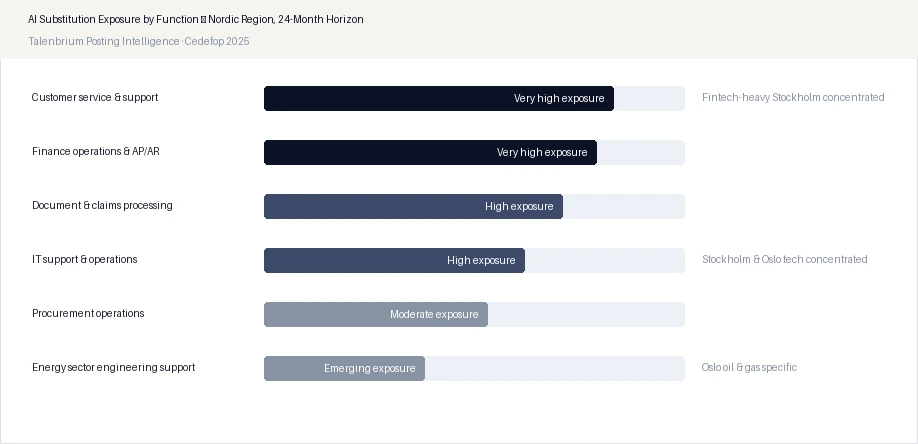
Talenbrium's posting intelligence shows Stockholm's technology and fintech sector driving the highest AI adoption rate in the Nordic region, while Copenhagen shows the fastest AI-linked restructuring completion time of any market in this six-country study, a direct product of the flexicurity model's design. Oslo's oil and gas-adjacent professional services sector shows moderate AI adoption with restructuring timelines closer to the Swedish pattern than the Danish one.
66 / 41 / 62
Talenbrium Restructuring Difficulty Index — Sweden / Denmark / Norway respectively
Talenbrium composite · OECD EPL indicators
2-3x
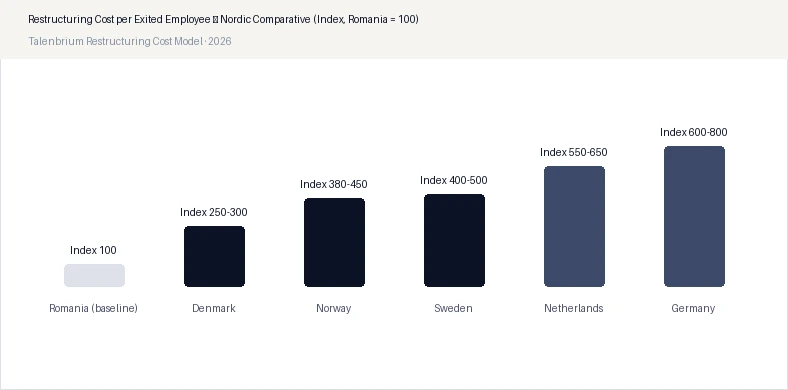
Denmark fully-loaded exit cost multiple vs. Romania baseline — lowest in Western Europe
Talenbrium restructuring cost model
LIFO
Sweden's LAS seniority rule — last in, first out, by collective agreement unit
Swedish Employment Protection Act · Talenbrium legal analysis
58%
Share of Nordic AI-adopting employers citing Sweden's LIFO rule as their primary restructuring constraint
Talenbrium Q1 2026 Pulse Survey · Nordic sub-sample
3.9:1
Demand-push ratio — open destination-function roles per AI-displaced worker, Stockholm metro
Talenbrium posting intelligence · trailing 12 months
AI Substitution Exposure by Function — Nordic Region, 24-Month Horizon
Three Nordic markets, three different restructuring realities — Denmark is the outlier that makes flexicurity worth understanding.Sweden's Lagen om anstallningsskydd (LAS) applies a strict seniority principle to redundancy selection — last in, first out, by employment unit — meaning employers cannot simply select the employees whose roles were most affected by AI; they must work through seniority order within the relevant collective agreement unit, which frequently protects long-tenured employees over the specif...
Full data available to purchasers
Job postings prove the case both ways: declining demand for AI-exposed roles, rising demand for the roles workers could move into.

Talenbrium's proprietary posting database tracks year-over-year change in active job postings by function across the Nordic region. For AI-exposed functions, posting volume has fallen consistently over the trailing 12 months as employers automate first and hire less into these roles — relevant evidence regardless of which of the three legal frameworks applies. For destination functions, the pattern reverses: postings are rising, meaning a documented reskilling pathway into these roles is backed by live employer demand today, not aspiration.
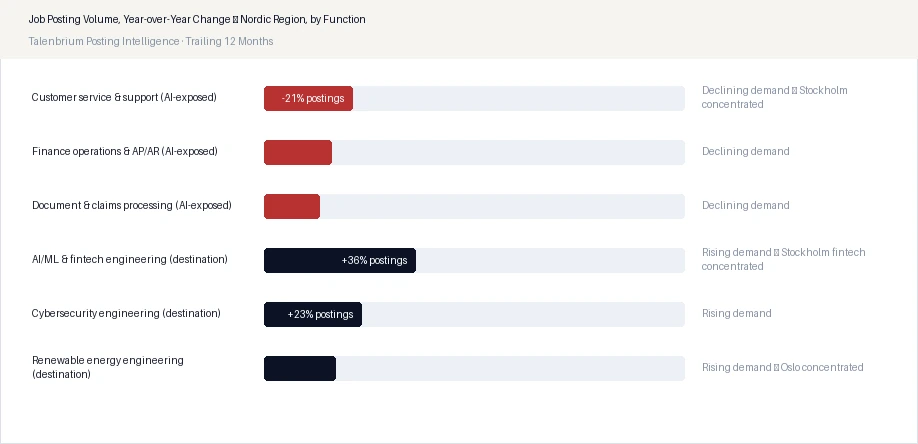
Job Posting Volume, Year-over-Year Change — Nordic Region, by Function
Denmark's flexicurity model is not a loophole. It is a deliberate policy design that most multinationals underuse.

The Danish flexicurity system trades low individual dismissal protection for a strong social safety net: employers can execute redundancies with notice periods as short as one to six months depending on tenure, no mandatory severance beyond notice pay in most cases, and minimal consultation requirements relative to Sweden, Germany, or France. In exchange, displaced workers receive up to two years of unemployment benefit at up to 90% of prior salary (capped) through the A-kasse system, plus mandatory access to jobcenter retraining programmes. For multinationals with Nordic operations spanning all three countries, this creates a strategic sequencing question: restructuring in Copenhagen first, while Stockholm and Oslo processes are still working through consultation, is frequently the fastest path to overall Nordic headcount reduction.

Talenbrium's Q1 2026 Pulse Survey found Nordic HR leaders who sequenced multi-country restructuring programmes starting with Denmark, rather than running all three markets in parallel, completed the full regional programme an average of 11 weeks faster.

"Sweden's LAS seniority rule means AI-driven role elimination and legally permissible redundancy selection are often two different lists of names. Denmark has no such constraint. Employers who understand this sequence their Nordic restructuring accordingly — and the ones who don't lose months reconciling AI business logic with LIFO law." — Talenbrium Workforce Intelligence, Q1 2026
Restructuring Cost per Exited Employee — Nordic Comparative (Index, Romania = 100)
Table of Contents
01Executive Summary: Three Nordic Markets, Three Restructuring Realities
02AI Substitution Exposure by Function — Regional and City-Level
03Sweden: LAS Seniority Rules and Collective Agreement Units
04Denmark: The Flexicurity Model and A-kasse Transition Support
05Norway: Arbeidsmiljoloven Consultation and NAV Notification
06Cost Calculator by Country and Seniority Tier
07City Analysis: Stockholm, Copenhagen, Oslo
08Redeployment Absorption Capacity by City
09Reskilling Pathways: Cost, Duration, and Viability by Function
10Salary Benchmarks: Displaced Roles vs. Destination Roles
11Multi-Country Nordic Sequencing Framework
12Strategic Recommendations
13Methodology and Data Sources
Report scope
Geography
Sweden, Denmark, Norway + Stockholm, Copenhagen, Oslo
Legal framework
LAS (SE) · Flexicurity model (DK) · Arbeidsmiljoloven (NO)
Sectors
Fintech & technology · Financial services · Energy-adjacent professional services
Primary research
Talenbrium Q1 2026 Pulse Survey · Nordic sub-sample
Cost model calibration
OECD EPL indicators · A-kasse and national settlement data
Secondary validation
SCB · DST · SSB · Cedefop 2025 · Eurostat Structure of Earnings
Customisation
10 hours free customisation included · Country-specific extensions available
Delivery
Within 2–4 business days of purchase · 52 pages + cost calculator
Assigned Author
Diptanjan Biswas

Diptanjan Biswas

Principal Head, Strategic Consulting

Diptanjan Biswas leads strategic consulting at Talenbrium, bringing nine years of experience across research, risk, and workforce intelligence in banking, technology, and advisory sectors.

Workforce Strategy Labour Market Intelligence Credit Risk Recoveries Strategy
View Full Author Profile Linked to Talenbrium's public author library

Ready to access the full intelligence?

Purchase directly, or speak with our team to discuss your requirements first.

Purchase
Buy this report — USD 4,999
Enquire
Speak with our research team
Custom
Commission a bespoke engagement
Home Reports Insights Contact