
Dutch employers pursuing AI-linked redundancy can route through the UWV (Employee Insurance Agency) permit process for economic-reason dismissals, or negotiate mutual consent termination agreements (vaststellingsovereenkomst) directly with employees. The UWV route is slower and requires demonstrating the redundancy is structural, not temporary, and that no reasonable redeployment option exists within a reasonable retraining period, but produces a lower and more predictable transition payment (transitievergoeding). The mutual consent route is faster and more flexible on terms but typically costs more, since employees have leverage in individual negotiation. Works Councils, where present under the Wet op de Ondernemingsraden (WOR), hold advisory rights over major operational decisions including AI system implementation, though their rights are weighted toward consultation rather than the German-style co-determination veto.
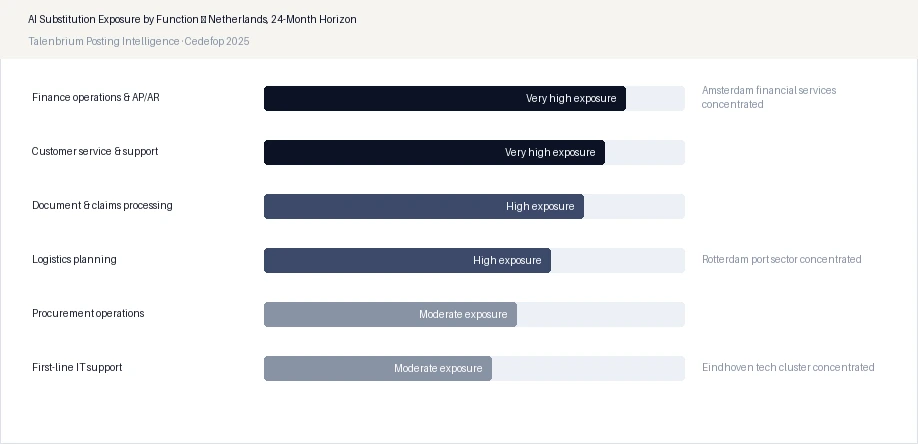
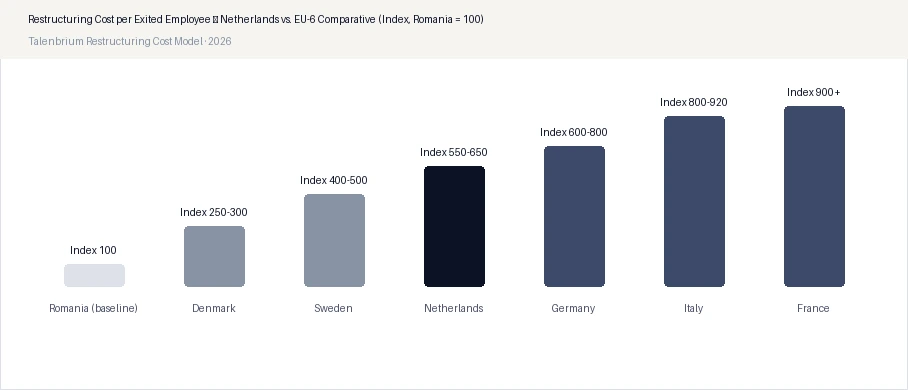
Talenbrium's posting intelligence shows the Netherlands has among the highest AI adoption rates in the EU-6 markets covered, concentrated in Amsterdam's financial and professional services sector and Eindhoven's technology and semiconductor cluster. The transitievergoeding formula, capped and predictable, makes the Netherlands a comparatively lower-friction market for AI-linked restructuring relative to Germany, France, and Italy, despite still ranking well above Romania on restructuring difficulty.
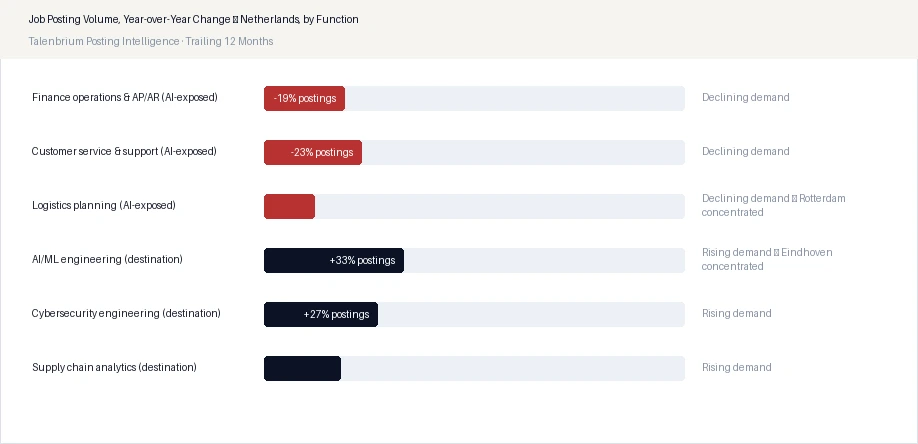
Talenbrium's proprietary posting database tracks year-over-year change in active job postings by function across the Dutch market. For AI-exposed functions, posting volume has fallen consistently over the trailing 12 months as employers automate first and hire less into these roles — evidence that strengthens either a UWV permit application or a mutual consent negotiating position. For destination functions, the pattern reverses: postings are rising, meaning a documented reskilling pathway into these roles is backed by live employer demand today, not aspiration.
The transitievergoeding formula is statutorily capped and calculable to the euro based on tenure and age, which makes the UWV route attractive for employers restructuring at scale who want cost predictability across dozens or hundreds of employees. Mutual consent agreements, by contrast, are negotiated individually, and Dutch employment lawyers routinely secure settlements above the statutory transitievergoeding minimum, particularly for employees with strong external market options — precisely the profile of employees affected by AI substitution in finance, customer service, and analytics functions, who often have transferable skills and genuine alternative employment prospects.
Talenbrium's Q1 2026 Pulse Survey found Dutch employers who ran a structured internal redeployment and reskilling assessment before initiating either route reported settlement costs averaging 18% lower than those who proceeded directly to termination negotiation, largely because a documented redeployment effort strengthens the employer's negotiating position under both routes.

Customise the study to your target geography, role, skill cluster, or benchmark set, or request a sample before you proceed.