
The global cybersecurity workforce gap of 4.8 million unfilled roles has pushed Western firms to build security teams in Central and Eastern Europe. Poland offers the largest talent pool, Romania a multilingual workforce with more than 80 percent of IT staff speaking several languages, and Czechia a security-engineering heritage anchored on Brno, home to Red Hat and the Avast lineage now part of Gen.
This report treats the roles as the unit of analysis across the three markets. It profiles each designation, sets demand against supply, benchmarks pay in euros, names the employers hiring the most, and maps the top five talent cities in each country.
Security work splits into three layers: the defensive roles that detect and respond, the offensive roles that test and secure, and the governance and operational-technology roles that manage risk and protect the plant floor. CEE offers strong depth in engineering and SOC roles and a rising operational-technology base on its manufacturing heritage.
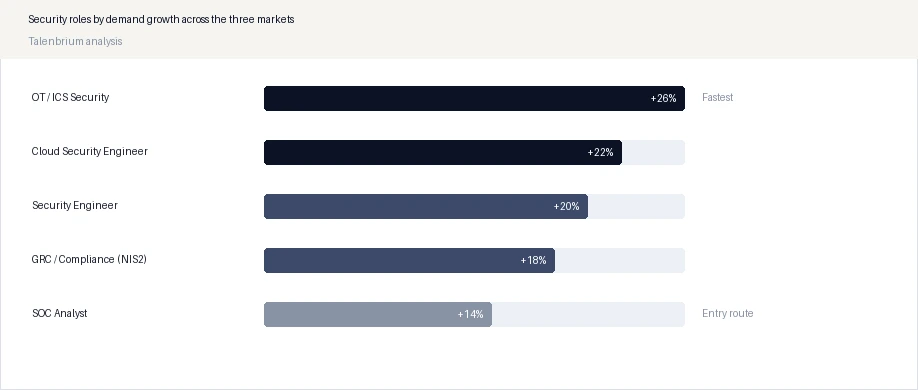
Demand across the region is led by SOC analysts as the entry route and by security engineers as the scarce core. Romania and Poland supply strong SOC and engineering talent, while security architects and operational-technology specialists are thin, the latter rising fast on the region’s automotive and industrial base.
NIS2 compliance across the European Union has lifted governance and OT demand sharply, and the qualified pool for control-system security cannot grow on that timeline.
Poland pays the highest security base rates in the region, Czechia sits close behind on the strength of Brno, and Romania is lowest on base with strong multilingual value. All three run well below Western European security pay.
The table sets year-over-year demand and median base pay in euros for each designation across the three markets.
| Role | Demand, YoY | Poland (EUR) | Romania (EUR) | Czechia (EUR) |
|---|---|---|---|---|
| Security Architect | +16% | €80,000 | €62,000 | €68,000 |
| Cloud Security Engineer | +22% | €66,000 | €50,000 | €58,000 |
| OT / ICS Security Engineer | +26% | €64,000 | €50,000 | €56,000 |
| Security Engineer | +20% | €62,000 | €48,000 | €56,000 |
| Penetration Tester | +14% | €60,000 | €46,000 | €54,000 |
| Incident Responder | +16% | €58,000 | €45,000 | €52,000 |
| GRC / Compliance Analyst | +18% | €55,000 | €44,000 | €50,000 |
| SOC Analyst | +14% | €42,000 | €32,000 | €40,000 |
Median base pay, mid-level, in euros. Poland highest, Czechia close behind on the Brno security base, Romania lowest with multilingual value. Demand is the Talenbrium year-over-year posting change. Source: Talenbrium posting intelligence and compensation model
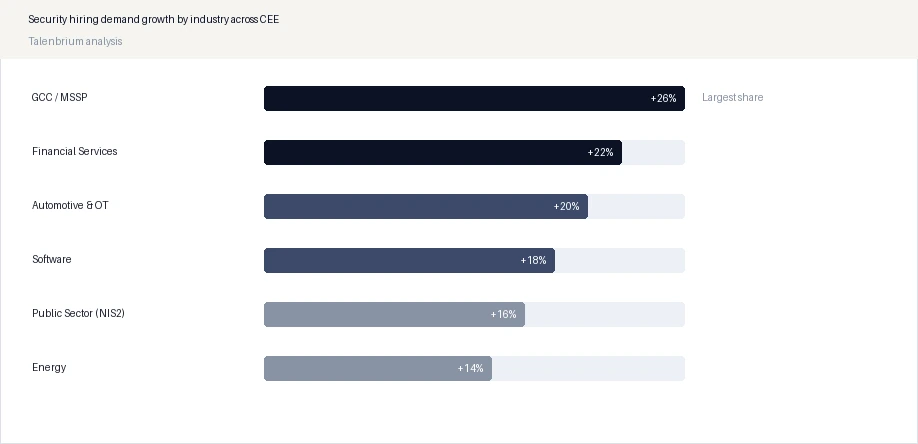
The steepest demand comes from the managed-security and capability centres that Western firms run in the region, followed by financial services and the automotive and industrial base driving operational-technology security. Public-sector demand is rising on NIS2 obligations.
The push runs toward operational-technology and cloud security, the two areas hardest to staff and where the region’s industrial heritage gives it an edge.
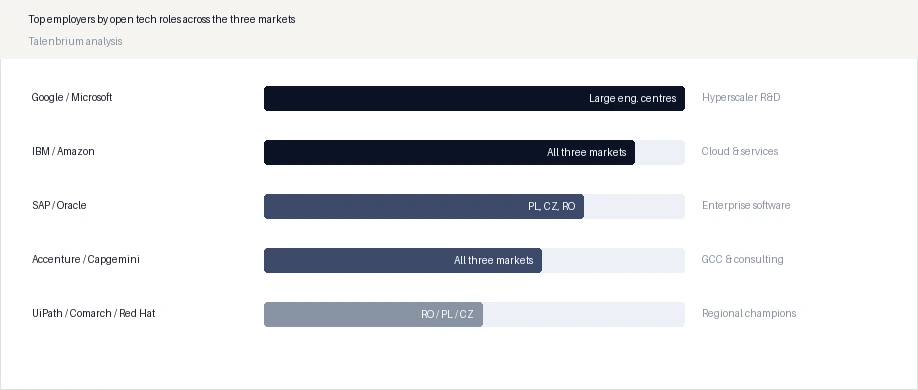
The largest hirers are the global technology and services firms running security operations in the region, led by IBM, Microsoft and the Big Four managed-security practices, with strong regional roots at Gen (Avast) and Red Hat in Brno. Financial-services centres add steady SOC and engineering demand.
For a Western firm building a nearshore security team, this sets the frame. The majors and the Brno security base set the pay ceiling, so a new entrant competes on mission, on flexibility and on speed.
Security talent concentrates in the same hubs as broader tech, with Brno standing out as a genuine security-engineering centre. These are the fifteen cities where a security hire is realistic today.
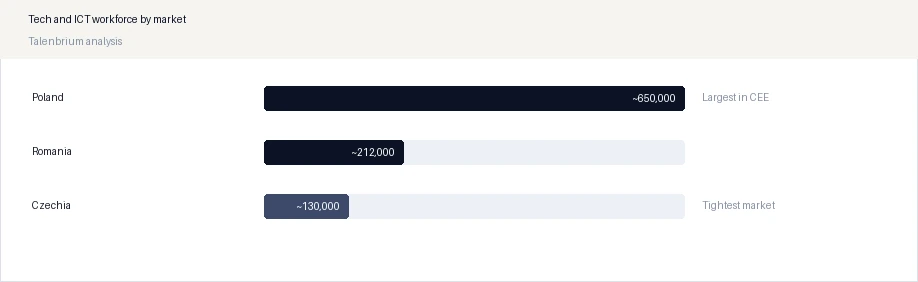
Poland offers the widest security hiring options on its 650,000-strong tech pool. Romania adds a multilingual workforce that suits pan-European security operations, and Czechia, though smaller and tighter at about 130,000 developers, brings genuine security-engineering depth around Brno.
Depth shapes the model. Poland suits large security operations centres, Romania suits multilingual follow-the-sun coverage, and Czechia suits high-value engineering and research teams.
Three forces drive CEE security demand. The 4.8 million global workforce gap pushes work to lower-cost, high-skill markets. NIS2 compliance across the European Union lifts governance and reporting demand. And the convergence of information and operational technology opens a new front on the region’s dense manufacturing base. None eases inside a hiring cycle.
The report turns the role-level pattern into a CEE security hiring and reskilling plan across Poland, Romania and Czechia.
Year-over-year demand and median pay for every security role across Poland, Romania and Czechia.
Median and senior pay by role in euros for all three markets, including the contractor premium.
Full employer league table of who hires the most, by role and country.
The five leading talent cities per country, with pool depth, demand and salary.
Shortest reskilling routes into each role, with cost and duration.
Cost comparison of hiring, contracting and internal reskilling by role.
Projected demand and time-to-fill by role, from live pipeline data.
Every exhibit supplied as an Excel workbook.
The report is built on Talenbrium's four-layer data method: real-time job-posting intelligence, a proprietary skills taxonomy of more than 8,000 skills, employer hiring tracking, and a quarterly Workforce Pulse Survey, triangulated against external benchmarks. Role demand comes from posting analysis. Pay is drawn from posted and surveyed compensation and regional salary data, converted to euros, and is reported at median and at the 90th percentile. City figures draw on Talenbrium talent-hub analysis.

Customise the study to your target geography, role, skill cluster, or benchmark set, or request a sample before you proceed.