
Medical device exports rose from 10.7 billion dollars in 2020 to 20.6 billion in 2025 according to the central bank, a doubling in five years. Over the same period the national statistical office recorded employment in the core medical equipment manufacturing class falling in every month of 2025 against 2024, from 1.1 percent down in January to 5.5 percent down in May, closing the year around 5.3 percent lower.
Those two facts describe the whole problem. Output is expanding and headcount is not, which means the growth is being absorbed by automation and by higher output per worker rather than by hiring. For a workforce planner this changes the question. It is no longer how many people are needed. It is which people, because the roles that are disappearing and the roles that are scarce are not the same roles, and the second group is not being produced fast enough by anything currently in place.
| $20.6bn Medical device exports, 2025, doubled from 2020 Banco de Mexico | -5.3% Employment change in medical equipment manufacturing, 2025 INEGI | 98.8% Peak plant capacity utilisation before the export surge INEGI | 22,801 Average monthly wage in Baja California, pesos, the second highest of any state IMSS |
Mexico is the leading medical device exporter in Latin America. The cluster that produces most of that output sits in the country's second most expensive labour market.
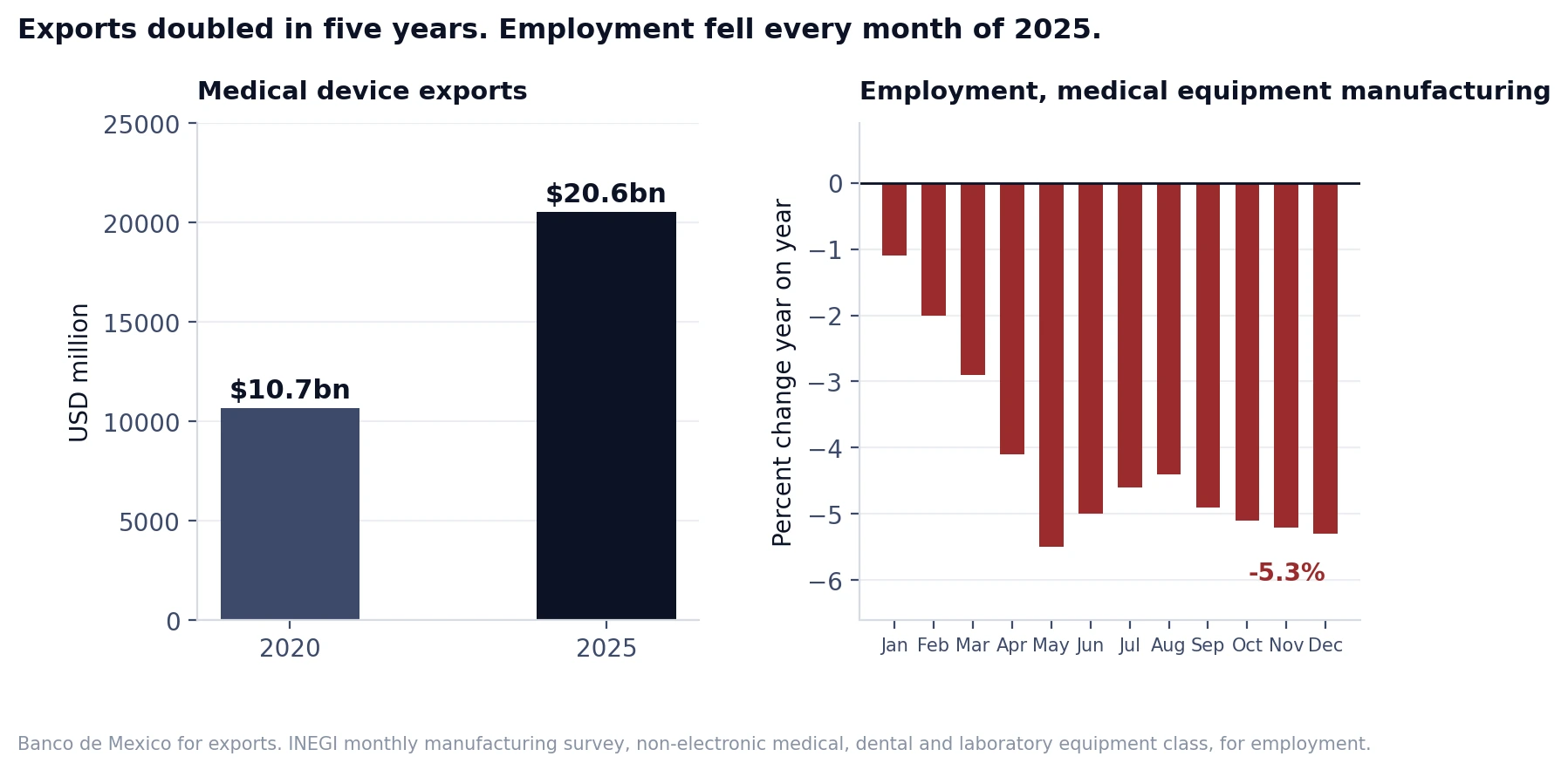
Source: Banco de Mexico for exports. INEGI monthly manufacturing survey for employment
The divergence is not a data artefact. Both series come from official sources, both cover the same period, and both are consistent across months. Export value doubled while the workforce producing it contracted.
The third piece of official data explains how. Plant capacity utilisation in the medical equipment class ran between 92.1 and 98.8 percent through 2024. Those plants were already close to their ceiling before the export surge arrived. Capacity that full cannot absorb more volume by adding shifts, so it is absorbed by automation, by line rebalancing and by higher output per worker instead.
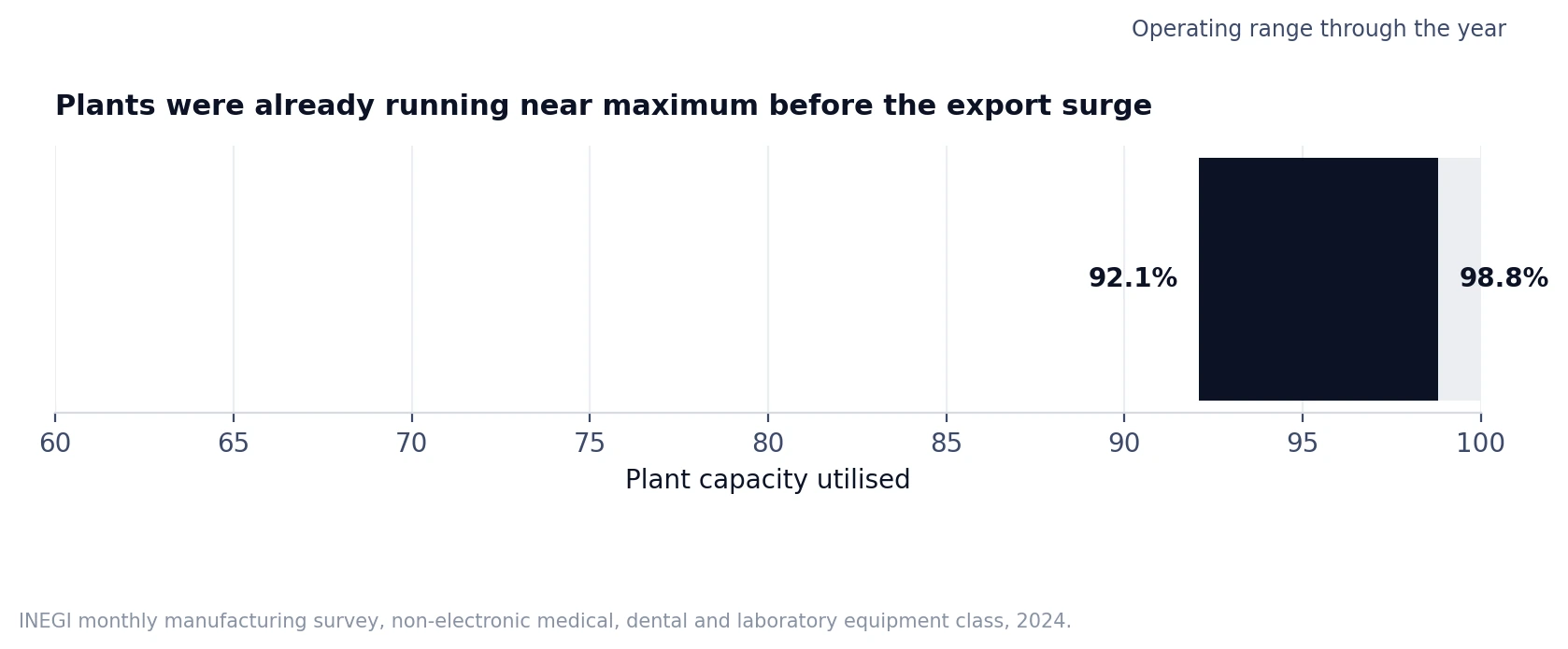
Source: INEGI monthly manufacturing survey, 2024
Three consequences follow, and each of them inverts a common assumption about this market.
The first is that headcount growth is a poor proxy for demand. A sector adding output while shedding people is still hiring, and hiring hard, but the vacancies sit in automation, controls, validation and systems roles rather than in assembly. Planning against the aggregate employment number will underestimate the difficulty of every hire that matters.
The second is that the labour cost assumption is wrong. The social security institute reports an average monthly wage of 22,801 pesos in Baja California in January 2026, the second highest of any state in Mexico and above the national manufacturing average of 22,192 pesos. The main device cluster is not in a low cost labour market. It is in an expensive one that happens to be adjacent to a more expensive one.
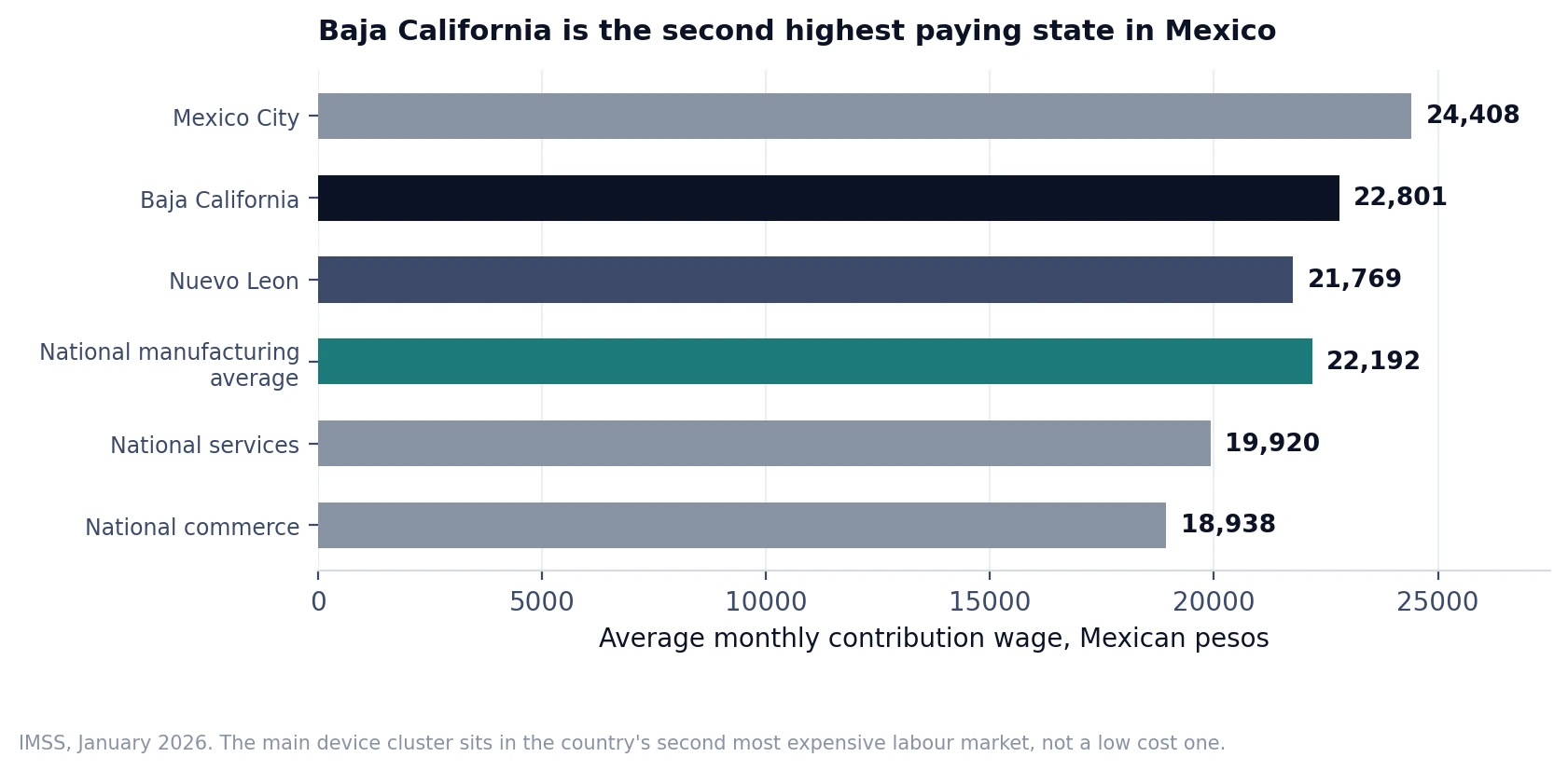
Source: IMSS, January 2026
The third is that the formal employer base is contracting. Employer registrations with the social security institute stood at 1,020,270 at the end of March 2026, down 2.7 percent against a year earlier. Fewer registered employers competing for a workforce that is itself shrinking produces a tighter market than the headline suggests, not a looser one.
| A sector that adds output while shedding people is still hiring. It is hiring different people, and those people are the ones nobody has enough of. Talenbrium Workforce Intelligence, Q3 2026 |
This report profiles emerging and future-driven roles only. Established assembly and bench roles with deep existing supply are excluded, because they do not constrain a hiring plan and because they are the roles the employment data shows contracting. Each description names what has changed about the work rather than what the job is called.
Manufacturing Automation Technician
Runs and maintains integrated robotic cells rather than operating a single station. The scarce skill is fault diagnosis across a connected line, and this is the role directly created by the capacity constraint described above.
Industrial Robotics and Controls Engineer
Designs and commissions the automation that is absorbing the output growth. Demand here is a direct function of plants running at 98 percent capacity with no room to add volume any other way.
Manufacturing Systems and MES Engineer
Owns the execution system carrying electronic batch records and line telemetry. A condition of scaling that most Mexican device plants did not need a decade ago.
Computer System Validation Engineer
Validates the software running regulated production. Every automation project creates validation work, so this role scales with the automation programme rather than with headcount.
Process and Sterilisation Validation Engineer
Designs and defends process and sterilisation qualification. Requires statistics and regulatory judgement in one person, and the local pipeline reliably produces one without the other.
Regulatory Affairs Specialist, dual framework
Works to United States Food and Drug Administration requirements and to the Mexican health regulator simultaneously. The role has moved from document assembly to structured data management under electronic submission formats.
Design Transfer Engineer
Takes a product from development into validated volume production. The role that decides whether a site moves from contract assembly toward development work, and the hardest of the nine to fill locally.
Electronics and Embedded Device Engineer
Builds connected and instrumented devices where the electronics content is the product rather than a component. Concentrated in Guadalajara, where the electronics base and the device base overlap.
Supply Chain and Trade Compliance Specialist
Manages rules of origin, tariff classification and cross-border compliance. A support function that became a named engineering-adjacent hire once tariff volatility and the trade agreement review made classification decisions financially material.
The national statistical office classifies medical device activity into three economic classes covering disposable medical material, non-electronic medical, dental and laboratory equipment, and compressed non-woven fabrics. It does not classify by occupation at the granularity of these roles. All nine fold into broader manufacturing or professional categories, so official statistics understate demand for every one of them and no government wage series exists at role level. That absence is a finding rather than a gap, and it is why role level pay in this report comes from Talenbrium's compensation model.
This section carries more weight in Mexico than in any comparable market, because the decline is visible in official data rather than inferred. Employment in the core medical equipment class fell in all twelve months of 2025 while output rose. Something is being displaced, and naming it correctly is the difference between a reskilling plan that works and a redundancy programme that loses the wrong people.
Four role types are contracting. Single station manual assembly is being consolidated into automated cells, which cuts headcount per unit and raises the skill floor for those who remain. Manual visual inspection is being displaced by automated optical inspection, and inspectors who understand defect modes convert well into vision system work. Paper batch record handling is disappearing into electronic systems, converting into manufacturing systems roles with modest training. Manual material handling and line feeding is the fourth, and it converts least well, because the replacement is equipment rather than a different task.
Three of the four convert into roles on the emerging list. The report prices each conversion against the cost of an external hire for the receiving role in the same city, which in most cases favours conversion by a wide margin.
Mexican device manufacturing is not one market. The five leading cities differ in cost, in role mix and in competitive intensity to a degree that makes a single national hiring plan unworkable.
Tijuana and the wider Baja California cluster hold the largest concentration of device manufacturing in North America. It is also, per the social security data, the second most expensive labour market in the country. Depth is the highest available anywhere in Mexico and so is competition, and proximity to Southern California creates a persistent outflow of experienced engineers that shapes retention planning more than pay does.
Ciudad Juarez is the second large cluster and prices below Tijuana. The trade off is a thinner professional and engineering layer relative to its technician base, so volume production staffs easily while validation, systems and design roles take materially longer.
Queretaro is the fastest changing of the five. Recent investment has been weighted toward higher complexity production rather than volume assembly, which pulls the role mix upward and puts it in direct competition with the aerospace and automotive sectors already established there for the same automation and controls people.
Guadalajara is the electronics market. Device work here overlaps with a deep electronics and software base, which makes it the only one of the five with a genuine embedded engineering and device software pool. It is the natural location for connected device work and the wrong location for volume assembly.
Monterrey is the industrial and engineering market, with the strongest advanced manufacturing base of the five and the highest wage expectations outside Baja California. It competes for the same engineers as heavy industry, which sets a floor unrelated to the device sector.
No official body publishes device employment or pay at city level. The city model is Talenbrium's own, built from employer presence, industrial park data and posting concentration, anchored to the state level wage series published by the social security institute. The table below is the format example. The full report carries the same structure for all five cities with depth ratings by role family, observed time to fill and a pay index.
| City | Talent depth | Demand | Cost position | Profile |
|---|---|---|---|---|
| Tijuana | Deep | High | Highest | Largest device cluster in North America. Deepest pool, tightest competition, cross-border wage pressure. |
| Ciudad Juarez | Deep | High | Moderate | Strong technician base, thinner professional layer. Best cost to depth ratio for volume production. |
| Queretaro | Moderate | Rising | Moderate | Higher complexity production. Competes with aerospace and automotive for the same automation talent. |
| Guadalajara | Moderate | High | High | Electronics and software depth. The only viable location for connected device engineering. |
| Monterrey | Moderate | Moderate | High | Advanced manufacturing and engineering. Wage floor set by heavy industry, not by devices. |
Format example. The full report adds role family depth, time to fill and pay index for each city.
Source: Talenbrium analysis, anchored to IMSS state wage data
Mexico has better official wage data than most emerging manufacturing markets, and this report uses it properly rather than replacing it with a model.
The social security institute publishes average contribution wages monthly, by state and by economic sector. At the end of March 2026 the national average daily contribution wage reached 663.5 pesos, up 7.1 percent on the year, the fourth largest March increase on record. On a monthly basis the transformation sector averaged 22,192 pesos, against 19,920 in services and 18,938 in commerce. By state, Mexico City led at 24,408 pesos, Baja California followed at 22,801 and Nuevo Leon at 21,769.
Those are real, checkable, government figures and they set the frame. What they do not give is pay by occupation. No official series reports what a validation engineer or an automation technician earns, in any state. Role level figures in this report therefore come from Talenbrium's compensation model, indexed against the official state and sector averages above so that every modelled figure is anchored to something verifiable rather than floating free.
The full report benchmarks all nine designations across all five cities with junior, mid and senior bands, 135 cells in total, each expressed in pesos and in dollars at the prevailing rate, and each indexed against the state contribution wage average. It also models the total cost of employment including mandatory social security contributions, the statutory profit share, the thirteenth month payment and the northern border wage zone differential, which together move the real cost of a hire well away from the headline salary.
Mexico operates a separate higher minimum wage zone along the northern border, which covers Tijuana and Ciudad Juarez. It compresses the gap between entry level and skilled technician pay in exactly the two cities where most device manufacturing sits. For an employer, that compression matters more than the absolute minimum, because it reduces the pay signal available to attract someone from assembly into a technician role, which is the conversion the automation programme depends on.
The report sets pay against available supply depth and observed time to fill for each of the nine roles in each of the five cities.
Two patterns are worth knowing before reading the tables. First, the deepest city is not the fastest to fill. Tijuana has the largest pool in the country and the highest probability that a candidate is already being counter-offered or is considering a move across the border. Second, the cheapest city is not the cheapest hire. Ciudad Juarez prices below Tijuana on wage but runs longer on time to fill for every role above technician level, and vacancy duration on a validation or systems role costs more than the wage differential saves.
Design Transfer Engineer and Industrial Robotics and Controls Engineer run longest of the nine in every city. The first is scarce because it needs production and development experience in one person. The second is scarce because every manufacturer in the country is competing for it at once, and in Queretaro and Monterrey the competition is not other device manufacturers.
The report sets out a city specific approach covering the channels that produce candidates, realistic offer positioning against the state wage average, and the constraints that change the arithmetic of a hiring plan.
Four points shape strategy in Mexico more than elsewhere. Technical university and polytechnic partnerships produce more usable automation and controls candidates than open advertising, because those people are hired before they reach the open market. Cross-border retention is a Tijuana specific problem that no pay strategy fully solves and that is better addressed through scope and progression. Competition for automation talent in Queretaro and Monterrey comes from outside the device sector, so benchmarking against device peers alone will price an offer too low. And English proficiency operates as a hard filter on the professional layer and a soft one on the technician layer, with the report quantifying how much each narrows the pool.
The report also covers statutory severance, the profit sharing obligation, union presence by city and the practical implications of the labour reform for hiring and subcontracting, all of which change total cost and time to hire against a simple wage comparison.
Employer competition is described by employer type rather than by name. Four types set this market. Large United States headquartered device manufacturers with multi-plant Mexican operations hold the deepest internal pipelines and set the ceiling in Tijuana and Ciudad Juarez. European device manufacturers compete on scope and stability rather than pay and concentrate in Queretaro and Monterrey. Contract manufacturers and component specialists hire the widest range of technician roles and turn over fastest. The fourth type is the one most often missed, which is non-device manufacturers competing for the same automation, controls and systems people, principally aerospace, automotive and electronics, and in Queretaro and Monterrey they are the binding competitor rather than any device peer.
The report sets out the hiring posture of each type by city and seniority band, and identifies where a new entrant faces least direct competition for a given role.
Reskilling is not an alternative to hiring in Mexico. It is the primary route, because the sector is releasing people from roles that are contracting while competing hard for roles that are not, and the same employer frequently does both in the same plant in the same year.
The report maps the shortest internal conversion path into each of the nine designations with the source role, the gap that has to close, realistic duration and cost against an external hire in the same city.
Three conversions are short. Visual inspectors convert into machine vision and inspection work in under four months because they already know the defect modes. Line technicians convert into automation technicians with structured controls training. Quality technicians convert into validation roles faster than engineers do, because documentation discipline is the harder half to teach.
One conversion is long and is attempted often. Production engineers do not become design transfer engineers inside a hiring cycle, because the missing element is development experience rather than training hours. The report says so rather than presenting a route that does not work.
Three frameworks shape hiring in this market.
United States Food and Drug Administration requirements govern most of what is produced here, since the overwhelming majority of output crosses the northern border. Quality system requirements, electronic submission structure and the premarket cybersecurity mandate for connected devices each translate into named roles on a Mexican site.
The Mexican health regulator governs domestic market authorisation and site licensing, and operates equivalence routes that recognise certain foreign approvals. Working to both frameworks at once is the defining feature of the regulatory affairs role here and the reason it is listed as an emerging designation rather than an established one.
The trade framework is the third and currently the most volatile. Device output moves under the North American trade agreement, and the report notes that medical equipment can cross the border several times during a single production and distribution cycle, which makes rules of origin and tariff classification unusually consequential. The scheduled review of the agreement, together with tariff movements affecting components sourced from Asia, is the direct cause of the supply chain and trade compliance role appearing on the designation list. That role did not exist as a distinct hire in most Mexican device plants three years ago.
Three things are worth watching before the next edition.
The first is whether the productivity gap closes or widens. Output rising while employment falls can continue only while automation capacity is being installed. If installation outpaces the supply of people who can run and validate it, the constraint moves from capital to labour, and the automation and validation roles on this list reprice sharply upward.
The second is the trade agreement review and tariff policy. Mexico's position rests on preferential access to the United States market. Any material change alters the case for Mexican production against domestic United States capacity and against Costa Rica, and would show up in hiring plans before it shows up in export data.
The third is the contracting employer base. Registered employers fell 2.7 percent in the year to March 2026. If consolidation continues, the practical effect for a new entrant is fewer but larger competitors, deeper internal pipelines held by incumbents, and a harder market to enter at any wage.
The report turns the role level pattern into a Mexican hiring, placement and reskilling plan.
| ROLE LEVEL DEMAND MODEL Year over year demand and median pay for all nine emerging designations across all five cities. | SALARY BENCHMARKS 135 role, city and seniority cells in pesos and dollars, each indexed against the official state contribution wage average. |
| TOTAL COST OF EMPLOYMENT MODEL Social security contribution, profit share, thirteenth month payment and border zone differential by city. | TOP FIVE CITIES Talent depth by role family, observed time to fill, cost position and pay index for each city. |
| TALENT ACQUISITION STRATEGY Channel guidance, offer positioning, cross-border retention and English proficiency filters by city. | TALENT BENCHMARKING Supply depth and time to fill by role and city, set against cost. |
| PEER HIRING ANALYSIS Employer type competition map by city and seniority band, including non-device competitors. | RESKILLING AND CONVERSION MODEL Shortest internal route into each role, with duration and cost against an external hire. |
| REGULATORY AND TRADE READINESS VIEW How United States, Mexican and trade agreement requirements translate into named roles. | EDITABLE DATA TABLES Every exhibit supplied as an Excel workbook. 10 hours of customisation included. |
| ROLES IN SCOPE 9 emerging and future-driven medical device designations across 3 layers. Established assembly and bench roles excluded by design. | GEOGRAPHY Mexico. Tijuana, Ciudad Juarez, Queretaro, Guadalajara and Monterrey. |
| INDUSTRIES Medical device manufacturing, contract manufacturing, components and packaging, device electronics, and sterilisation services. | DATA PERIOD Q3 2026 snapshot. Trend series 2020 to Q1 2026. |
| PRIMARY RESEARCH Talenbrium posting intelligence and Talenbrium compensation model. | SECONDARY VALIDATION INEGI, IMSS, Banco de Mexico, Secretaria de Economia, Mexican health regulator, US Food and Drug Administration. |
| STATED DATA GAPS No national occupational code exists for any of the 9 roles. No government wage series exists at role level. City level device employment is not published by any official body. | SOURCING POLICY Government and intergovernmental bodies are cited by name. Private companies, industry associations and press outlets are not named anywhere in this report. |
| CUSTOMISATION 10 hours free customisation included. Single city and single role family extensions available. | DELIVERY Within 2 to 4 business days of purchase. Report plus editable data tables. |

Customise the study to your target geography, role, skill cluster, or benchmark set, or request a sample before you proceed.