
India hosts between 1,700 and 1,900 global capability centres, and the total is moving toward 2,000 with deeper mandates in each. The workforce across all capability centres is heading toward 2.3 million people. Banking, financial services and insurance is one of the largest segments within that, and the sector now employs more people through capability centres than the traditional commercial banking industry does directly. This is no longer offshore back office. It is where a growing share of global financial services capability is built.
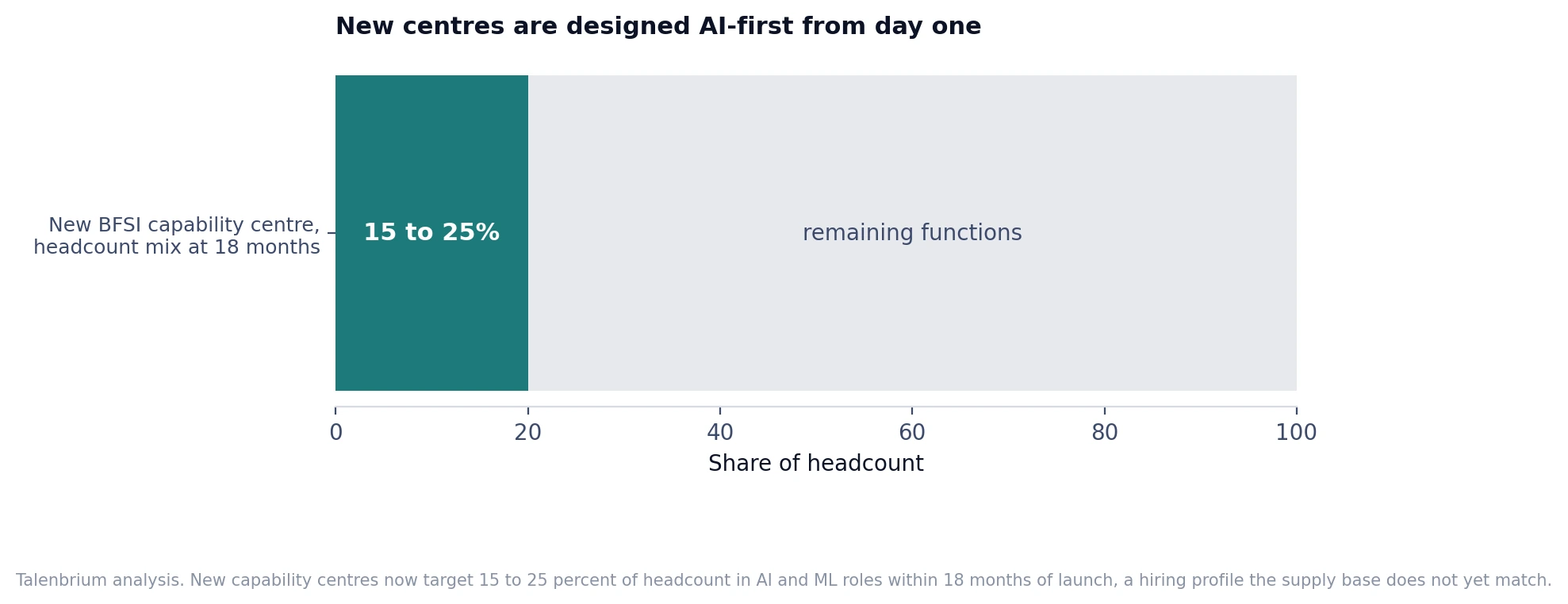
The hiring problem sits in the composition rather than the scale. New capability centres are designed to run artificial intelligence workloads from the first day rather than adding them later, with an expectation of 15 to 25 percent of headcount in machine learning and AI roles within eighteen months of launch. The supply of those people in India is nowhere near 15 to 25 percent of the available financial services talent pool, which means every new centre is competing for the same scarce group at once.
| 1,150+ IFSCA-registered entities at GIFT City, February 2026 IFSCA | $106.7bn GIFT City banking assets, up from 14 billion dollars in 2020 IFSCA | 100,000 GIFT City employment projected by 2030 GIFT City official | 15 to 25% AI and ML share of headcount new centres target within 18 months Talenbrium analysis |
The government-anchored figures describe GIFT City specifically. The sector-wide headcount, premium and attrition figures in this report are Talenbrium's own, since no government body publishes them.
This report separates two kinds of number, and it is worth being explicit about which is which, because the capability centre market is heavily reported by private advisory firms whose figures cannot be cited as official.
The government-anchored figures come from the International Financial Services Centres Authority, the statutory regulator of GIFT City, and from official GIFT City disclosures. These cover registered entities, banking assets, capital markets activity and projected employment. They are real, checkable and attributed by name.
The sector-wide capability centre figures, the total centre count, the workforce total, the salary premium, attrition rates and city cost indices, are Talenbrium's own collation and analysis. No government body publishes them at this level. Where this report gives such a figure it is labelled as Talenbrium collation, compensation model or analysis, and it is never dressed as an official statistic. That discipline matters more in this market than in most, because the freely available numbers mostly come from sources this report does not cite.
Source: Talenbrium analysis
The defining change in 2026 is that new BFSI capability centres are built artificial-intelligence-first. A decade ago a centre opened to run transaction processing and reporting, then slowly added analytics. Today a new centre is designed from the outset around machine learning, data and AI roles, with those functions expected to reach 15 to 25 percent of headcount within eighteen months. That is a fundamentally different hiring profile, and it lands on a supply base built for the older model.
The second change is the move up the value chain. Capability centres are no longer where execution happens while decisions are made elsewhere. They increasingly hold product ownership, risk modelling, quantitative work and platform engineering, which are senior, scarce and expensive roles rather than volume ones. The pay premium reflects that. Capability centres pay a premium of roughly 12 to 20 percent over traditional technology services firms for comparable roles, and lead the market on annual increments.
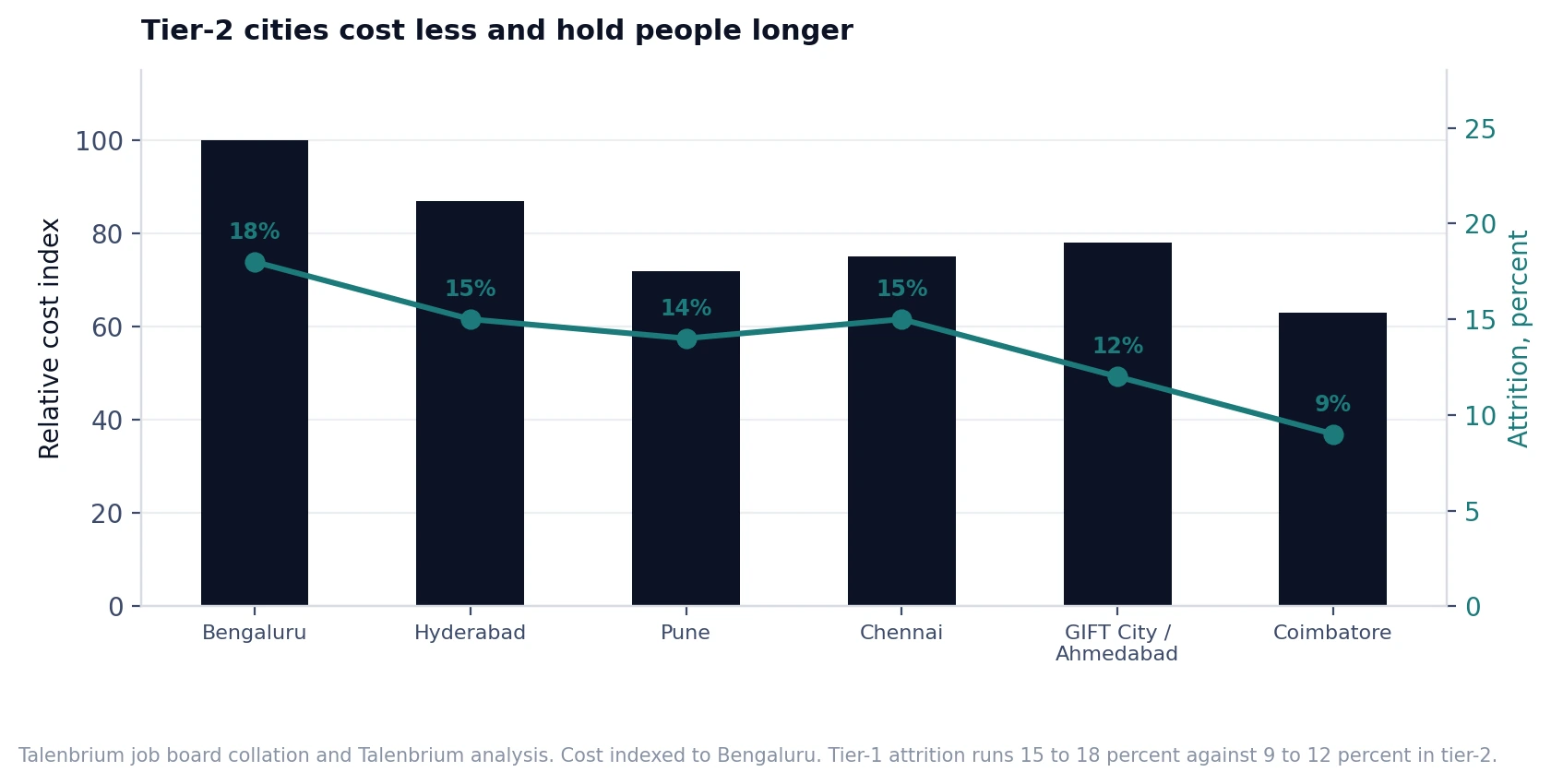
The third change is geographic. Attrition of 15 to 18 percent in the primary hubs of Bengaluru and Hyderabad is pushing employers to seed satellite operations in smaller cities where attrition runs 8 to 12 percent and costs 25 to 35 percent lower. The hub-and-spoke model is now standard: leadership and AI in Bengaluru or Hyderabad, scaled engineering in Pune or Chennai, and cost-sensitive functions in tier-2 cities. For BFSI specifically, GIFT City has moved from an interesting option to a top-three location alongside Mumbai and Bengaluru.
| A new capability centre is designed AI-first and staffed against a supply base built for the old model. The gap between the two is the hiring problem this report addresses. Talenbrium Workforce Intelligence, Q3 2026 |
This report profiles emerging and future-driven roles only. Every entry clears two bars rather than one. There has to be real hiring demand, and the role itself has to be new or fundamentally reshaped. Scarcity alone does not qualify, which is why several genuinely hard-to-fill BFSI capability centre titles appear later as reskilling sources rather than here. Established operations and support roles are excluded entirely.
Financial Services AI and ML Engineer
Builds and deploys machine learning models for credit, fraud, pricing and risk inside a regulated financial environment. Distinct from a general ML engineer because the models have to survive model risk governance and explainability requirements.
GenAI and LLM Engineer, financial applications
Builds retrieval and agent systems over financial data, from document processing to customer and adviser assistance. A role that did not exist at scale before 2023 and is now a stated priority in new centre design.
AI Governance and Model Risk Specialist
Governs AI and model risk to supervisory expectations, covering validation, bias, explainability and monitoring. Created by the collision of AI adoption and financial regulation, and scarce because it needs both quantitative and regulatory depth.
Quantitative Risk and Analytics Engineer
Builds the risk, capital and pricing analytics that capability centres now own rather than support. The work moved from running models built elsewhere to building them, which changed the seniority and scarcity of the role.
Financial Crime and Fraud Analytics Engineer
Applies machine learning to transaction monitoring, sanctions and fraud, replacing rule-based systems. The shift from static rules to learned detection is the reshaping that qualifies this as an emerging role.
Cloud and Data Platform Engineer, regulated data
Builds the data platform that feeds models and reporting under financial data residency and privacy constraints. The regulated-data dimension is what separates this from a general platform role.
Financial Services Cybersecurity Engineer
Secures financial systems against a threat environment specific to the sector, under supervisory cyber requirements. Hired against a national cyber shortage rather than a BFSI-specific pool.
Payments and Digital Banking Platform Engineer
Builds real-time payments, open banking and embedded finance infrastructure. India's domestic digital payments depth makes the base skill available and the regulated cross-border version scarce.
Product Owner, AI-Enabled Financial Products
Owns the roadmap and adoption of AI-enabled financial products from inside the capability centre, translating model behaviour and evaluation into a product plan. A genuine ownership role rather than a delivery one, which is the change from the older model.
India's labour statistics classify employment at a broad level and do not track these roles as distinct occupations. There is no government wage series at this granularity, and the capability centre workforce is not separately enumerated in official data at all. Role level pay and demand in this report are therefore Talenbrium's own, indexed to the city and seniority evidence that exists and labelled throughout.
The capability centre model was built on functions that are now the most exposed to automation, so the decline set here is unusually direct. The people in these roles are also, in most cases, the nearest internal pool for the emerging roles above, which makes reskilling central rather than optional.
Four are worth naming. Manual transaction processing and reconciliation, historically the volume backbone of BFSI centres, is being absorbed by automation and increasingly by AI. Rule-based fraud and compliance checking is giving way to learned detection. Manual report production is being displaced by self-service and natural language query. And first-line technology support is being consolidated by automation and AI assistance. Three of the four convert upward with structured effort, and the report prices each conversion against an external hire in the same city.
The central placement question in India BFSI is not which single city, but how to distribute a centre across the tier-1 and tier-2 map. The report is built around that decision.
Source: Talenbrium job board collation and Talenbrium analysis
Bengaluru holds roughly 880 capability centre units and about a third of national capability centre talent, with the deepest AI and engineering pool in the country. It also carries the highest cost and attrition of 15 to 18 percent. It is the right location for leadership, AI innovation and deep engineering, and the wrong location for anything cost-sensitive.
Hyderabad is the fastest-scaling tier-1 city, strong in BFSI and digital, with attrition slightly below Bengaluru and costs 10 to 15 percent lower. Pune offers 20 to 30 percent cost savings over Bengaluru with attrition around 14 percent and the fastest capability centre growth of the established cities, expanding from about 210 centres in 2019 to over 360 in 2025. Chennai adds scaled engineering and BFSI depth.
GIFT City and Ahmedabad are the distinctive BFSI play. GIFT City is India's only International Financial Services Centre, regulated by a single unified authority, and treated as offshore for tax and foreign exchange purposes while sitting inside India for talent access. Office and talent costs run well below Mumbai, and for capital markets, fintech and cross-border financial services it has become a top-tier location rather than a cost option. It is the one location in this report with a genuine regulatory anchor, and the report treats it separately for that reason.
No official body publishes capability centre employment or pay at city level. The location model is Talenbrium's own, anchored where possible to the IFSCA figures for GIFT City. The table below is the format example. The full report carries the same structure for all five locations with depth ratings by role family, attrition, cost index and observed time to fill.
| Location | Talent depth | Attrition | Cost | Profile |
|---|---|---|---|---|
| Bengaluru | Deepest | 15 to 18% | Highest | AI, engineering and leadership. Deepest pool, highest cost and attrition. |
| Hyderabad | Deep | ~15% | High | BFSI and digital, fastest-scaling tier-1, slightly calmer than Bengaluru. |
| Pune | Deep | ~14% | Moderate | Scaled engineering, fastest capability centre growth, 20 to 30 percent cheaper. |
| Chennai | Moderate | ~15% | Moderate | Scaled engineering and BFSI operations depth. |
| GIFT City / Ahmedabad | Emerging | ~12% | Lowest | The IFSC play. Offshore regulatory status, lowest cost, rising fast for BFSI. |
Format example. Attrition and cost figures are Talenbrium analysis. The full report adds role family depth and time to fill per location.
Source: Talenbrium analysis, GIFT City anchored to IFSCA
No government body publishes pay at role level for capability centre work, and the capability centre workforce is not separately enumerated in official statistics. Every role level figure in this report is Talenbrium's compensation model, and this report is explicit about that rather than borrowing a private advisory number and presenting it as fact.
Two structural features shape the pay picture and both are Talenbrium analysis. The first is the capability centre premium of roughly 12 to 20 percent over traditional technology services firms for comparable roles, which sets the floor a new entrant competes against. The second is that cash compensation alone no longer retains senior talent. Equity grants from the parent firm have become standard for senior roles, and total compensation for senior individual contributors and leadership runs materially above fixed cash. A benchmark built on cash alone will lose every senior hire, and the report models total compensation rather than base.
The full report benchmarks all nine designations across all five locations with junior, mid and senior bands, 135 cells in total, in rupees and dollars, each carrying the tier-1 to tier-2 differential and the cash-to-total-compensation gap for senior roles, together with the projected increment, which capability centres lead the market on at around 10 percent.
In this market, attrition matters as much as time to fill, and the report treats the two together. A role that fills quickly in Bengaluru but turns over at 18 percent a year has a different real cost from the same role in a tier-2 city that fills slower but holds for longer.
The pattern that defines India BFSI is that the AI, quantitative and governance roles are scarce everywhere and turn over fastest where they are deepest. The AI and model risk roles run longest to fill and highest on attrition, because demand is universal and the qualified pool is small. The report quantifies the attrition-adjusted cost of each role in each location, which is a different and more useful number than time to fill alone.
The report sets out a location-specific and tier-specific approach covering candidate channels, offer positioning against the capability centre premium, and the retention design that hiring in this market requires.
Four points shape strategy here. The hub-and-spoke distribution decision comes before any single hire, because putting the wrong role in the wrong tier is the most expensive error in this market. Total compensation design, including parent equity, is a hiring tool rather than a retention afterthought for senior roles. Fresher hiring at scale, through hackathons and specialised internships rather than conventional recruitment, is how the primary hubs fill volume, and a majority of capability centres plan to increase it. And GIFT City requires its own approach, since its offshore regulatory status changes both the tax position and the talent proposition. The report covers each.
Employer competition is described by employer type rather than by name. Four types set this market. Global banks and insurers running their own captive capability centres hold the deepest pipelines and set the ceiling in Bengaluru, Hyderabad and increasingly GIFT City. Global technology and consulting firms with large India centres compete for the same AI, engineering and platform people. Indian technology services firms are both a competitor and, through the capability centre premium, the pool that captive centres hire from. Fintech and digital-native firms form the fourth type, competing hardest for the payments, platform and AI roles. For several of the emerging roles the binding competitor is not another BFSI centre but a technology firm that pays comparably and carries no regulatory overhead.
Reskilling is central in India BFSI, because the functions the model was built on are exactly the functions being automated, and the people in them are the nearest available pool for the roles being added.
The report maps the shortest internal conversion path into each designation with the source role, the gap that has to close, realistic duration and cost against an external hire in the same location.
Three conversions are practical. Rule-based fraud and compliance analysts convert into financial crime and fraud analytics engineering, since they know the domain and the machine learning is the addition. Reporting and analytics staff convert into data platform roles. Quantitative analysts running existing models convert into building them with additional engineering skill. One conversion is genuinely hard. Transaction processing staff do not convert into AI or quantitative roles inside a hiring cycle, because the gap is foundational rather than incremental, and the report says so rather than implying a route that does not work at scale.
Regulation shapes both where BFSI capability centres locate and what they are allowed to do, and it is the direct cause of several roles on the designation list.
The International Financial Services Centres Authority is the defining regulatory feature. Established in 2020, it is a single unified regulator for banking, capital markets, insurance and fund management within GIFT City, replacing the fragmented oversight of the separate mainland regulators for entities inside the zone. That unified structure, together with offshore tax and foreign exchange treatment, is why GIFT City has moved from a cost option to a strategic BFSI location, and it is a genuine and citable government anchor in a market otherwise short of them.
For work serving global parents, the supervisory expectations of the parent's home regulators reach into the Indian centre, particularly on model risk, AI governance, operational resilience and cyber. Those expectations are the direct origin of the AI governance and model risk role and a major driver of the cybersecurity and quantitative roles. Indian data protection and the Reserve Bank of India's requirements on data localisation and outsourcing shape the platform and data roles. The report sets out how each translates into named hiring rather than treating regulation as background.
Three things are worth watching before the next edition.
The first is the pace of GIFT City growth. Employment there is projected to pass 100,000 by 2030 from a low base, and if BFSI capability centres cluster there as the regulatory and cost case suggests, it will reprice the whole map and pull senior talent toward Ahmedabad. If growth is slower, Bengaluru and Mumbai remain the centre of gravity. The report treats both as live.
The second is the AI-first design becoming universal. If every new centre targets 15 to 25 percent AI headcount, aggregate demand for a small pool rises faster than the pool can grow, and the premium on those roles widens. This is the single biggest upward pressure on cost in the market.
The third is tier-2 maturation. If tier-2 cities continue to combine lower cost with lower attrition, the hub-and-spoke model deepens and the primary hubs specialise further into leadership and AI. The competitive advantage shifts to employers who design their distribution well rather than those who simply pay most in Bengaluru.
The report turns the role level pattern into an India BFSI capability centre hiring, placement and reskilling plan built around the hub-and-spoke decision.
| ROLE LEVEL DEMAND MODEL Year over year demand and total compensation for all nine emerging designations across all five locations. | SALARY AND TOTAL COMPENSATION BENCHMARKS 135 role, location and seniority cells in rupees and dollars, with the cash-to-total gap modelled for senior roles. |
| HUB-AND-SPOKE PLACEMENT MODEL Where each role should sit across tier-1 and tier-2, with cost, attrition and depth traded off explicitly. | ATTRITION-ADJUSTED COST MODEL The real cost of each role in each location once turnover is priced in, not time to fill alone. |
| TOP FIVE LOCATIONS Talent depth by role family, attrition, cost index and time to fill, with GIFT City anchored to IFSCA. | TALENT ACQUISITION STRATEGY Channel guidance, total compensation design, fresher pipelines and the GIFT City proposition. |
| PEER HIRING ANALYSIS Employer type competition map, including the technology and fintech competitor set. | RESKILLING AND CONVERSION MODEL Shortest internal route into each role, with the hard conversions stated honestly. |
| REGULATORY READINESS VIEW How IFSCA, parent-regulator expectations and Indian data rules translate into named roles. | EDITABLE DATA TABLES Every exhibit supplied as an Excel workbook. 10 hours of customisation included. |
| ROLES IN SCOPE 9 emerging and future-driven BFSI capability centre designations across 3 layers. Established operations and support roles excluded by design. | GEOGRAPHY India. Bengaluru, Hyderabad, Pune, Chennai, and GIFT City with Ahmedabad. |
| SEGMENT BFSI global capability centres: banking, capital markets, insurance and financial technology captives. | DATA PERIOD Q3 2026 snapshot. Trend series 2020 to Q1 2026. |
| PRIMARY RESEARCH Talenbrium posting intelligence, Talenbrium compensation model and Talenbrium analysis. | SECONDARY VALIDATION IFSCA, official GIFT City disclosures, Reserve Bank of India, and state capability centre policy bodies. |
| STATED DATA GAPS No government body enumerates the capability centre workforce or publishes pay at role level. Sector headcount, the salary premium and attrition are Talenbrium figures, labelled throughout. Only the GIFT City figures are government-anchored. | SOURCING POLICY Government and intergovernmental bodies are cited by name. Private advisory firms, recruiters, named capability centres and named banks are not named anywhere in this report. |
| CUSTOMISATION 10 hours free customisation included. Single location and single role family extensions available. | DELIVERY Within 2 to 4 business days of purchase. Report plus editable data tables. |

Customise the study to your target geography, role, skill cluster, or benchmark set, or request a sample before you proceed.