
Poland's business services sector employs close to half a million people across more than 2,000 centres, contributes about 5.7 percent of national output and exported roughly 42.3 billion dollars of knowledge-intensive services in 2024, up from 36.8 billion the year before. Financial services shared and global business centres are a large part of that. The sector is projected to pass 504,000 employees in 2026.
The strategic point for a hiring plan is that Poland is not the cheapest place to run financial services work, and it does not try to be. Its advantage is European time zone alignment, familiarity with European Union financial regulation, and unusual language breadth, with roughly a fifth of the sector's workforce made up of foreign nationals serving clients across many countries and languages. That positioning means the scarce people here are not the same as the scarce people in a pure cost location. The premium roles are the ones that require regulatory judgement, language depth and proximity to European clients, not the lowest hourly rate.
| ~488,700 People employed in Poland's business services sector, early 2025 Talenbrium collation | $42.3bn Knowledge-intensive services exports, 2024, up from 36.8 billion PAIH | 5.7% Business services share of Polish GDP in 2025 PAIH | 19.6% Share of the sector's workforce made up of foreign nationals Talenbrium collation |
The export value and GDP share are corroborated by the state investment agency. Headcount and the foreign-national share are Talenbrium's collation, since no government body publishes the sector at that level.
As with any modern business services market, most granular sector data in Poland is published by an industry association and by private advisory firms. Those cannot be cited as official under this report's sourcing policy, so this report separates two kinds of number.
The government-anchored figures come from the Polish Investment and Trade Agency, a state body, whose investment guide republishes headline sector figures, together with the national statistical office, Eurostat and the national bank. These cover exports, GDP share, wage levels and the broad labour market. They are cited by name.
The sector-specific figures, employment by city, centre counts, the foreign-national share, attrition and role level pay, are Talenbrium's own collation and analysis, labelled throughout. Where the state agency has itself republished an association figure, this report attributes it to the state agency. Everything else at sector granularity is Talenbrium's.
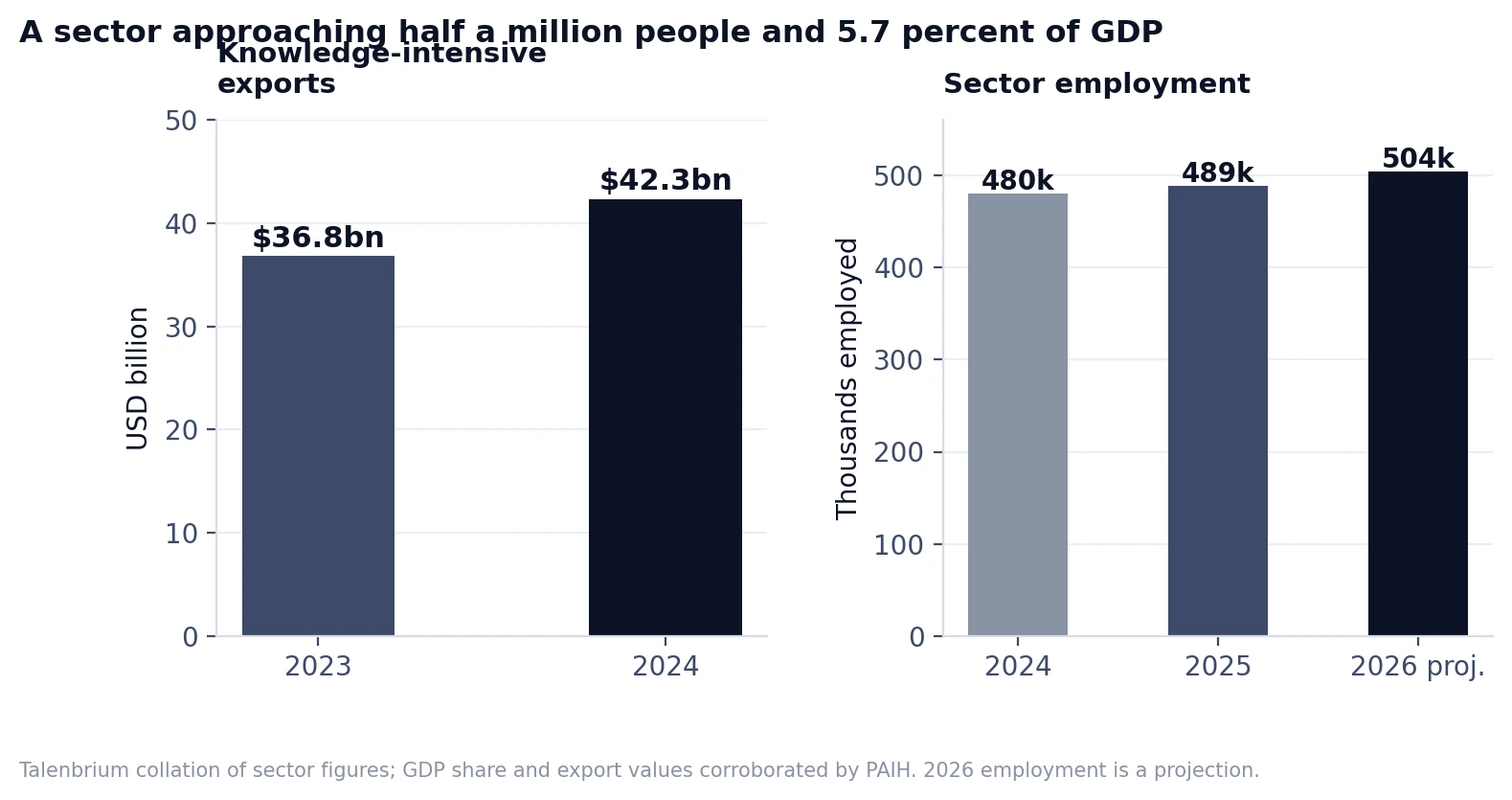
Source: Talenbrium collation; exports and GDP share corroborated by PAIH
The sector's evolution matters more to a hiring plan than its size. Poland's business services centres began as transaction and back-office delivery. They have moved steadily toward specialised, knowledge-intensive work, which now makes up close to 60 percent of activity, and information technology centres are the fastest-growing segment. For financial services specifically, that means the work arriving in Poland is increasingly risk, compliance, regulatory reporting, financial crime, data and platform work rather than routine processing.
Two forces drive that shift. The first is European regulation. A financial services centre in Poland serves European clients under European Union rules, which makes regulatory familiarity a hiring requirement rather than a nice-to-have, and creates demand for people who understand both the process and the supervisory framework behind it. The second is artificial intelligence and automation, which is absorbing the routine work the sector was built on and pushing the remaining roles up the skill curve.
The consequence is a widening gap. Routine roles are contracting while specialised financial and technology roles are scarce, and the internal pool from the first group does not automatically supply the second. That gap is the subject of this report.
| The work arriving in Poland is no longer processing. It is regulatory, risk and platform work for European clients, and the people who can do it are scarcer than the people who could do what came before. Talenbrium Workforce Intelligence, Q3 2026 |
This report profiles emerging and future-driven roles only. Every entry clears two bars rather than one. There has to be real hiring demand, and the role itself has to be new or fundamentally reshaped. Scarcity alone does not qualify, which is why several genuinely hard-to-fill Polish shared services titles appear later as reskilling sources rather than here. Established processing and support roles are excluded entirely.
Financial Services AI and ML Engineer
Builds and deploys machine learning for risk, fraud and reporting inside a European regulated environment. Distinct from a general ML engineer because the models face European model governance and explainability expectations.
AI Governance and Model Risk Specialist
Governs AI and model risk to European supervisory standards, covering the incoming Artificial Intelligence Act and existing model risk rules. Created by the collision of AI adoption and European financial regulation, and scarce because it needs both.
Data Platform Engineer, regulated financial data
Builds the data platform that feeds reporting and models under European data protection and financial data rules. The regulated-data and cross-border dimension separates this from a general platform role.
Regulatory Reporting and RegTech Engineer
Automates regulatory reporting to European frameworks, replacing manual compilation with structured, tool-driven reporting. The shift from manual to engineered reporting is the reshaping that qualifies this role.
Financial Crime and AML Analytics Engineer
Applies machine learning to anti-money-laundering, sanctions and fraud monitoring for European clients, replacing rule-based screening. Language breadth is a genuine advantage here, since screening spans many jurisdictions.
ESG and Sustainability Reporting Specialist
Builds the data and reporting capability for European sustainability disclosure requirements as they reach financial institutions. A role created directly by new European regulation, with almost no established supply.
Financial Services Cybersecurity Engineer
Secures financial systems under European operational resilience requirements, including the Digital Operational Resilience Act. Hired against a European cyber shortage rather than a Poland-specific pool.
Operational Resilience and DORA Specialist
Builds the operational resilience and third-party risk capability the Digital Operational Resilience Act now requires of financial entities. A named regulatory role that did not exist as a distinct hire before the regulation.
Payments and Digital Banking Platform Engineer
Builds real-time payments, open banking and embedded finance infrastructure for European markets under the European payments framework.
The Polish and European occupational classifications track employment at a broad level and do not distinguish these roles. There is no government wage series at this granularity, and the business services workforce is not separately enumerated in official statistics. Role level pay and demand are therefore Talenbrium's own, indexed to the national and city wage evidence from the statistical office and labelled throughout.
Poland's shared services sector was built on the roles now most exposed to automation, so the decline set is direct and the people in it are the nearest internal pool for the roles above.
Four are worth naming. Manual finance and accounting processing, historically the core of Polish shared services, is being automated and increasingly handled by AI. Manual regulatory report compilation is giving way to engineered reporting. Rule-based transaction screening is being replaced by learned detection. And first-line support is being consolidated by automation. Three of the four convert upward, and the report prices each conversion against an external hire in the same city. The language skills that made these roles valuable in the first place transfer well and are an advantage in the receiving roles.
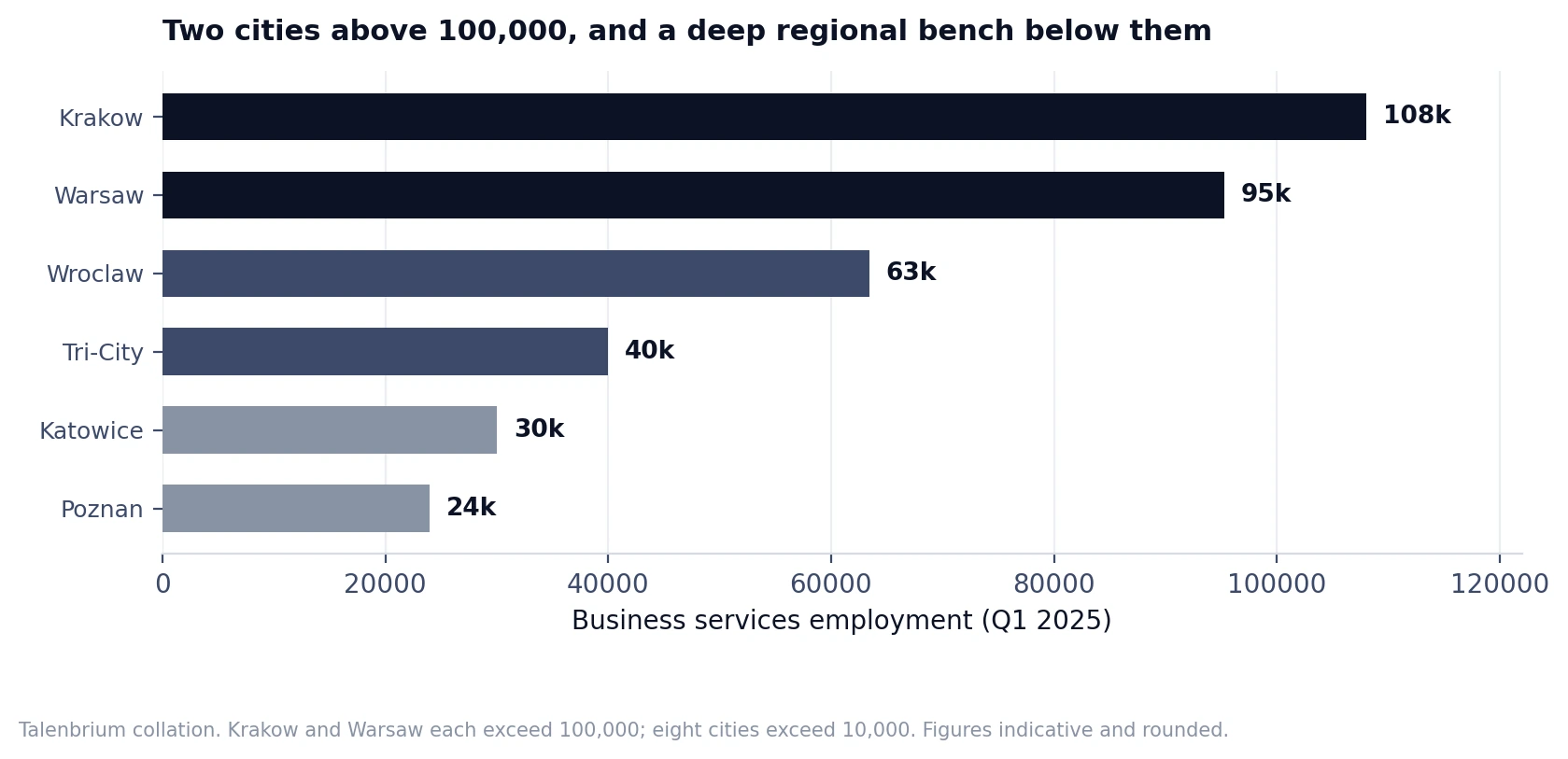
Source: Talenbrium collation
Poland's sector is unusually distributed. Two cities exceed 100,000 business services employees and eight exceed 10,000, which gives an employer real choice rather than a single dominant hub.
Krakow is the largest and most mature, with the deepest specialised and financial services talent and the strongest university pipeline, and it is where the highest-value work concentrates. Warsaw is close behind, carries the most centres, and adds proximity to the domestic financial sector and to headquarters functions. Wroclaw is the strong third, with deep engineering and technology talent. The Tri-City on the coast and Katowice in the south complete the set, each cheaper and less contested than Krakow and Warsaw, with the largest recent employment increases occurring outside the two leading cities.
The practical decision this creates is between the depth and competition of Krakow and Warsaw and the lower cost and lower attrition of the regional cities. Office supply tightens that decision, since competition for the best space in Krakow and Warsaw is intensifying and the regional cities offer more room. The report treats location as a genuine optimisation rather than a default to the largest city.
No official body publishes business services employment or pay at the sector-and-city level. The location model is Talenbrium's own, anchored to the national and regional wage data the statistical office does publish. The table below is the format example. The full report carries the same structure for all five locations with depth ratings by role family, attrition, cost index and time to fill.
| Location | Talent depth | Cost | Competition | Profile |
|---|---|---|---|---|
| Krakow | Deepest | High | Very high | Largest and most mature. Deepest specialised and financial talent, tightest competition and office market. |
| Warsaw | Deep | Highest | High | Most centres, proximity to the domestic financial sector and headquarters functions. |
| Wroclaw | Deep | Moderate | High | Strong engineering and technology depth, third-largest hub. |
| Tri-City | Moderate | Moderate | Moderate | Coastal cluster, fast recent growth, lower competition than the leaders. |
| Katowice | Moderate | Lowest | Moderate | Southern hub, best cost position, growing specialised base. |
Format example. Cost and competition ratings are Talenbrium analysis. The full report adds role family depth, attrition and time to fill per location.
Source: Talenbrium analysis
Poland has usable official wage data at the national and regional level from the statistical office and from Eurostat, and this report anchors to it, but no government series reports pay at the role level these designations require.
The useful government anchor is the gap between Polish wage levels and Western European ones, which is what makes the proximity play economically viable, together with regional wage variation that the statistical office does publish. Warsaw and Krakow sit above the national average, the regional cities below. Every role level figure in this report is Talenbrium's compensation model, indexed to that official regional wage evidence and to the euro-denominated pay that some financial services roles command, and labelled as modelled.
The full report benchmarks all nine designations across all five locations with junior, mid and senior bands, 135 cells in total, in zloty and euro, each carrying the Krakow-and-Warsaw to regional-city differential, the language premium that multilingual roles command, and the total cost of employment including statutory social contributions, which add materially to headline salary in Poland.
The report sets pay against available supply depth and observed time to fill for each of the nine roles in each of the five locations.
The pattern that defines Poland is that language and regulation compound scarcity. A role that is already scarce, such as AI governance or operational resilience, becomes scarcer still when it also requires a specific European language and familiarity with a specific supervisory regime. The report separates the base scarcity of a role from the additional scarcity that language and jurisdiction requirements add, because the two together determine the real hiring difficulty and neither alone captures it.
The operational resilience and ESG reporting roles run longest to fill, because both were created by recent European regulation and the qualified pool has had little time to form.
The report sets out a location-specific approach covering candidate channels, offer positioning against the correct regional wage reference, and the constraints specific to the Polish market.
Four points shape strategy here. University partnerships in Krakow, Warsaw and Wroclaw are the primary pipeline for specialised roles, and the strongest candidates are visible before they reach the open market. The foreign-national workforce, close to a fifth of the sector, is a genuine and active recruitment channel for multilingual roles rather than an incidental feature. Regional cities offer a real cost and retention advantage that a plan defaulting to Krakow or Warsaw will miss. And European work permit and relocation processes matter for the multilingual hiring the sector depends on, which the report covers directly.
Employer competition is described by employer type rather than by name. Four types set this market. Global banks and insurers running European shared services and capability centres hold the deepest pipelines and set the ceiling in Krakow and Warsaw. Global technology and consulting firms with large Polish centres compete for the same AI, data and platform people. Domestic Polish financial institutions compete for the regulatory and risk talent specifically. And business process and technology providers form the fourth type, hiring the widest range and turning over fastest. For several emerging roles the binding competitor is a technology firm rather than a financial one, and for the multilingual roles it is any employer across Europe that can hire remotely.
Reskilling is central in Poland, because the finance and accounting processing workforce the sector was built on is both large and directly exposed to automation, and it carries the language skills the emerging roles need.
The report maps the shortest internal conversion path into each designation with the source role, the gap that has to close, realistic duration and cost against an external hire in the same city.
Three conversions are practical. Regulatory reporting analysts convert into RegTech engineering, since they know the frameworks and the automation is the addition. Compliance and screening analysts convert into financial crime analytics with machine learning training. Finance staff with strong language skills convert into ESG and sustainability reporting, where the regulatory content is new to almost everyone and the language and process discipline transfer. One conversion is hard. Processing staff without a technical base do not convert into AI or platform engineering inside a hiring cycle, and the report says so.
European Union financial regulation is the defining feature of this market and the direct cause of most of the emerging roles, which is precisely what distinguishes Poland from a non-European delivery location.
The Digital Operational Resilience Act is the clearest current driver. It imposes operational resilience, third-party risk and testing obligations on financial entities, and it is the direct origin of the operational resilience role and a major driver of the cybersecurity role. European sustainability disclosure requirements are creating the ESG reporting role from almost nothing. The Artificial Intelligence Act adds governance obligations that feed the AI governance and model risk role. European anti-money-laundering and payments frameworks shape the financial crime and payments roles.
The strategic point is that all of this regulation applies to European clients regardless of where the work is performed, and Poland's advantage is that its workforce already operates inside that regulatory world. A delivery location outside Europe has to acquire that familiarity. Poland has it as a starting condition, and the report treats it as the core of the value proposition rather than as background.
Three things are worth watching before the next edition.
The first is wage convergence with Western Europe. Poland's proximity advantage rests partly on a cost gap that is narrowing as Polish wages rise faster than Western European ones. If convergence continues, the case shifts further from cost toward capability, and the premium roles in this report become the whole rationale rather than part of it.
The second is the pace of European regulation. Each new European financial rule creates demand for the specialised roles this report describes and widens the gap between them and the processing roles being automated. The regulatory pipeline is full, which points to sustained demand for regulatory, resilience and reporting talent.
The third is competition from other Central European locations and from remote hiring across the European Union. Poland is the largest business services market in the region but not the only one, and the multilingual, regulation-literate people it depends on can increasingly be hired remotely from anywhere in Europe. Retention and location strategy matter more as a result, and the report treats both as active rather than settled.
The report turns the role level pattern into a Poland financial shared services hiring, placement and reskilling plan built around the proximity and regulation advantage.
| ROLE LEVEL DEMAND MODEL Year over year demand and median pay for all nine emerging designations across all five locations. | SALARY BENCHMARKS 135 role, location and seniority cells in zloty and euro, with the language premium and the capital-to-regional differential modelled. |
| LOCATION OPTIMISATION MODEL Krakow and Warsaw against the regional cities on depth, cost, attrition and office availability. | SCARCITY DECOMPOSITION Base role scarcity separated from the additional scarcity that language and jurisdiction requirements add. |
| TOP FIVE LOCATIONS Talent depth by role family, cost, competition and time to fill for each location. | TALENT ACQUISITION STRATEGY University pipelines, the multilingual channel, regional cost advantage and permit processes. |
| PEER HIRING ANALYSIS Employer type competition map, including the technology and remote-hiring competitor set. | RESKILLING AND CONVERSION MODEL Shortest internal route into each role, using the language-skilled processing workforce as the source pool. |
| REGULATORY READINESS VIEW How the resilience, sustainability, AI and payments frameworks translate into named roles. | EDITABLE DATA TABLES Every exhibit supplied as an Excel workbook. 10 hours of customisation included. |
| ROLES IN SCOPE 9 emerging and future-driven financial shared services designations across 3 layers. Established processing and support roles excluded by design. | GEOGRAPHY Poland. Krakow, Warsaw, Wroclaw, the Tri-City and Katowice. |
| SEGMENT Financial and business shared services: banking, insurance and financial technology shared services, global business services and captive centres. | DATA PERIOD Q3 2026 snapshot. Trend series 2020 to Q1 2026. |
| PRIMARY RESEARCH Talenbrium posting intelligence, Talenbrium compensation model and Talenbrium analysis. | SECONDARY VALIDATION PAIH, GUS, Eurostat, Narodowy Bank Polski, European Commission. |
| STATED DATA GAPS No government body enumerates the business services workforce or publishes pay at role level. Sector headcount, city employment and attrition are Talenbrium figures, labelled throughout. Export value and GDP share are corroborated by PAIH. | SOURCING POLICY Government and intergovernmental bodies are cited by name. Industry associations, private advisory firms and named companies are not named anywhere in this report. |
| CUSTOMISATION 10 hours free customisation included. Single location and single role family extensions available. | DELIVERY Within 2 to 4 business days of purchase. Report plus editable data tables. |

Customise the study to your target geography, role, skill cluster, or benchmark set, or request a sample before you proceed.