
Poland, Romania and Czechia form the manufacturing core of Europe. Czechia builds more cars per capita than any other EU country, Poland has become a battery and electric-vehicle hub anchored by one of Europe’s largest gigafactories in Wroclaw, and Romania carries a deep automotive base around Dacia, Ford, Bosch and Continental. The scarce people are the controls, robotics and operational-technology engineers who run those lines.
This report treats the roles as the unit of analysis across the three markets. It profiles each designation, sets demand against supply, benchmarks pay in euros, names the employers hiring the most, and maps the top five manufacturing cities in each country.
Automation work splits into three layers: the engineers who design and program the line, the specialists who secure and inspect it, and the technicians who install and maintain it. CEE offers a deep controls and maintenance base on its automotive heritage, with operational-technology security the scarcest rising skill.
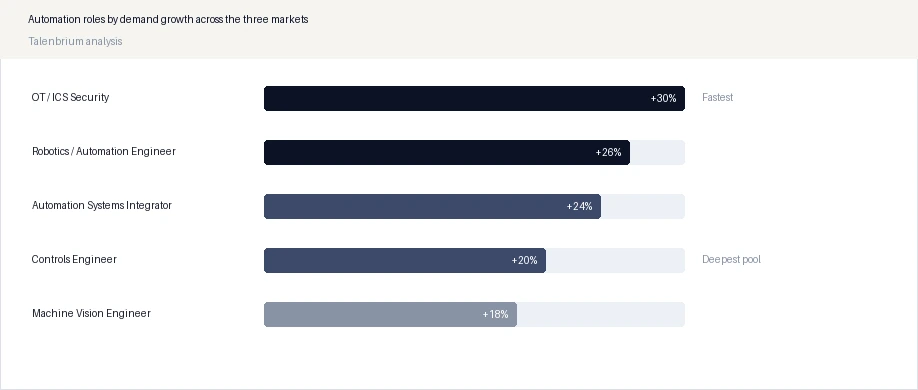
Demand across the region is led by controls engineers and automation technicians, the roles that keep automotive and battery lines running. Supply is strong on the region’s manufacturing heritage, but operational-technology security and systems integration are thin and rising fast as lines connect to the network.
The electric-vehicle and battery build-out, above all in Poland, has pulled demand for robotics and battery-line automation faster than the local pipeline can supply.
Automation pay in CEE sits below the region’s IT rates and well below Western Europe. Poland pays the most, Czechia close behind on its automotive base, and Romania lowest. Operational-technology security carries the clear premium.
The table sets year-over-year demand and median base pay in euros for each designation across the three markets.
| Role | Demand, YoY | Poland (EUR) | Romania (EUR) | Czechia (EUR) |
|---|---|---|---|---|
| OT / ICS Security Engineer | +30% | €58,000 | €45,000 | €54,000 |
| Automation Systems Integrator | +24% | €55,000 | €42,000 | €52,000 |
| Robotics / Automation Engineer | +26% | €52,000 | €40,000 | €50,000 |
| Machine Vision Engineer | +18% | €52,000 | €40,000 | €50,000 |
| Controls Engineer | +20% | €50,000 | €38,000 | €48,000 |
| SCADA / PLC Programmer | +16% | €48,000 | €36,000 | €46,000 |
| Mechatronics Engineer | +15% | €46,000 | €35,000 | €44,000 |
| Maintenance & Reliability Engineer | +12% | €40,000 | €30,000 | €38,000 |
Median base pay, mid-level, in euros. Automation pay runs below CEE IT rates. Poland highest, Czechia close on its automotive base, Romania lowest. Demand is the Talenbrium year-over-year posting change. Source: Talenbrium posting intelligence and compensation model
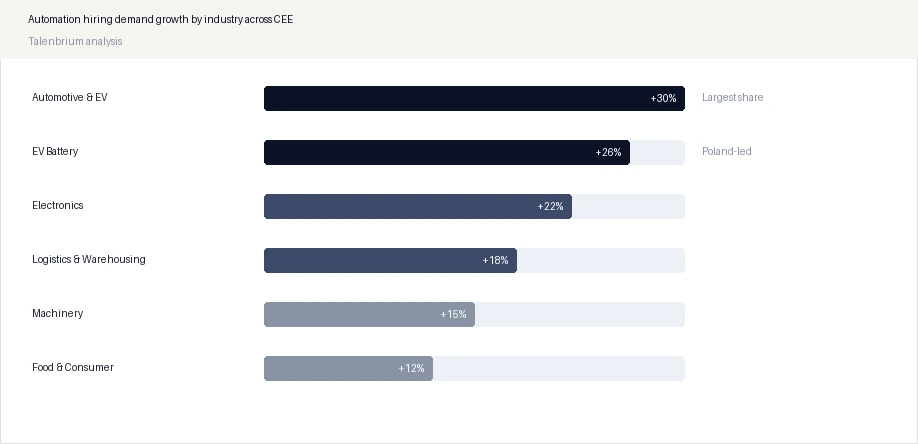
The steepest demand comes from automotive and electric-vehicle plants, followed by the battery gigafactories concentrated in Poland and electronics manufacturing. Logistics automation and machinery add steady pull.
The push runs toward robotics, battery-line automation and operational-technology security, exactly where the region’s pipeline is thinnest relative to the build-out.
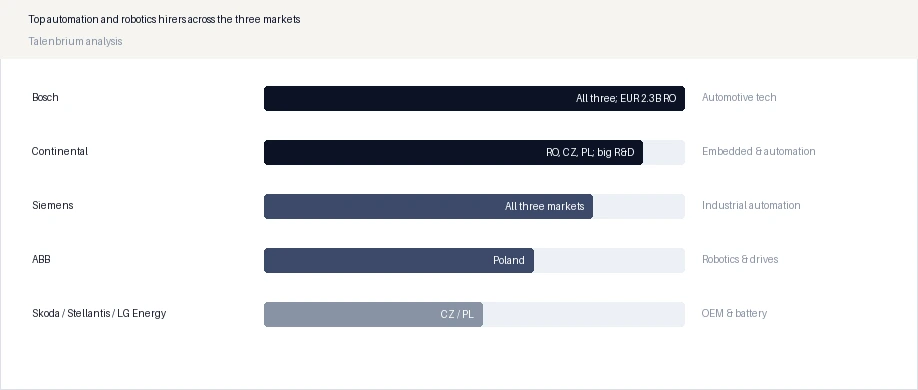
The largest hirers are the automotive and industrial majors, led by Bosch and Continental with deep plants and R&D across all three countries, followed by Siemens, ABB in Poland, and the vehicle makers Skoda, Stellantis and the Wroclaw battery operations.
For a smaller manufacturer or integrator, this sets the frame. The majors hire in waves around each new line and set the pay ceiling, so competing means targeting specific cities or niches rather than head-to-head bidding.
Automation talent sits where the plants are, in the automotive and battery clusters of each country. These are the fifteen cities where an automation hire is realistic today.
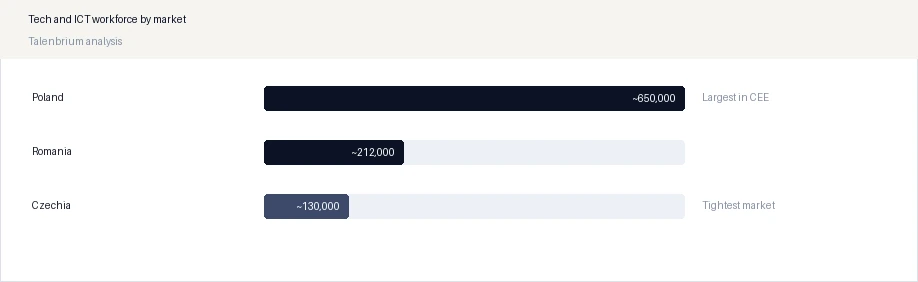
Czechia leads the European Union in cars produced per capita, which gives the densest controls and automation base per head. Poland has become the battery and electric-vehicle hub with one of Europe’s largest gigafactories, pulling robotics and battery-line talent, and Romania combines assembly with deep automotive R&D at Bosch and Continental.
Depth shapes strategy. Czechia suits high-density automotive automation, Poland suits battery and greenfield electric-vehicle lines, and Romania suits cost-efficient R&D and embedded work.
Three forces drive CEE automation demand. The shift to electric vehicles and batteries has built new lines faster than the workforce can be trained, above all in Poland. Reshoring keeps European production concentrated in the region. And the convergence of information and operational technology has made control-system security a plant-floor capability. None eases inside a hiring cycle.
The report turns the role-level pattern into a CEE automation hiring and reskilling plan across Poland, Romania and Czechia.
Year-over-year demand and median pay for every automation role across Poland, Romania and Czechia.
Median and senior pay by role in euros for all three markets, including the contractor premium.
Full employer league table of who hires the most, by role and country.
The five leading talent cities per country, with pool depth, demand and salary.
Shortest reskilling routes into each role, with cost and duration.
Cost comparison of hiring, contracting and internal reskilling by role.
Projected demand and time-to-fill by role, from live pipeline data.
Every exhibit supplied as an Excel workbook.
The report is built on Talenbrium's four-layer data method: real-time job-posting intelligence, a proprietary skills taxonomy of more than 8,000 skills, employer hiring tracking, and a quarterly Workforce Pulse Survey, triangulated against external benchmarks. Role demand comes from posting analysis. Pay is drawn from posted and surveyed compensation and regional salary data, converted to euros, and is reported at median and at the 90th percentile. City figures draw on Talenbrium talent-hub analysis.

Customise the study to your target geography, role, skill cluster, or benchmark set, or request a sample before you proceed.