
Research CatalogueGermany: AI Workforce Displacement and Labor Transition Intelligence — What AI Adoption Costs When Works Councils Have a Vote
Research Report2026-07-0958 pages

Germany: AI Workforce Displacement and Labor Transition Intelligence — What AI Adoption Costs When Works Councils Have a Vote

Talenbrium Research  |  2026-07-09  |  By Diptanjan Biswas  |  Talenbrium Proprietary Intelligence
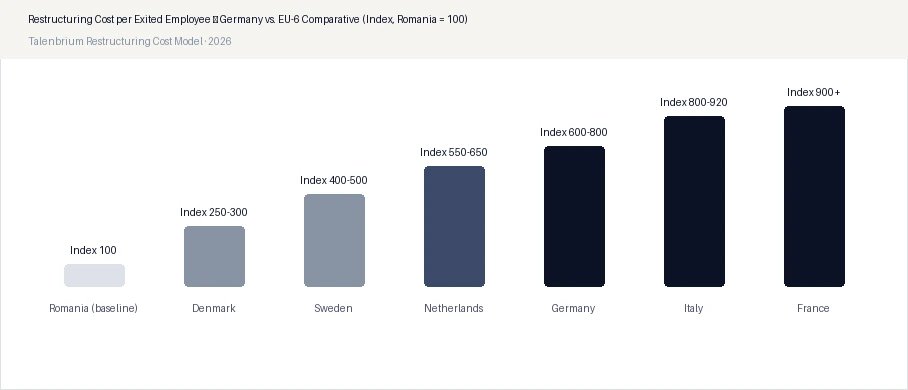
German employers face the highest AI-era restructuring cost in Europe — and the longest timeline to execute it.

Germany runs the most codified employee co-determination system in the developed world. Works Councils hold statutory consultation and, in many cases, veto-adjacent rights over operational change under the Betriebsverfassungsgesetz (BetrVG), and any AI system that alters workflow, monitors performance, or changes job content triggers formal Works Council involvement under Section 87. For headcount reduction tied to AI adoption, the Kundigungsschutzgesetz (KSchG) requires social selection criteria, and any collective dismissal above statutory thresholds requires a negotiated Sozialplan. The result: German employers can adopt AI systems, but converting AI efficiency into headcount reduction is slower, more expensive, and more procedurally exposed than anywhere else in the EU-6 markets this report covers.

Talenbrium's proprietary posting intelligence shows German employers are adopting AI-driven systems in finance operations, customer service, and document processing at a pace comparable to the UK and Netherlands. But headcount reduction linked to that adoption is lagging by an estimated 9 to 14 months relative to comparable US and UK restructurings, as employers work through consultation timelines and negotiate Sozialplan terms function by function.
84/100
Talenbrium Restructuring Difficulty Index — Germany, EU-6 comparative
Talenbrium composite · OECD EPL indicators
6-8x
Fully-loaded exit cost multiple vs. Romania baseline, per employee
Talenbrium restructuring cost model
9-14mo
Average delay between AI system go-live and completed headcount adjustment
Talenbrium posting intelligence · Q1 2026
72%
Share of AI-adopting German employers with an active Works Council covering affected functions
Talenbrium Q1 2026 Pulse Survey · Germany sub-sample
3.1:1
Demand-push ratio — open destination-function roles per AI-displaced worker, Munich metro
Talenbrium posting intelligence · trailing 12 months
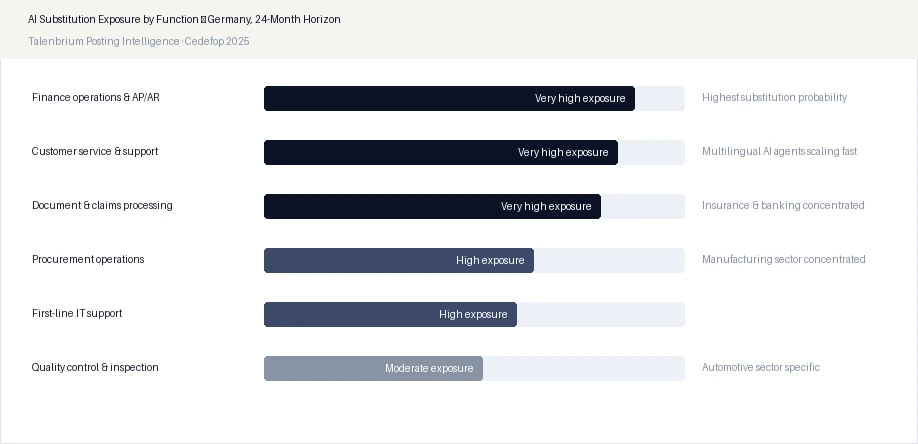
AI Substitution Exposure by Function — Germany, 24-Month Horizon
German employers face the highest AI-era restructuring cost in Europe — and the longest timeline to execute it.Germany runs the most codified employee co-determination system in the developed world. Works Councils hold statutory consultation and, in many cases, veto-adjacent rights over operational change under the Betriebsverfassungsgesetz (BetrVG), and any AI system that alters workflow, monitors performance, or changes job content triggers formal Works Council involvement under Section 87. For headcount reduc...
Full data available to purchasers
Job postings prove the case both ways: declining demand for AI-exposed roles, rising demand for the roles workers could move into.

Talenbrium's proprietary posting database tracks year-over-year change in active job postings by function across the German market. For AI-exposed functions, posting volume has fallen consistently over the trailing 12 months as employers automate first and hire less into these roles — evidence that directly supports the Sozialauswahl and redeployment-effort documentation German employers must present to Works Councils. For destination functions, the pattern reverses: postings are rising, meaning a documented reskilling pathway into these roles is backed by live employer demand today, not aspiration.
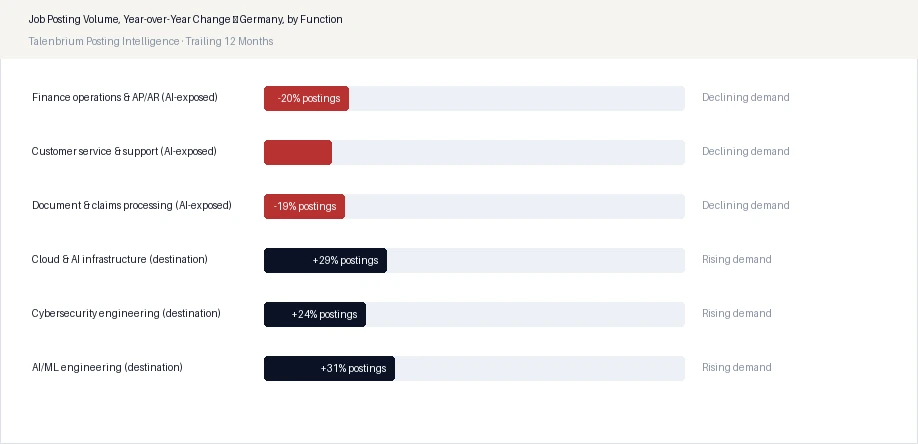
Job Posting Volume, Year-over-Year Change — Germany, by Function
The Works Council is not an obstacle to route around. It is the mechanism through which AI transitions get approved.

Section 87 BetrVG gives the Works Council co-determination rights over the introduction of technical systems capable of monitoring employee behaviour or performance — a category that captures most AI productivity and analytics tools by design. Employers who deploy AI systems without Works Council agreement (a Betriebsvereinbarung) face the system being blocked or unwound after the fact, which is more costly than negotiating terms upfront. Talenbrium's Q1 2026 Pulse Survey found that German HR leaders who negotiated AI deployment terms with Works Councils before go-live reported 40% fewer implementation delays than those who did not.

Where AI adoption leads to genuine redundancy, the KSchG social selection criteria (Sozialauswahl) require employers to weigh age, tenure, dependents, and disability status when selecting which employees to release from a pool of comparable roles — a process that frequently protects long-tenured employees over the specific individuals whose tasks were most affected by AI. This creates a structural mismatch between where AI reduces workload and where the law permits headcount reduction, which is precisely why documented redeployment and reskilling pathways carry disproportionate weight in German restructuring strategy.

"In Germany, the AI business case and the AI restructuring case are two separate documents, built on two separate timelines, and approved by two separate audiences. Employers who conflate them lose months to Works Council disputes that a negotiated Betriebsvereinbarung would have avoided." — Talenbrium Workforce Intelligence, Q1 2026
Restructuring Cost per Exited Employee — Germany vs. EU-6 Comparative (Index, Romania = 100)
Table of Contents
01Executive Summary: The German AI-Restructuring Equation
02AI Substitution Exposure by Function — National and City-Level
03The Works Council System: Section 87 BetrVG and AI Deployment
04KSchG Social Selection and the Redundancy Mismatch Problem
05Sozialplan Cost Calculator by Seniority Tier and Bundesland
06City Analysis: Munich, Berlin, Frankfurt, Hamburg, Stuttgart
07Redeployment Absorption Capacity by City
08Reskilling Pathways: Cost, Duration, and Viability by Function
09Salary Benchmarks: Displaced Roles vs. Destination Roles
10The Betriebsvereinbarung Framework: Negotiating AI Deployment Terms
11Romania Relocation Comparison: When It Beats In-Country Restructuring
12Strategic Recommendations
13Methodology and Data Sources
Report scope
Geography
Germany national + Munich, Berlin, Frankfurt, Hamburg, Stuttgart
Legal framework
BetrVG Section 87 · KSchG · Sozialplan negotiation practice
Sectors
Financial services · Manufacturing · Automotive · Professional services
Primary research
Talenbrium Q1 2026 Pulse Survey · Germany sub-sample
Cost model calibration
OECD EPL indicators · national settlement data
Secondary validation
Destatis · Cedefop 2025 · Eurostat Structure of Earnings
Customisation
10 hours free customisation included · Bundesland-specific extensions available
Delivery
Within 2–4 business days of purchase · 58 pages + cost calculator
Assigned Author
Diptanjan Biswas

Diptanjan Biswas

Principal Head, Strategic Consulting

Diptanjan Biswas leads strategic consulting at Talenbrium, bringing nine years of experience across research, risk, and workforce intelligence in banking, technology, and advisory sectors.

Workforce Strategy Labour Market Intelligence Credit Risk Recoveries Strategy
View Full Author Profile Linked to Talenbrium's public author library

Ready to access the full intelligence?

Purchase directly, or speak with our team to discuss your requirements first.

Purchase
Buy this report — USD 4,999
Enquire
Speak with our research team
Custom
Commission a bespoke engagement
Home Reports Insights Contact