
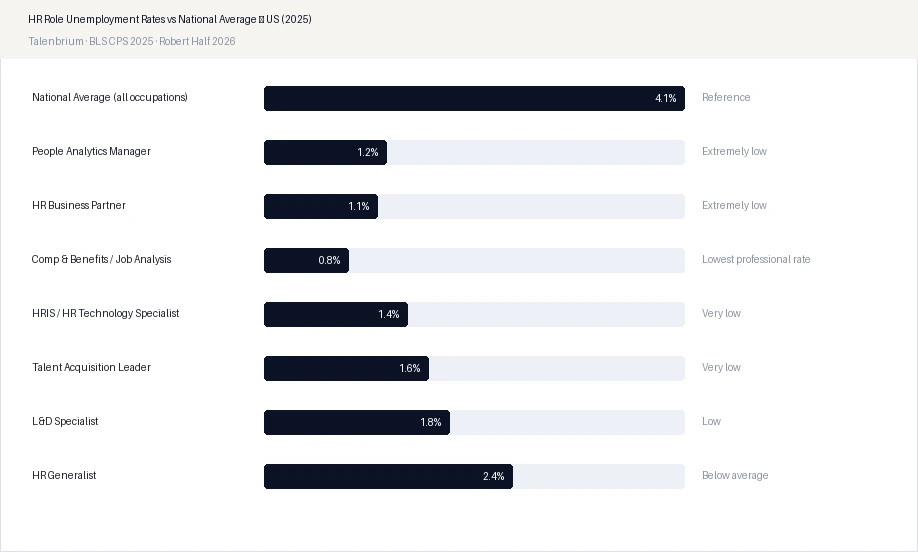
Professional services and the HR function represent two overlapping talent markets that are both experiencing their own version of the skills shortage they are professionally tasked with solving. Compensation, benefits, and job analysis specialists recorded an annual unemployment rate of just 0.8% in 2025 — one of the lowest across all professional occupations in BLS data. HR business partners posted 1.1% unemployment. People analytics managers posted 1.2%. Talenbrium's Q1 2026 Workforce Pulse Survey found that 59% of HR leaders reported it more difficult to find skilled HR talent than a year earlier.
AI transformation management is the top CHRO priority for 2026, displacing talent acquisition for the first time (Gartner). BCG's analysis of 7,000+ HR and business leaders found organisations with advanced GenAI and workforce analytics capabilities filling vacant roles up to three weeks faster than competitors — establishing a measurable business case for HR technology investment that is directly driving HR analytics and HR technology specialist hiring.
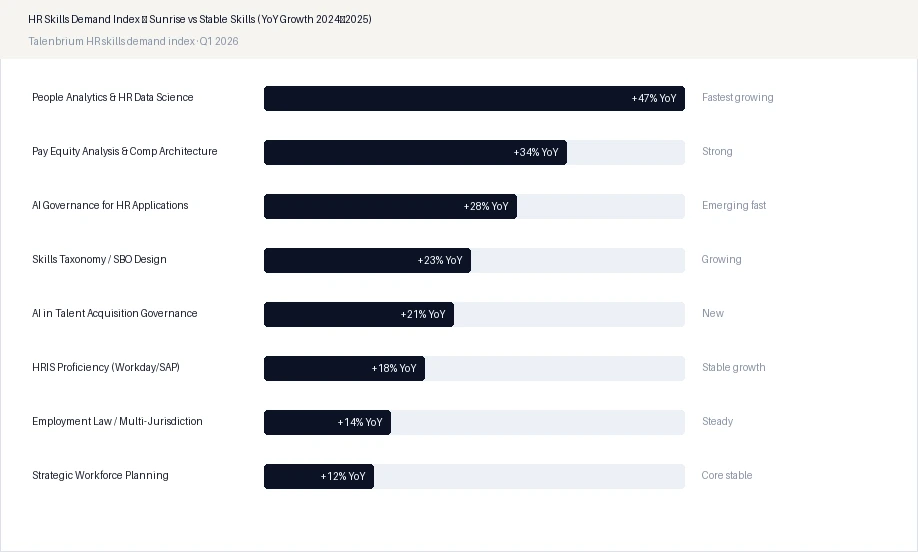
Only 15% of organisations had implemented strategic workforce planning based on skills as of early 2025 per cross-industry research Talenbrium validates independently. Technology sector adoption moved from 28% to 52% between 2023 and 2025. Financial services from 18% to 38%. This pace of adoption requires HR practitioners with skills architecture and job design competencies that most HR teams currently lack. Talenbrium's analysis of HR role postings identifies compensation equity analyst as the fastest-growing HR sub-role in 2025 — up 34% YoY — driven directly by state-level pay transparency legislation covering 40% of the US workforce.

Customise the study to your target geography, role, skill cluster, or benchmark set, or request a sample before you proceed.