
Penang is a mature medical device manufacturing base with deep talent and slowing growth. Johor is a near-empty page onto which a very large hiring requirement is being written, driven by a cross-border special economic zone with Singapore. They are 600 kilometres apart, they compete for different people, and the single most common planning error in this market is treating Malaysian device talent as one pool.
The scale of the shift is visible in the investment data. The national investment authority approved 92.8 billion ringgit of investment in the first quarter of 2026 alone, expected to create more than 50,000 jobs across sectors, and device specific commitments within that included a 308 million ringgit expansion of intravascular lithotripsy device production in Batu Kawan, Penang. Penang has drawn about 3.6 billion ringgit of approved manufacturing investment in scientific and measuring equipment, including medical devices, over the 2020 to 2024 period, roughly 30 percent of the national total for that category.
| RM92.8bn National approved investment in Q1 2026, expected to create over 50,000 jobs MIDA | RM3,278 Mean monthly manufacturing wage, the fastest rising sector at 7.4 percent DOSM | RM3,500 Penang median monthly wage, above the national RM3,167 DOSM | Up to 15 yr Tax incentive for device investment in the Johor cross-border zone MIDA |
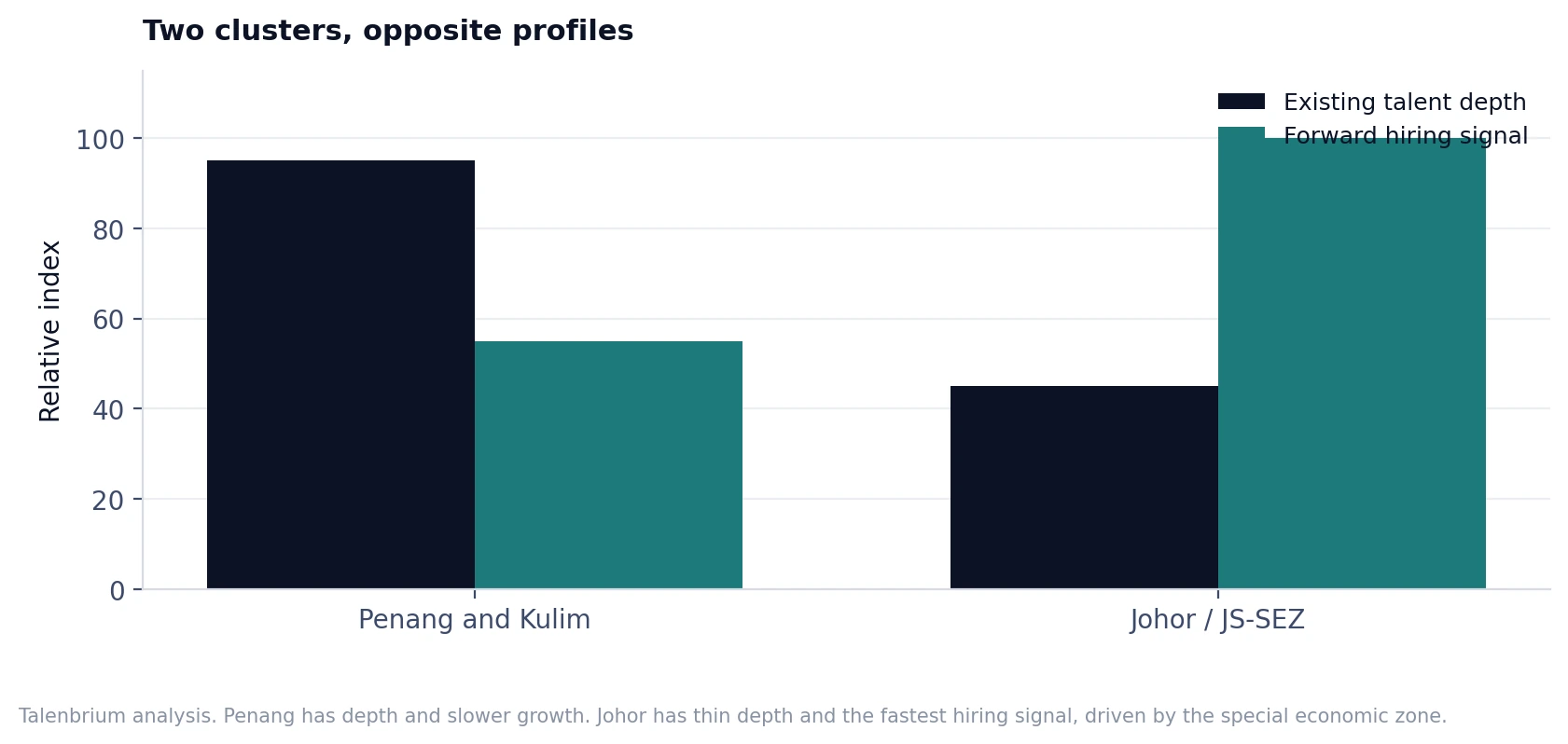
Penang carries six of the global top forty device companies. Johor carries the incentive that is about to change the map.
Source: Talenbrium analysis
Penang and the adjacent Kulim high technology park are the established cluster, described by the state investment body as holding the highest concentration of medical technology companies in Malaysia and Southeast Asia, including six of the global top forty device firms by sales. Depth here is genuine. Growth is steadier and the competition for experienced people is already intense, because the same engineers are wanted by the semiconductor and electronics sectors that share the location.
Johor is the opposite profile. The Johor cross-border special economic zone with Singapore offers device investors tax incentives of up to fifteen years for commitments ranging from 500 million to more than one billion ringgit. That incentive is pulling new capacity toward a location that does not yet have the workforce to staff it. The hiring signal is the strongest in the country and the existing talent depth is the thinnest, which is a specific and solvable problem but not the same problem as hiring in Penang.
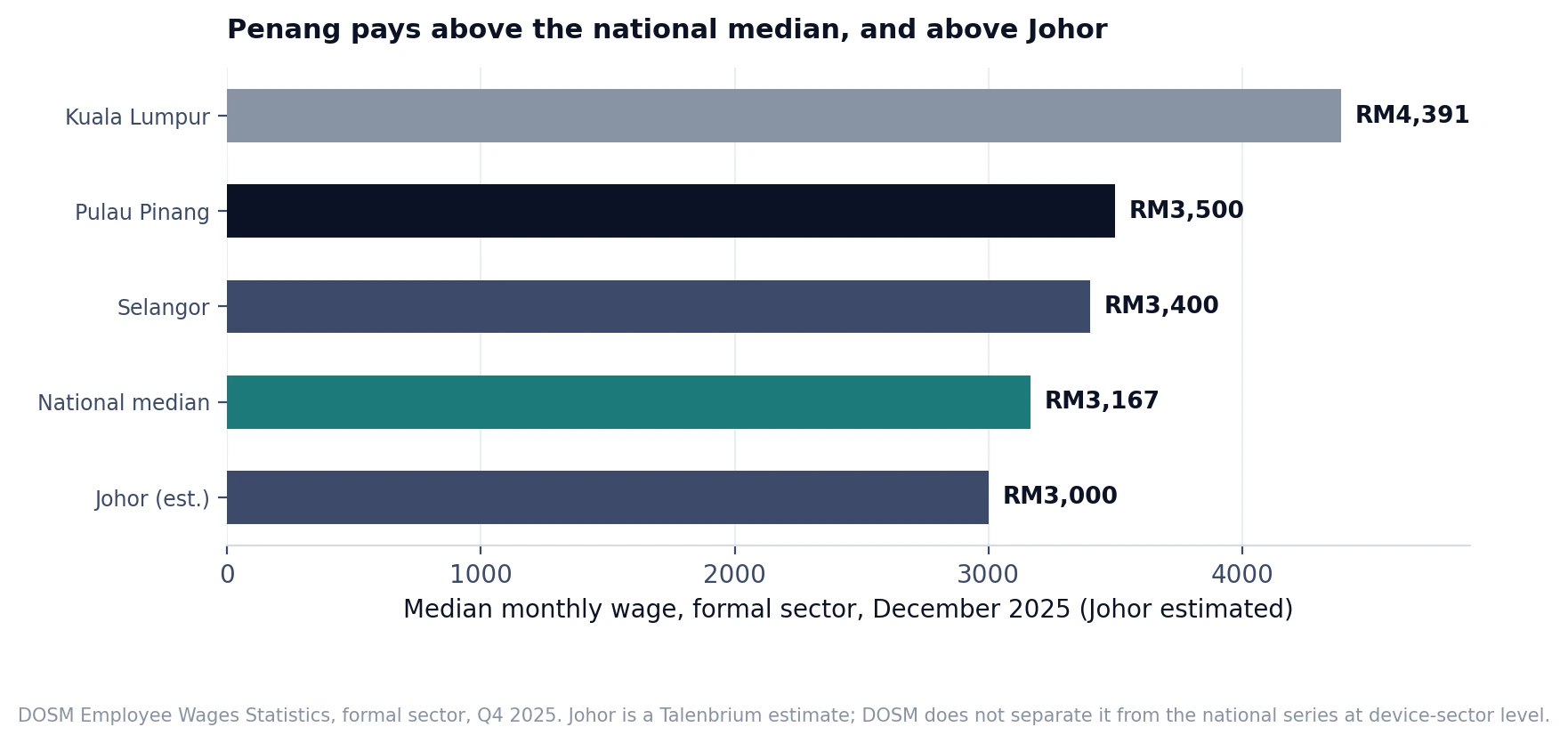
The statistical office reports the median monthly wage for formal employees at 3,167 ringgit in December 2025, up 4.0 percent on the year. Manufacturing recorded the fastest mean wage increase of any sector at 7.4 percent, reaching 3,278 ringgit. By state, Penang sat at 3,500 ringgit median in December 2025, above the national figure and behind only Kuala Lumpur and, marginally, Selangor.
Source: DOSM Employee Wages Statistics, formal sector, Q4 2025
For an employer, the useful point is that Penang is not a low cost location within Malaysia. It is one of the higher paying states, and the device sector competes there against electronics and semiconductor employers who set the reference. Johor prices lower today, but the special economic zone and the Singapore commuter effect will move that quickly, and a hiring plan built on today's Johor wage will be wrong within a year.
| Penang has the people and rising pay. Johor has the incentive and almost no one. Both are real hiring markets. Neither is the other. Talenbrium Workforce Intelligence, Q3 2026 |
This report profiles emerging and future-driven roles only. Every entry clears two bars rather than one. There has to be real hiring demand, and the role itself has to be new or fundamentally reshaped. Scarcity alone does not qualify, which is why several genuinely hard-to-fill Malaysian titles appear later as reskilling sources rather than here. Established assembly and bench roles are excluded entirely.
Smart Factory and Industrial IoT Engineer
Connects device production lines to the data layer under the national industrial digitalisation policy. The scarce skill sits between controls engineering and data engineering, and the national policy framework has made it a stated hiring priority rather than an option.
AI Vision and Automated Inspection Engineer
Trains and governs learned inspection models that judge defects rather than applying fixed rules. A different job from operating a rule-based optical system, and it carries a validation burden the older equipment never had.
Precision Machining and Advanced Materials Engineer
Produces medical-grade components and surgical subcomponents drawing on Malaysia's precision engineering base. The shift is toward advanced materials and micro-scale tolerances for implants and catheters rather than commodity plastics.
Sterilisation Modality Transition Engineer
Moves products off ethylene oxide onto radiation or low-temperature hydrogen peroxide and defends the change to a regulator. Created directly by tightening emissions regulation and relevant here given the volume Malaysia sterilises for the United States and European markets.
Device Cybersecurity Engineer
Designs security into connected devices to meet the United States premarket cybersecurity mandate in force since late 2023. A role created by regulation within the last three years.
Regulatory Data and Structured Submissions Engineer
Builds and maintains the structured data behind electronic submissions to multiple regulators. Data engineering against a regulatory schema rather than regulatory writing, and the two skill sets rarely sit in one person.
Robotic-Assisted Surgical Systems Engineer
Develops the mechatronics and control systems behind robotic surgical platforms, a named target of national industrial policy for moving the sector up the value chain from consumables toward high-value hardware.
Connected Device and Remote Monitoring Engineer
Builds instrumented devices that report from outside the hospital, spanning hardware, wireless and cloud. Draws directly on the synergy between Malaysia's electronics base and its device base.
AI Model Lifecycle Engineer
Maintains models that keep learning after the device ships, under predetermined change control plans. Governing a model that changes is a different discipline from validating one that does not.
The statistical office publishes wages by broad sector and by state, not by occupation at this granularity, and its economic census classifies device activity into component and assembly categories rather than by role. All nine roles fold into wider manufacturing or professional categories. No government wage figure exists at role level, so role level pay in this report comes from Talenbrium's compensation model, indexed to the official state and sector wage series.
The national investment authority states the direction plainly. As global safety and traceability requirements tighten, manual manufacturing is steadily giving way to automated and precision-driven production. That shift names the roles that are contracting.
Four are worth setting out. Manual assembly of consumables, historically the backbone of the Malaysian sector, is being consolidated into automated lines. Manual visual inspection is being displaced by automated optical and vision-based inspection. Manual documentation for regulatory submission is moving into structured digital systems. And basic machine minding is giving way to multi-machine supervision. Three of the four convert upward into roles on the emerging list, and the report prices each conversion against the cost of an external hire in the same state.
No official body publishes device employment at city level, and the statistical office reports wages by state rather than by city or sector combined. The location model is Talenbrium's own, built from investment data and employer presence, anchored to the state wage series. The table below is the format example. The full report carries the same structure for all five locations with depth ratings by role family, observed time to fill and a pay index.
| Location | Talent depth | Demand | Cost position | Profile |
|---|---|---|---|---|
| Penang | Deep | High | High | Densest device and electronics cluster in the region. Competes with semiconductor employers for the same engineers. |
| Kulim | Moderate | High | Moderate | High technology park adjacent to Penang. Manufacturing depth, thinner professional layer. |
| Johor Bahru | Emerging | Rising | Rising | The special economic zone play. Thin today, fastest hiring signal, Singapore commuter pressure on pay. |
| Kuala Lumpur | Moderate | Moderate | Highest | Regulatory, commercial and headquarters functions. Highest wages in the country. |
| Melaka | Emerging | Moderate | Lowest | Established component base, least contested, best retention profile. |
Format example. The full report adds role family depth, time to fill and pay index for each location.
Source: Talenbrium analysis, anchored to DOSM state wage data
Malaysia publishes usable official wage data by state and by sector, updated quarterly, and this report anchors to it rather than replacing it.
The statistical office reports the national median formal wage at 3,167 ringgit a month in December 2025, the manufacturing sector mean at 3,278 ringgit, and state medians ranging from 4,391 ringgit in Kuala Lumpur down to 1,800 ringgit in the lowest states. Penang at 3,500 ringgit sits in the upper group. The 90th percentile of formal employees earned at least 9,000 ringgit a month, which matters because the emerging device roles in this report sit at or above that percentile, well outside the range the median describes.
What the official data does not give is pay by occupation, and it does not separate Johor device wages from the national series. Role level figures and the Johor estimate in this report therefore come from Talenbrium's compensation model, indexed to the official state and sector wage series and labelled as modelled wherever they appear.
The full report benchmarks all nine designations across all five locations with junior, mid and senior bands, 135 cells in total, in ringgit and dollars, each indexed to the official state and sector series, together with the Singapore commuter premium that shapes Johor pay and the total cost of employment including statutory contributions.
The report sets pay against available supply depth and observed time to fill for each of the nine roles in each of the five locations. The pattern that defines Malaysia is the split between the two clusters.
In Penang, the people mostly exist and the constraint is competition, primarily from the semiconductor and electronics sectors that share the location and often pay more. In Johor, the constraint is absence. The special economic zone is creating roles faster than the local pool can supply them, and the realistic sources are relocation from Penang, cross-border commuting from Singapore at a premium, and a training pipeline that does not yet exist at scale.
Robotic-Assisted Surgical Systems Engineer and AI Model Lifecycle Engineer run longest of the nine in every location, because they are new to the Malaysian sector and the domestic pipeline for them is thin regardless of cluster.
The report sets out a location specific approach covering candidate channels, offer positioning against the correct state and sector wage reference, and the constraints that change a hiring plan.
Four points shape strategy here. Competition in Penang comes as much from semiconductor and electronics employers as from device peers, so benchmarking against device firms alone will price an offer too low. The Johor special economic zone changes the arithmetic on a two to three year horizon rather than immediately, so a plan for that location has to be built forward rather than on current conditions. The Singapore commuter effect sets a hard floor on Johor professional pay that no domestic benchmark captures. And Malaysia's foreign worker framework and the halal and multilingual dimensions of the workforce are practical hiring factors the report covers directly.
Employer competition is described by employer type rather than by name. Four types set this market. Large United States headquartered device manufacturers with established Penang operations hold the deepest pipelines and set the ceiling there. European device manufacturers compete on scope and are expanding into the newer locations. The semiconductor and electronics sector is the competitor most often underestimated, hiring the same automation, vision, data and systems engineers the device sector now needs, and in Penang it is the binding competitor rather than any device peer. Contract manufacturers and component specialists form the fourth type, hiring the widest range of technician roles.
Reskilling matters more in Malaysia than in most markets, because the electronics and semiconductor base next door is a large adjacent pool of exactly the automation, vision and data skills the device sector is short of.
The report maps the shortest internal conversion path into each designation with the source role, the gap that has to close, realistic duration and cost against an external hire in the same state.
Three conversions are short. Electronics test engineers convert into AI vision and inspection work quickly, since they already understand automated test. Semiconductor process and equipment engineers convert into smart factory and industrial IoT roles with limited additional training. Visual inspectors convert into AI vision work in under six months because they know the defect modes a model has to be taught. One conversion is long. General manufacturing engineers do not become robotic surgical systems engineers inside a hiring cycle, because the mechatronics and regulatory content is a genuine retraining rather than an adjustment, and the report says so.
Three frameworks shape device hiring in Malaysia.
The domestic framework is the Medical Device Authority under the Ministry of Health, which licenses establishments and registers devices, together with the national industrial policy and the special economic zone incentives that are actively steering where new capacity is built and therefore where hiring happens.
United States Food and Drug Administration requirements govern the large share of Malaysian output destined for the United States, including quality system requirements and the premarket cybersecurity mandate for connected devices, which is the direct origin of the device cybersecurity role. European Union medical device regulation applies to European-bound output. Because Malaysia sterilises and manufactures for both markets, the tightening of sterilisation emissions regulation in the United States translates into a real hiring driver here, which is why the sterilisation modality transition role appears on the designation list.
Three things are worth watching before the next edition.
The first is the pace of the Johor build-out. If the special economic zone fills at the rate the incentives imply, it will pull experienced people out of Penang and reprice both clusters. If it fills slowly, Penang remains the centre of gravity and Johor stays a forward bet. The report treats both as live scenarios rather than assuming the optimistic one.
The second is the convergence with electronics. National policy is explicitly linking the medical device and electronics sectors around AI data centre demand and smart manufacturing. That convergence deepens the adjacent talent pool the device sector can reskill from, and it intensifies the competition for the same people. It works in both directions and the net effect depends on which sector moves faster.
The third is wage escalation. Manufacturing wages rose 7.4 percent in the latest data, the fastest of any sector, and the Singapore commuter effect adds a separate upward pull on Johor. A hiring plan built on current wages will understate cost within a year in exactly the locations where new capacity is going.
The report turns the role level pattern into a Malaysian hiring, placement and reskilling plan across two very different clusters.
| ROLE LEVEL DEMAND MODEL Year over year demand and median pay for all nine emerging designations across all five locations. | SALARY BENCHMARKS 135 role, location and seniority cells in ringgit and dollars, each indexed to the official DOSM state and sector wage series. |
| TWO-CLUSTER PLACEMENT MODEL Penang against Johor on depth, cost, competition and forward hiring signal, with the Singapore commuter premium modelled. | TOP FIVE LOCATIONS Talent depth by role family, observed time to fill, cost position and pay index for each location. |
| TALENT ACQUISITION STRATEGY Channel guidance, cross-sector competition, foreign worker framework and offer positioning by location. | TALENT BENCHMARKING Supply depth and time to fill by role and location, set against cost. |
| PEER HIRING ANALYSIS Employer type competition map by location, including the semiconductor and electronics competitor set. | RESKILLING AND CONVERSION MODEL Shortest internal route into each role, including conversion from the adjacent electronics pool. |
| REGULATORY READINESS VIEW How United States, European and Malaysian requirements translate into named roles. | EDITABLE DATA TABLES Every exhibit supplied as an Excel workbook. 10 hours of customisation included. |
| ROLES IN SCOPE 9 emerging and future-driven medical device designations across 3 layers. Established assembly and bench roles excluded by design. | GEOGRAPHY Malaysia. Penang, Kulim, Johor Bahru, Kuala Lumpur and Melaka. |
| INDUSTRIES Medical device manufacturing, component and consumables manufacturing, contract manufacturing, sterilisation services, and device electronics. | DATA PERIOD Q3 2026 snapshot. Trend series 2020 to Q1 2026. |
| PRIMARY RESEARCH Talenbrium posting intelligence and Talenbrium compensation model. | SECONDARY VALIDATION DOSM, MIDA, MITI, Ministry of Health, US Food and Drug Administration, European Commission. |
| STATED DATA GAPS No occupational code or government wage series exists at role level. Device employment is not published at city level, and DOSM does not separate Johor device wages from the national series, so the Johor figure is a Talenbrium estimate. | SOURCING POLICY Government and intergovernmental bodies are cited by name. Private companies, trade associations and press outlets are not named anywhere in this report. |
| CUSTOMISATION 10 hours free customisation included. Single location and single role family extensions available. | DELIVERY Within 2 to 4 business days of purchase. Report plus editable data tables. |

Customise the study to your target geography, role, skill cluster, or benchmark set, or request a sample before you proceed.