Research CatalogueNursing Graduate Output vs. Clinical Demand: The Pipeline Gap in US and EU Markets
Research Report2026-07-0890 pages

Nursing Graduate Output vs. Clinical Demand: The Pipeline Gap in US and EU Markets

Talenbrium Research  |  2026-07-08  |  By Diptanjan Biswas  |  Talenbrium Proprietary Intelligence
Structural nursing shortage: US supply will meet only 91.94% of demand in 2026

The nursing workforce crisis is neither new nor resolved. What is new in 2026 is the precision with which the shortage can be quantified. The Health Resources and Services Administration (HRSA) projects that at the national level, US nursing supply in 2026 will account for 91.94% of demand — a shortage rate of 8.06%. The gap is sharpest for licensed practical nurses, where the shortage rate reaches 20%. Across Europe, the picture is equally acute: WHO projects a shortfall of 10 million healthcare workers globally by 2030, with nursing representing the largest single component.

This Talenbrium report analyses the university and training pipeline producing nursing and allied health professionals across the US and three European markets — quantifying graduate output, employer absorption rates, geographic distribution, and the specific programme characteristics associated with the highest hire-readiness in each market.
8.06%
US nursing shortage rate in 2026 — supply vs. demand gap
HRSA Healthcare Workforce Projections 2026
20%
US shortage rate for Licensed Practical Nurses specifically
HRSA 2026 national projection
10M
Global healthcare worker shortfall projected by 2030
WHO / WEF Future of Jobs 2025
16,900
Annual average RN job openings, US, 2024–2034 (BLS)
Bureau of Labor Statistics 2024
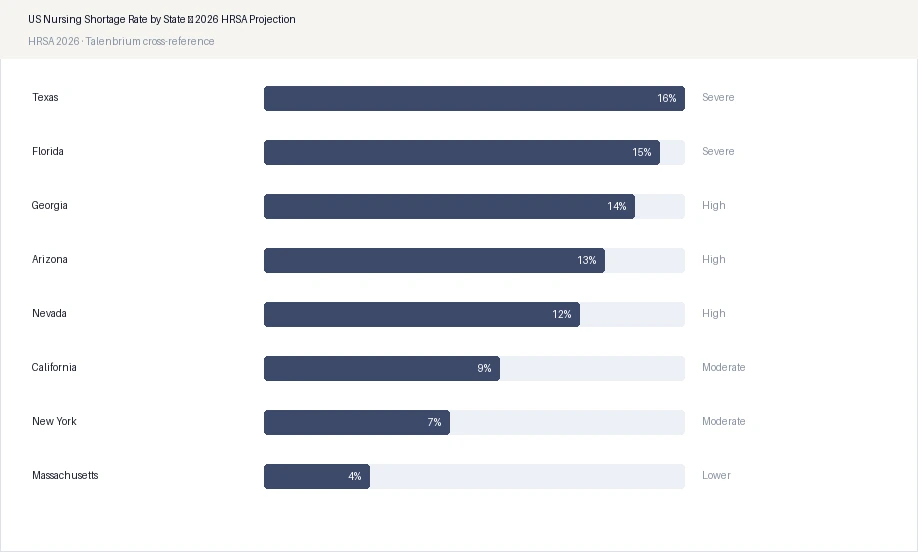
US Nursing Shortage Rate by State — 2026 HRSA Projection
Talenbrium What We Do Strategic Workforce Planning Talent Supply & Demand Analytics Skills Architecture & Intelligence Compensation Benchmarking Location Strategy Diversity & Inclusion Intelligence Industries Technology & Digital Banking & Financial Services Healthcare & Life Sciences Energy, Oil & Gas Manufacturing & Engineering Construction & Infrastructure By Function CHRO & HR Leadership Talent Acquisition Compensation & Benefits Learning & Development Workforce Analytics Methodology Perspectives All Perspec...
Full data available to purchasers
Graduate output is not the constraint — pipeline conversion is

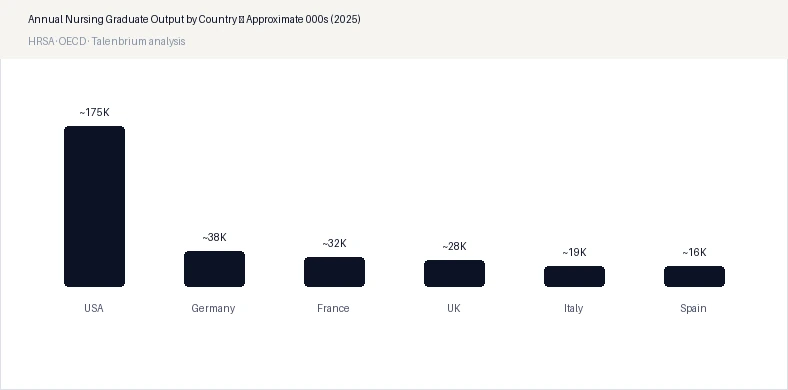
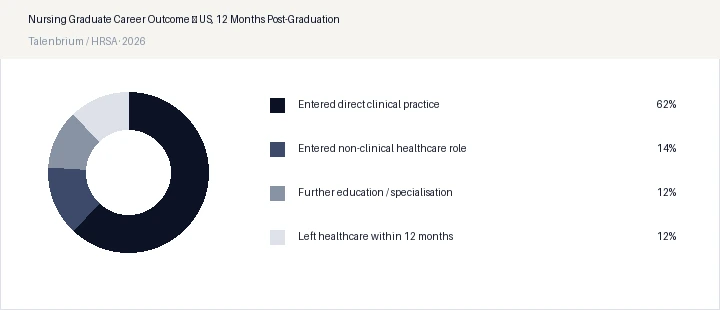
The US produces a significant volume of nursing graduates annually. The BLS reports that 5 of the 20 fastest-growing occupations in the country are in nursing. The problem is conversion: a significant share of nursing graduates do not immediately enter clinical practice, many leave the workforce within five years, and geographic distribution of graduates does not match the distribution of clinical need.

In Europe, the pipeline problem is more fundamental: nursing programme capacity has not expanded at the rate needed to offset retirement attrition. In Germany, where the demographic challenge is most acute, the nursing workforce is ageing more rapidly than the education system is producing replacements.
"Five of the twenty fastest-growing occupations in the United States are in nursing — yet the supply of practising nurses will fall 8% below demand in 2026." — HRSA Healthcare Workforce Projections 2026
Annual Nursing Graduate Output by Country — Approximate 000s (2025)Nursing Graduate Career Outcome — US, 12 Months Post-Graduation
The full report includes: institution-by-institution analysis of the top 100 US nursing programmes by graduate output and clinical placement rate; European country profiles for UK, Germany, and France covering programme capacity, attrition, and output trajectory; employer absorption rate benchmarks by hospital system type and geography; diversity of pipeline analysis including gender, ethnicity, and first-generation student representation; geographic mismatch analysis — where graduates are produced vs. where they are needed; compensation benchmarks for new-graduate nursing roles across all markets; and a 5-year pipeline outlook through 2030 by specialisation.
Full data available to purchasers
Table of Contents
01Executive Summary: Pipeline Gap QuantificationPreview
02US Nursing Shortage Context and HRSA Projection AnalysisPreview
03Top 100 US Nursing Programmes: Output and Placement RatesGated
04Geographic Distribution: Where Graduates Go vs. Where They Are NeededGated
05Workforce Attrition: 5-Year Retention Analysis Post-GraduationGated
06UK Nursing Pipeline: Programme Capacity and Clinical DemandGated
07Germany Nursing Pipeline: Demographic Pressure and Training OutputGated
08France Nursing Pipeline: Reform Impact on Graduate VolumeGated
09Employer Absorption Benchmarks: Hospital Systems and Community HealthGated
10Diversity of Pipeline: Representation by SpecialisationGated
11Compensation Context: New-Graduate Nursing Rates by MarketGated
125-Year Pipeline Outlook 2026–2030Gated
13Strategic Implications for Healthcare HR LeadersPreview
14MethodologyPreview
Report scope
Geography
United States (national + state level) · UK · Germany · France
Roles
RN, LPN, NP, allied health professionals
Institutions
Top 100 US nursing programmes · equivalent European coverage
Data period
2025–2026 graduation cohort · trend data 2020–2026
Primary sources
HRSA 2026, BLS 2024, OECD Health Statistics (benchmarks)
Talenbrium data
Workforce mobility tracking · employer absorption analysis
Survey validation
Workforce Pulse Survey Q1 2026 · n=284
Pages
~90 pages + institution database
Assigned Author
Diptanjan Biswas

Diptanjan Biswas

Principal Head, Strategic Consulting

Diptanjan Biswas leads strategic consulting at Talenbrium, bringing nine years of experience across research, risk, and workforce intelligence in banking, technology, and advisory sectors.

Workforce Strategy Labour Market Intelligence Credit Risk Recoveries Strategy
View Full Author Profile Linked to Talenbrium's public author library

Ready to access the full intelligence?

Purchase directly, or speak with our team to discuss your requirements first.

Purchase
Buy this report — USD 2,499
Enquire
Speak with our research team
Custom
Commission a bespoke engagement
Home Reports Insights Contact