
US life sciences reached a workforce milestone in early 2025: 2.1 million employed professionals, the highest level ever recorded. The sector is growing, well-funded, and generating sustained hiring demand — but at a pace that the talent supply infrastructure cannot match. Talenbrium's Hiring Difficulty Score for clinical data scientists stands at 8.6 out of 10. For regulatory affairs specialists it is 8.1. For biomanufacturing engineers it is 7.9. Manpower Group's Employment Outlook Survey reports a 28% net employment outlook for healthcare and life sciences — the highest of any sector.
The EU life sciences strategy launched July 2025, backed by more than EUR 10 billion per year, targets the full value chain from R&D through manufacturing. The UK government's sector plan targeting third-largest global life sciences status by 2035 carries equivalent hiring implications. Each of these strategies creates new regulatory affairs, quality assurance, and compliance roles on top of an already strained talent supply.
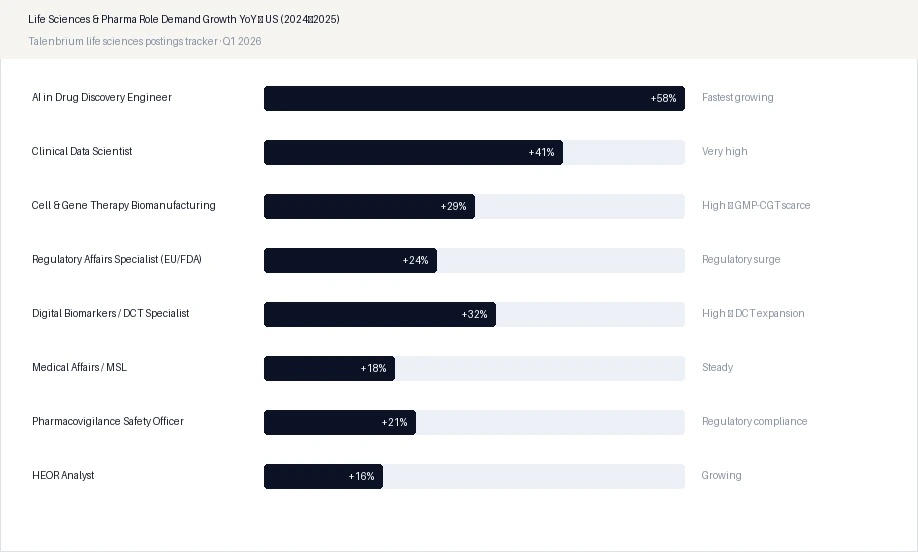
Talenbrium's life sciences co-hiring analysis identifies the regulatory affairs specialist as the most consistent co-hire alongside clinical research associate postings — appearing in 71% of cases. The clinical data scientist role co-posts with data engineer in 62% of cases and with biostatistician in 58%, indicating that pharma organisations are building integrated data science clusters rather than isolated analytical capabilities. CROs and CDMOs are Talenbrium's fastest-growing life sciences employer category — driven by pharma companies outsourcing clinical operations, effectively externalising their talent shortage to specialist organisations. The CROs themselves experience identical talent shortages.

Customise the study to your target geography, role, skill cluster, or benchmark set, or request a sample before you proceed.