
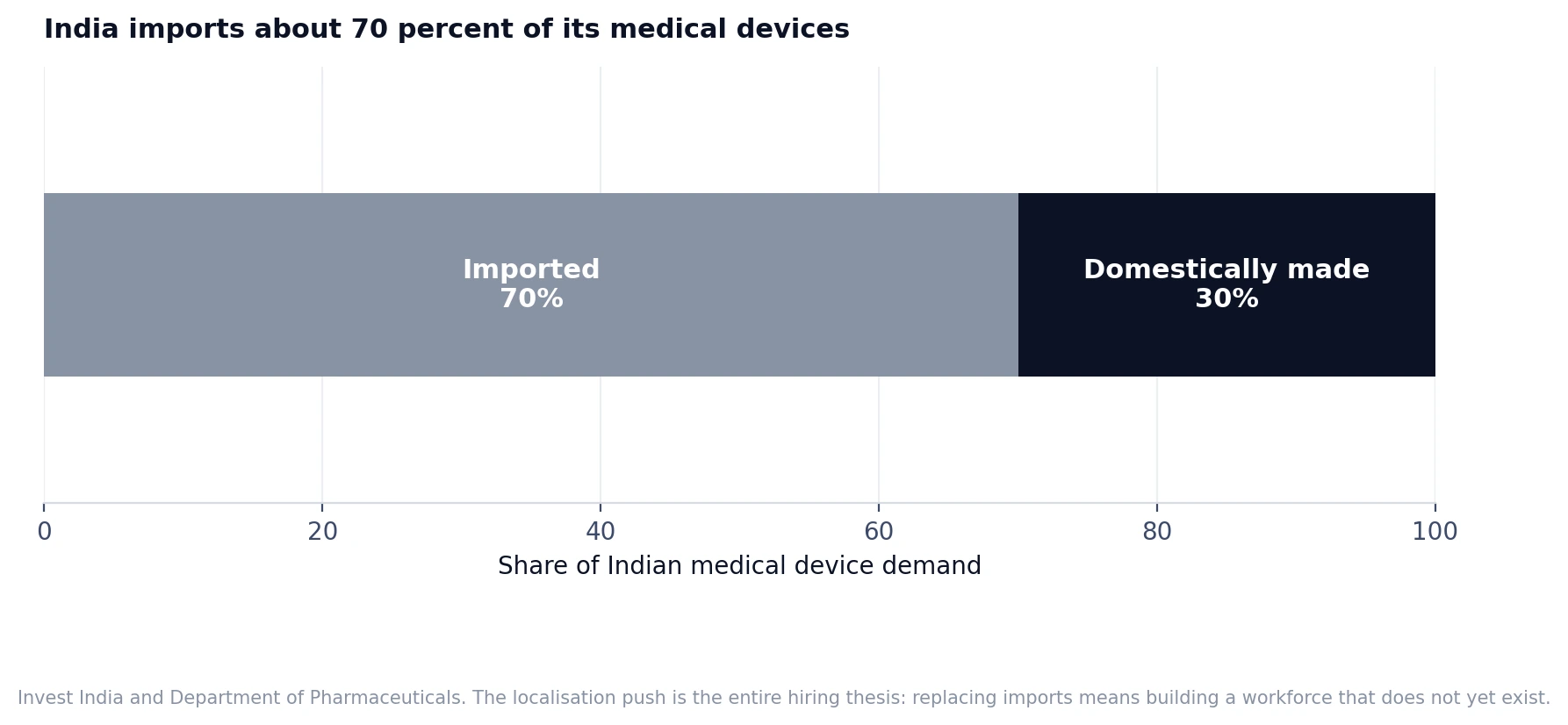
India imports around 70 percent of its medical devices. Reducing that is the stated aim of national policy, and it is being pursued through production incentives, dedicated manufacturing parks and a localisation push across eight to ten priority device categories. Every one of those levers converts, at the operational level, into a hiring requirement for people who are not yet in the sector at the scale required.
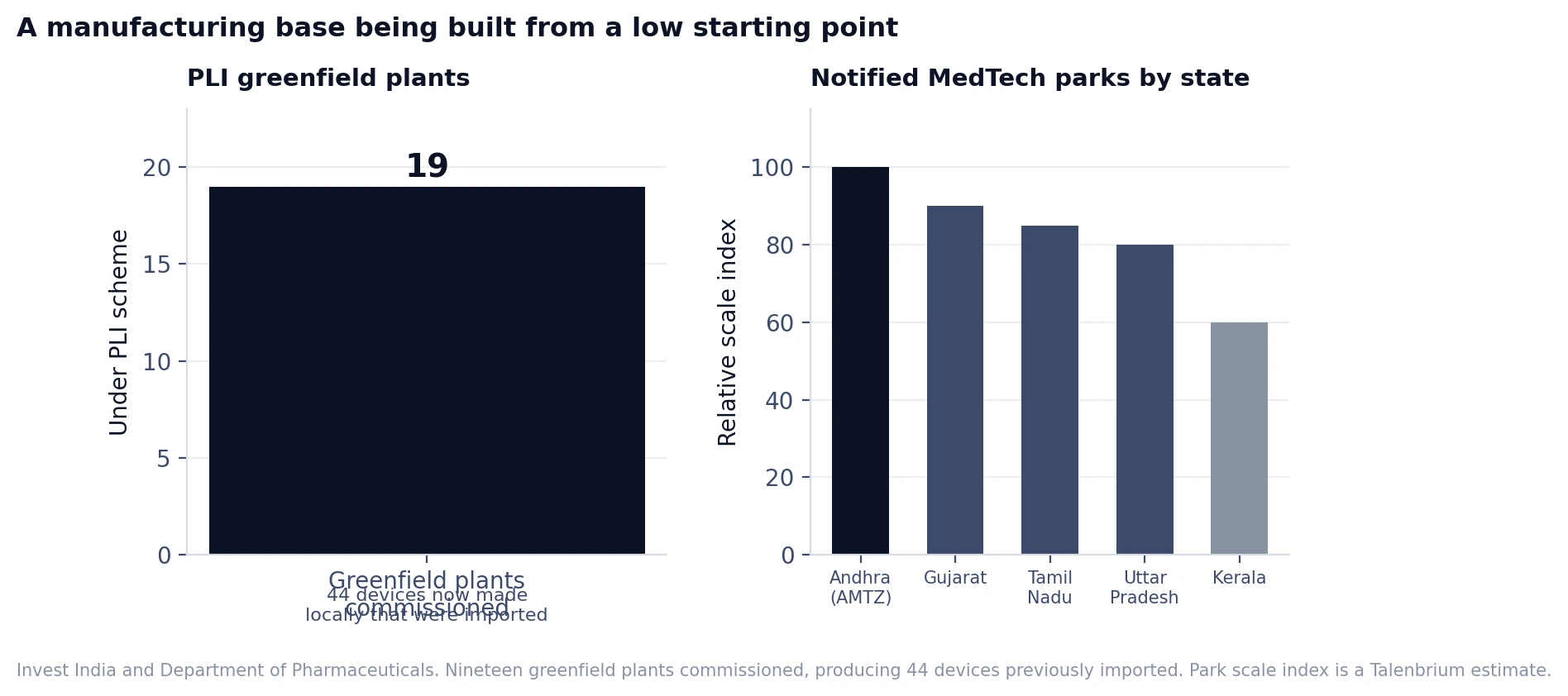
The scale is real and government-sourced. Nineteen greenfield plants have been commissioned under the production linked incentive scheme, producing 44 devices locally that were previously imported, including imaging systems, radiotherapy equipment and implants. Four notified medical device parks are operating or in development across Gujarat, Tamil Nadu, Andhra Pradesh, Uttar Pradesh and Kerala. The Uttar Pradesh park alone carries an approved cost of about 439 crore rupees. This is a manufacturing base being constructed rather than one being optimised, which makes the workforce question different from every other market in this series.
| ~70% Share of Indian medical device demand met by imports, the gap policy aims to close Invest India | 19 Greenfield plants commissioned under the production incentive scheme Dept. of Pharmaceuticals | 44 Devices now made in India that were previously imported Invest India | Rs 3,420 cr Financial outlay of the medical device production incentive scheme Dept. of Pharmaceuticals |
India is the youngest device manufacturing market in this series, which makes it the one where the workforce has to be built rather than hired.
Source: Invest India and Department of Pharmaceuticals
The 70 percent import share is the entire hiring thesis. Replacing an imported device with a domestically made one means standing up a production line, a quality system, a regulatory function and, increasingly, a design capability, all staffed with people the country has not historically trained in device-specific work. The policy is explicit about moving from simple consumables toward complex devices, imaging systems, implants and cardio-respiratory equipment, which are exactly the categories that need the scarcest people.
Source: Invest India and Department of Pharmaceuticals
The parks concentrate the demand geographically. Andhra Pradesh's MedTech Zone in Visakhapatnam is the largest and most established, offering shared manufacturing, testing and sterilisation infrastructure. Gujarat is positioning aggressively around Ahmedabad, backed by a state institution and a pharmaceutical education institute as the nodal body. Tamil Nadu, Uttar Pradesh and Kerala complete the set. Each park is a deliberate cluster, which means the hiring demand arrives in concentrated bursts in specific cities rather than spread across the country.
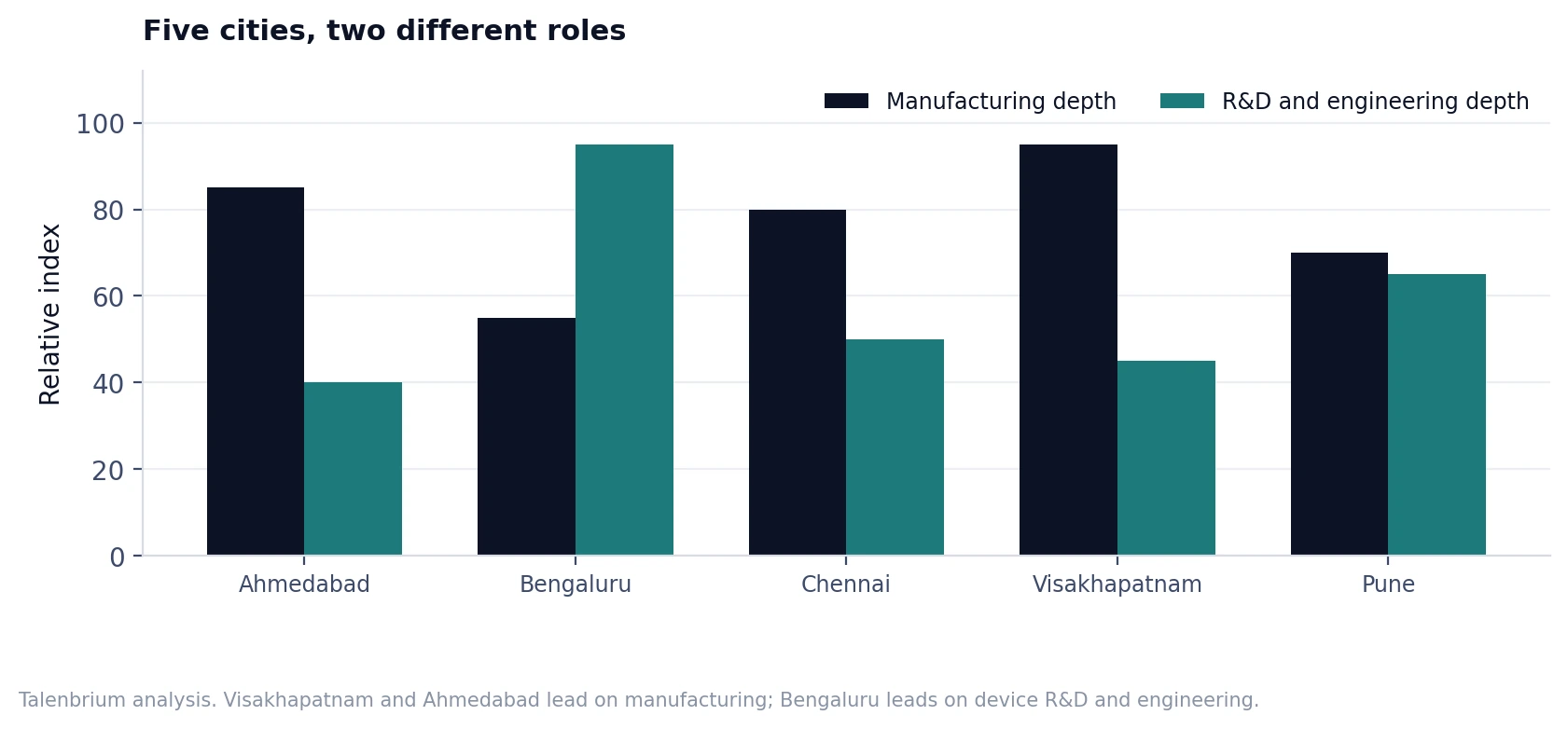
India is the only market in this series where the device manufacturing base and the device engineering base are largely in different places. Visakhapatnam, Ahmedabad and Chennai lead on manufacturing. Bengaluru leads on research, engineering and increasingly on device software and artificial intelligence work, hosting global research and development centres that develop products for export markets. Pune sits between the two. A workforce plan that treats India as one location will put the wrong roles in the wrong cities.
Source: Talenbrium analysis
| India is not optimising a device workforce. It is building one from a low base, which means the constraint is not competition for people. It is that the people do not yet exist in the numbers the policy requires. Talenbrium Workforce Intelligence, Q3 2026 |
This report profiles emerging and future-driven roles only. Every entry clears two bars rather than one. There has to be real hiring demand, and the role itself has to be new or fundamentally reshaped. Scarcity alone does not qualify, which is why several genuinely hard-to-fill Indian titles appear later as reskilling sources rather than here. Established assembly and bench roles are excluded entirely.
Complex Device Manufacturing Engineer
Builds production capability for imaging, radiotherapy and implant devices that India has historically imported. The role is scarce because the country has few people who have manufactured these specific device classes to international standard.
Medical Device Quality Systems Engineer, global standards
Stands up quality systems to the international standards required for export, covering the United States quality management regulation and the European regulation. Distinct from a general quality engineer because the standards are export-facing and new to most Indian sites.
Sterilisation and Regulatory Compliance Engineer, export markets
Builds sterilisation and compliance capability that meets United States and European requirements, including the shift away from ethylene oxide. A named requirement for any Indian site that wants to export rather than serve the domestic market only.
Medical Device R&D and Design Engineer
Develops devices rather than assembling imported designs, the capability the localisation policy is explicitly trying to build. Concentrated in Bengaluru and the strongest single differentiator between India and the nearshore markets in this series.
Software as a Medical Device Engineer
Builds regulated software that is itself the device, drawing on India's large software base but adding the regulated development discipline that base does not currently have.
AI and Medical Imaging Algorithm Engineer
Develops and validates the AI inside diagnostic and imaging products. India's imaging research depth makes this a genuine strength, and the regulated validation half is the scarce part.
Connected Device and Remote Monitoring Engineer
Builds instrumented devices that report from outside the hospital, spanning hardware, wireless and cloud, drawing on India's electronics and software base.
Device Cybersecurity Engineer
Designs security into connected devices to meet the United States premarket cybersecurity mandate in force since late 2023. A role created by regulation within the last three years.
AI Model Lifecycle Engineer
Maintains models that keep learning after the device ships, under predetermined change control plans. Governing a model that changes is a different discipline from validating one that does not.
India's labour statistics come mainly from the Periodic Labour Force Survey, which classifies employment at a broad occupational level and does not track device-specific roles. There is no government wage series at the granularity of these designations. Role level pay in this report therefore comes from Talenbrium's compensation model, indexed to the sector and city wage evidence that does exist, and labelled as modelled wherever it appears. This is a larger gap than in the other markets in this series, and the report states it plainly rather than implying a precision the official data does not support.
India's decline set is smaller than the mature markets, because the sector is growing from a low base rather than restructuring an established one. The roles under pressure are the low-value assembly and manual roles that the localisation push is deliberately trying to move beyond.
Three are worth naming. Manual assembly of basic consumables, historically the bulk of Indian device employment, is being automated as sites move toward export-grade production. Manual documentation for regulatory files is moving into structured digital systems as sites adopt export-facing quality standards. And manual inspection is being displaced by automated and vision-based systems on the newer lines. All three convert upward, and the report treats the transition as an opportunity to build the scarce workforce internally rather than as a straightforward loss.
No official body publishes device employment at city level. The city model is Talenbrium's own, built from park locations, investment data and employer presence. The table below is the format example. The full report carries the same structure for all five cities with depth ratings by role family, observed time to fill and a pay index, and it distinguishes manufacturing depth from engineering depth because the two do not coincide in India.
| City | Manufacturing | R&D and engineering | Demand | Profile |
|---|---|---|---|---|
| Ahmedabad | Deep | Moderate | Rising | Gujarat MedTech park anchor. Strongest manufacturing build-out, state-backed. |
| Bengaluru | Moderate | Deep | High | Device R&D, engineering and software. The design capability the policy wants to grow. |
| Chennai | Deep | Moderate | High | Established manufacturing and supplier base, Tamil Nadu park. |
| Visakhapatnam | Deep | Moderate | High | Largest and most established MedTech zone, shared infrastructure. |
| Pune | Moderate | Moderate | Rising | Balanced manufacturing and engineering, strong supplier depth. |
Format example. The full report adds role family depth, time to fill and pay index for each city.
Source: Talenbrium analysis
India has the least granular official wage data of the five markets in this series, and this report is explicit about what that means.
The Periodic Labour Force Survey provides broad employment and earnings data by sector and by broad occupation group, and it is the appropriate government anchor. It does not provide pay by device-specific role, and no government series does. Every role level figure in this report is therefore Talenbrium's compensation model, indexed to the available sector and city wage evidence and to the substantial pay differential between the manufacturing cities and the Bengaluru engineering market.
That differential is the single most important salary point for India. A manufacturing engineer in Visakhapatnam or Ahmedabad and a device research engineer in Bengaluru are priced very differently, and the gap is wider than in any other market in this series. Benchmarking a Bengaluru design role against a manufacturing city wage, or the reverse, is the most common and most expensive error in Indian device hiring, and the report is built to prevent it.
The full report benchmarks all nine designations across all five cities with junior, mid and senior bands, 135 cells in total, in rupees and dollars, each indexed to the appropriate city and sector evidence, together with the manufacturing-to-engineering differential and the total cost of employment including statutory contributions and the retention loading that high attrition imposes.
The report sets pay against available supply depth and observed time to fill for each of the nine roles in each of the five cities. Two patterns define India.
First, the constraint is absence rather than competition for most roles. The people who have manufactured complex devices to export standard, or built regulated device software, simply do not exist in large numbers yet, because the sector that would have trained them is the one now being built. Time to fill is long not because competitors are bidding but because the candidate pool is genuinely small.
Second, the software and engineering roles are the exception, and there the pattern inverts. Bengaluru has a very deep general software and engineering pool, so the constraint on device software and algorithm roles is not absence but the regulated-development gap, and the competition comes from the wider technology sector that pays well and imposes no regulatory overhead.
The report sets out a city specific approach covering candidate channels, offer positioning against the correct city and sector reference, and the constraints that change a hiring plan.
Four points shape strategy here. The manufacturing and engineering cities need different sourcing entirely, so a single national strategy fails on contact. For the scarcest manufacturing roles, the realistic route is reskilling from adjacent industries rather than hiring people who already have device experience, because too few exist. For Bengaluru software and algorithm roles, the competition is the wider technology sector, so device firms have to compete on the interest of the regulated work and on mission rather than on pay alone. And attrition is high across Indian technology and engineering employment, so retention planning is part of the hiring plan rather than separate from it. The report quantifies each of these.
Employer competition is described by employer type rather than by name. Four types set this market. Global device manufacturers running Indian research and development or manufacturing operations hold the deepest device-specific pipelines and concentrate in Bengaluru and the established manufacturing cities. Indian device companies and startups, growing quickly under the localisation push, hire across the widest range and lose people upward. Global engineering and research and development service firms compete hard for the same engineering and software talent, particularly in Bengaluru and Pune, and are frequently the binding competitor for those roles rather than any device peer. Contract manufacturers and component suppliers form the fourth type in the manufacturing cities.
Reskilling is not a secondary route in India. For the scarcest manufacturing and quality roles it is the primary one, because the external pool of people with device-specific experience is too small to hire from at the scale the sector needs.
The report maps the shortest internal conversion path into each designation with the source role, the gap that has to close, realistic duration and cost against an external hire in the same city.
Three conversions are practical. Pharmaceutical and automotive quality engineers convert into device quality systems roles, since the quality discipline transfers and the device-specific standards are teachable. General software engineers in Bengaluru convert into device software roles once the regulated-development discipline is added, though the transition is slower than employers expect and attrition during it is high. Electronics and embedded engineers convert into connected device roles. One conversion is genuinely long. Building a complex device manufacturing engineer from a general manufacturing base takes real time, because the device-specific process and regulatory knowledge cannot be shortcut, and the report gives an honest duration rather than an optimistic one.
Three frameworks shape device hiring in India, and they pull in a specific direction: toward export capability.
The domestic framework is the Central Drugs Standard Control Organisation, which regulates devices under the Medical Devices Rules, together with the production incentive scheme, the medical device parks and the national policy that together steer where capacity is built. The government support platform for device innovators adds coordinated regulatory facilitation.
The export frameworks are what make several of the emerging roles scarce. Any Indian site that wants to serve the United States or European markets, which is where the value is, must meet United States quality system and cybersecurity requirements and the European medical device regulation. The tightening of sterilisation emissions regulation in the United States reaches Indian exporters too. These export-facing requirements are new to most Indian sites and are the direct cause of the global-standards quality, sterilisation compliance and cybersecurity roles on the designation list. Building for the domestic market needs a different and smaller workforce than building for export, and the report distinguishes the two.
Three things are worth watching before the next edition.
The first is the shape of the next production incentive scheme. The current scheme runs to the 2026 to 2027 window, and a successor aimed at complex, high-end devices is under active consideration. If it lands, it will pull demand sharply toward the scarcest roles, the complex manufacturing and design engineers, and widen the gap the report describes. If it stalls, the trajectory softens.
The second is whether the design capability actually takes root. The policy wants India to move from assembling imported designs to developing its own devices. That depends on the research and engineering roles in Bengaluru scaling, which in turn depends on device firms winning people against a technology sector that pays more. This is the least certain part of the thesis and the report treats it as such.
The third is attrition. High turnover across Indian engineering and technology employment raises the real cost of every hire and every reskilling investment, because a proportion of trained people leave before the return is realised. A workforce plan that ignores attrition will understate cost materially, and in India that understatement is larger than in any other market in this series.
The report turns the role level pattern into an Indian hiring, placement and reskilling plan across a manufacturing base and an engineering base that sit in different cities.
| ROLE LEVEL DEMAND MODEL Year over year demand and median pay for all nine emerging designations across all five cities. | SALARY BENCHMARKS 135 role, city and seniority cells in rupees and dollars, indexed to the manufacturing-to-engineering pay differential. |
| MANUFACTURING VERSUS ENGINEERING SPLIT Where each role should sit, and the pay and depth differences between the manufacturing cities and the Bengaluru engineering market. | TOP FIVE CITIES Manufacturing depth and engineering depth separately, observed time to fill, and pay index for each city. |
| TALENT ACQUISITION STRATEGY City specific channels, cross-sector competition, attrition loading and offer positioning. | TALENT BENCHMARKING Supply depth and time to fill by role and city, distinguishing absence from competition. |
| PEER HIRING ANALYSIS Employer type competition map, including the engineering and R&D services competitor set. | RESKILLING AND CONVERSION MODEL Shortest internal route into each role, with the realistic long duration for complex manufacturing roles stated honestly. |
| EXPORT READINESS VIEW How United States and European requirements translate into named roles, and the domestic versus export workforce difference. | EDITABLE DATA TABLES Every exhibit supplied as an Excel workbook. 10 hours of customisation included. |
| ROLES IN SCOPE 9 emerging and future-driven medical device designations across 3 layers. Established assembly and bench roles excluded by design. | GEOGRAPHY India. Ahmedabad, Bengaluru, Chennai, Visakhapatnam and Pune. |
| INDUSTRIES Medical device manufacturing, device research and development, device software, component and consumables manufacturing, and sterilisation services. | DATA PERIOD Q3 2026 snapshot. Trend series 2020 to Q1 2026. |
| PRIMARY RESEARCH Talenbrium posting intelligence and Talenbrium compensation model. | SECONDARY VALIDATION Invest India, Department of Pharmaceuticals, Central Drugs Standard Control Organisation, Ministry of Health and Family Welfare, US Food and Drug Administration, European Commission. |
| STATED DATA GAPS India has the least granular official wage data of this series. No government series reports pay at device role level, and device employment is not published at city level. The compensation model carries more of this report than the others, and that is stated rather than hidden. | SOURCING POLICY Government and intergovernmental bodies are cited by name. Private companies, trade associations and press outlets are not named anywhere in this report. |
| CUSTOMISATION 10 hours free customisation included. Single city and single role family extensions available. | DELIVERY Within 2 to 4 business days of purchase. Report plus editable data tables. |

Customise the study to your target geography, role, skill cluster, or benchmark set, or request a sample before you proceed.