
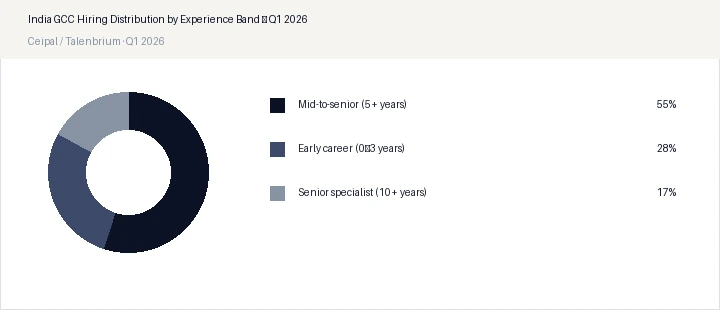
India's Global Capability Centre ecosystem is entering its most consequential phase of transformation. After years of aggressive hiring and high attrition, GCCs are recalibrating toward leaner, higher-impact teams — and the talent strategy has shifted accordingly. GenAI and LLM hiring demand in India surged 300% year over year in 2025–26 (Savanna HR GCC Q1 2026 Report), and 10+ major global enterprises announced or expanded GCCs in the last two quarters. The hardest talent gap now sits in the 8–15 year experience cohort across AI, cloud, and platform engineering roles — a supply constraint that will not resolve quickly.
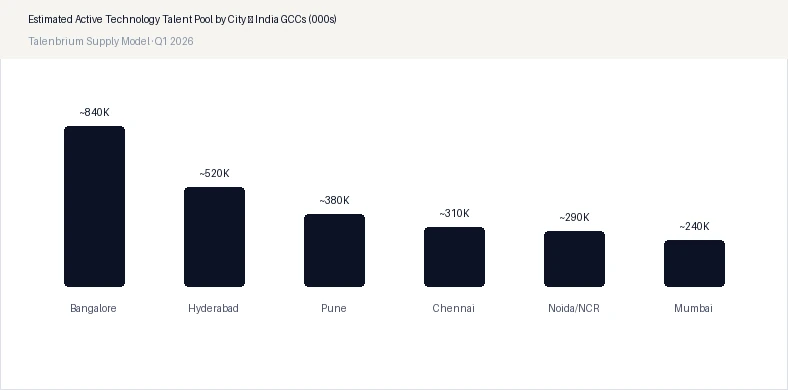
This Talenbrium report provides a city-by-city comparison of the four primary GCC technology hubs — Bangalore, Hyderabad, Pune, and Chennai — across talent pool depth, compensation benchmarks, attrition patterns, and competitive employer density.
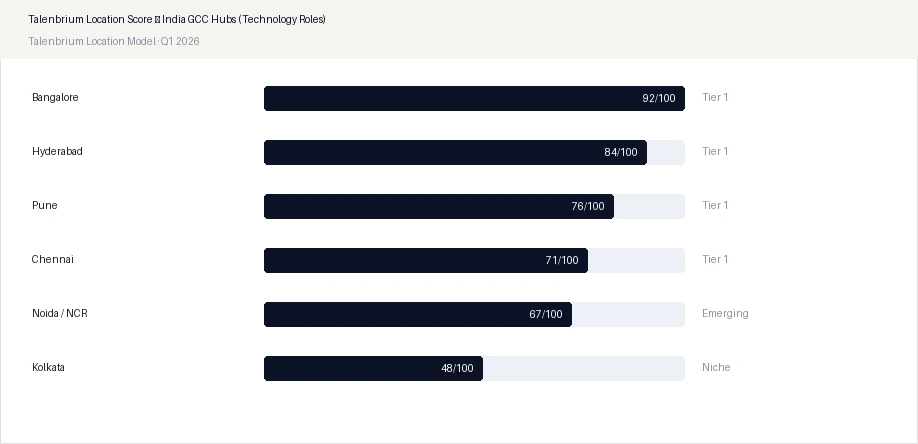
GCC compensation strategy in 2026 is becoming increasingly performance- and skills-driven. While overall salary increase budgets remain measured at 8–10% across the ecosystem, organisations continue to invest significantly in high-performing talent and niche skills across AI/ML, Cybersecurity, Data Science, Cloud, and Digital Engineering. Tier 2 city ranges typically sit 15–25% below metro benchmarks — but that gap is narrowing as demand outpaces supply in primary metros.
The structural weak point, consistently identified across multiple independent surveys, is the mid-level talent gap in the 8–15 year experience band — where deep technical skill must combine with delivery ownership and cross-functional leadership capability.

Customise the study to your target geography, role, skill cluster, or benchmark set, or request a sample before you proceed.