
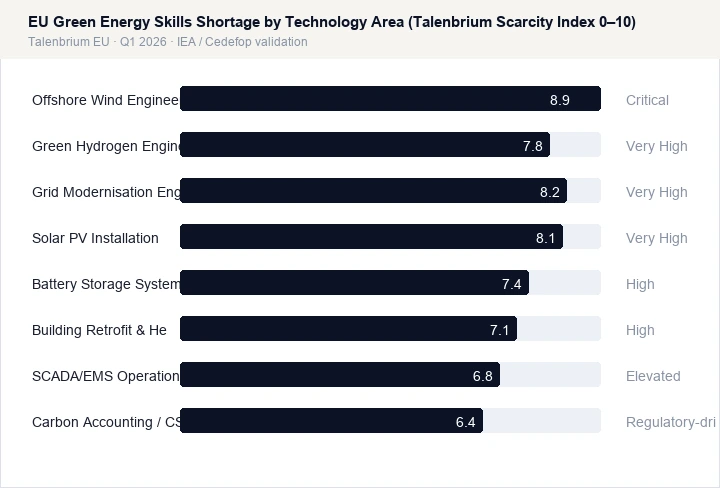
The EU clean energy workforce is the fastest-growing sector in Talenbrium's European job postings tracking. Clean energy job postings in Talenbrium's EU dataset grew 38% year-on-year between 2024 and 2025. Employment in EU renewable energy production doubled from approximately 600,000 in 2021 to 1.2 million in 2022, according to the European Environment Agency's Europe's Environment 2025 report. Talenbrium's Hiring Difficulty Score for offshore wind engineers stands at 8.9 out of 10 — the highest of any occupational cluster in Talenbrium's EU tracking.
The structural mismatch is quantified: green skills job postings grew 22% in 2025, but green-skilled worker supply grew only 12% — a 10 percentage point structural gap validated against LinkedIn's European Economic Graph, which Talenbrium uses as an external reference. 1 million solar workers are needed in the EU by 2030 (SolarPower Europe).
Talenbrium's EU clean energy compensation model identifies a structural salary gap between renewable energy roles and equivalent positions in oil, gas, and nuclear. The IEA World Energy Employment 2025 report, used by Talenbrium as a validation reference, shows renewables wage growth at 0.8% in 2025 against oil and gas at 3.7%. German entry-level solar installers earn EUR 32,000–38,000. Offshore wind engineers with five or more years of experience command EUR 65,000–90,000. These figures sit 15–25% below comparable fossil fuel sector roles in Talenbrium's benchmarking — a gap directly impacting talent attraction in Talenbrium's employer survey data.

Customise the study to your target geography, role, skill cluster, or benchmark set, or request a sample before you proceed.