
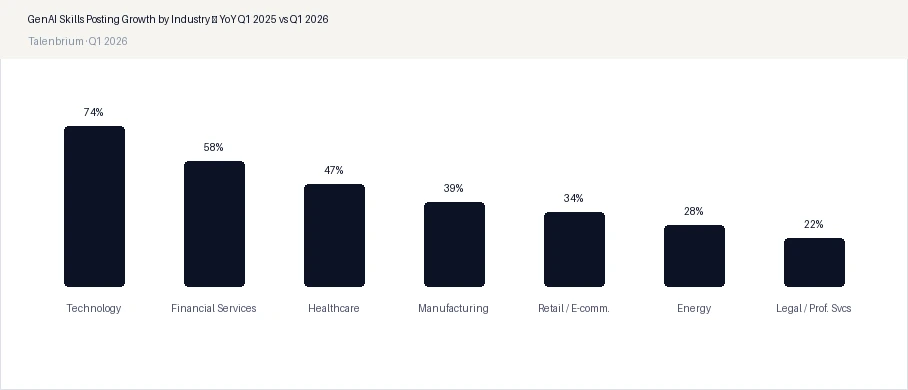
ManpowerGroup's 2026 Talent Shortage Survey — drawing on 39,000 employers across 41 countries — found that for the first time in the survey's history, AI skills have surpassed all others to become the most difficult capabilities to source globally. This is not a technology sector story. AI fluency requirements appear in 2.5% of all US job postings, a 297% increase over the past decade (Stanford HAI 2026 AI Index), and the growth is accelerating across financial services, healthcare, manufacturing, and logistics.
This Talenbrium report delivers a granular breakdown of which specific generative AI capabilities are scarcest, how scarcity varies by sub-skill and geography, where adjacency opportunities exist for reskilling, and what compensation premiums the market is applying to each capability cluster.
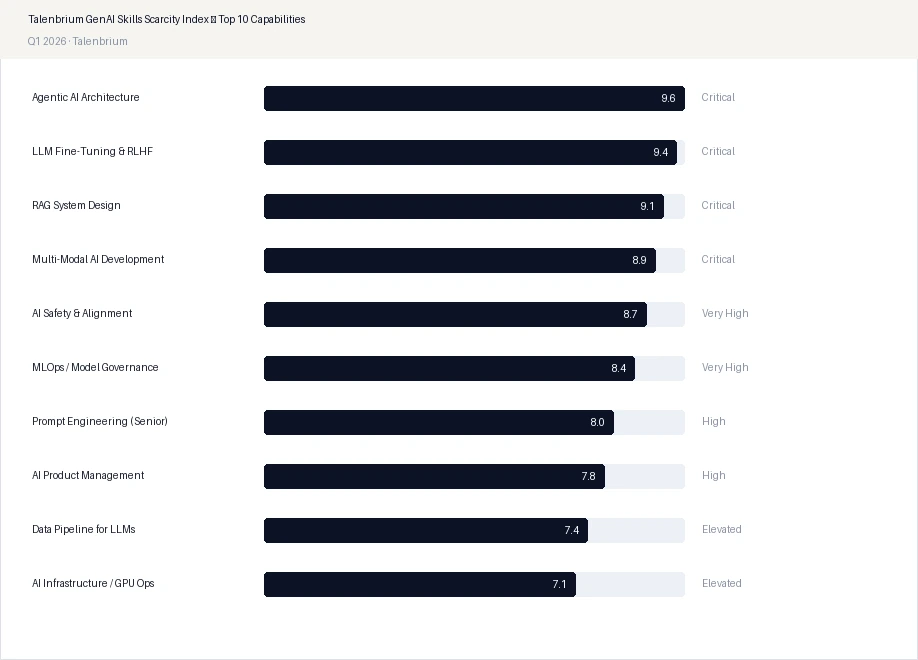
The WEF Future of Jobs Report 2025 projects that 39% of workers' core skills will be transformed or become outdated by 2030. For generative AI specifically, the transformation is happening in a two-to-three year window. The capabilities that were considered advanced twelve months ago — basic prompt engineering, fine-tuning standard models — are now baseline requirements in competitive postings. The market has moved to agentic architecture, multi-modal systems, and production-grade deployment at scale. Training pipelines — academic, corporate, or self-directed — cannot keep pace with this velocity.
Critically, the scarcity is compounded by the fact that the highest-value GenAI practitioners are not on the market: they are employed, well-compensated, and not actively seeking. The effective supply for an open hiring search is a small fraction of the total professional population with these capabilities.

Customise the study to your target geography, role, skill cluster, or benchmark set, or request a sample before you proceed.