Research CatalogueWorkforce PlanningFastest-Growing and Declining Roles 2026–2030: Workforce Planning Intelligence
Research Report2026-07-0878 pages

Fastest-Growing and Declining Roles 2026–2030: Workforce Planning Intelligence

Talenbrium Research  |  2026-07-08  |  By Diptanjan Biswas  |  Talenbrium Proprietary Intelligence
78 million net new jobs by 2030 — but the distribution will be highly uneven

The World Economic Forum's Future of Jobs Report 2025 — drawing on over 1,000 of the largest employers globally, representing 22 industry clusters and more than 14 million workers — projects that 170 million new jobs will be created by 2030 while 92 million are displaced. The net figure of 78 million obscures enormous sectoral and geographic variation that workforce planners cannot afford to miss. This Talenbrium report translates those macro projections into actionable intelligence for HR strategy — mapping which specific roles are growing, which are declining, and what the supply-demand dynamics look like today for the roles that matter most.

The fastest-growing roles reflect the convergence of three macro forces: AI and technology adoption, the green transition, and demographic-driven care economy expansion. The fastest-declining roles are concentrated in routine cognitive and administrative functions, where automation is most immediately viable. Planning assumptions built on today's role architecture will be structurally outdated by 2028.
170M
New jobs projected globally by 2030 (WEF FoJ 2025)
WEF Future of Jobs Report 2025
92M
Roles projected to be displaced by 2030
WEF Future of Jobs Report 2025
39%
Share of workers' skills expected to change by 2030
WEF Future of Jobs Report 2025
86%
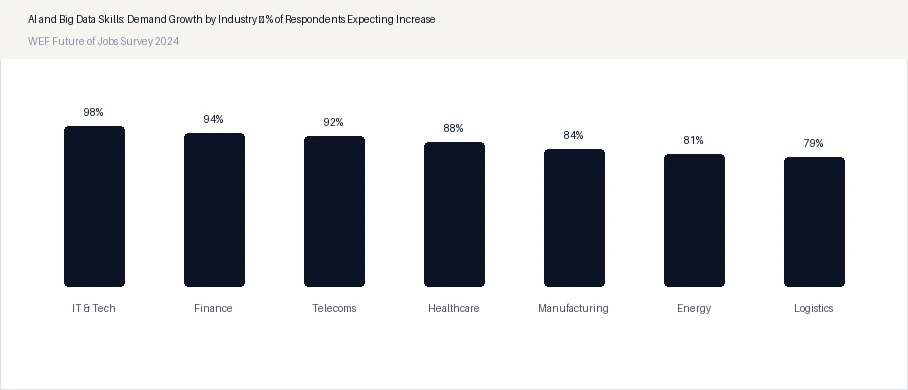
Employers expecting AI/big data to drive transformation
WEF Future of Jobs Survey 2024
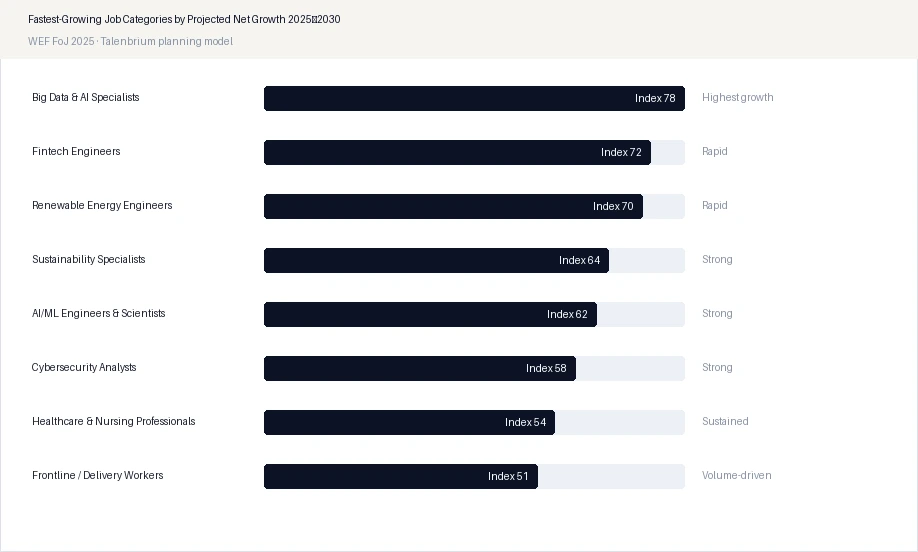
Fastest-Growing Job Categories by Projected Net Growth 2025–2030
Talenbrium What We Do Strategic Workforce Planning Talent Supply & Demand Analytics Skills Architecture & Intelligence Compensation Benchmarking Location Strategy Diversity & Inclusion Intelligence Industries Technology & Digital Banking & Financial Services Healthcare & Life Sciences Energy, Oil & Gas Manufacturing & Engineering Construction & Infrastructure By Function CHRO & HR Leadership Talent Acquisition Compensation & Benefits Learning & Development Workforce Analytics Methodology Perspectives All Perspec...
Full data available to purchasers
Declining roles: the automation frontier is advancing faster than anticipated

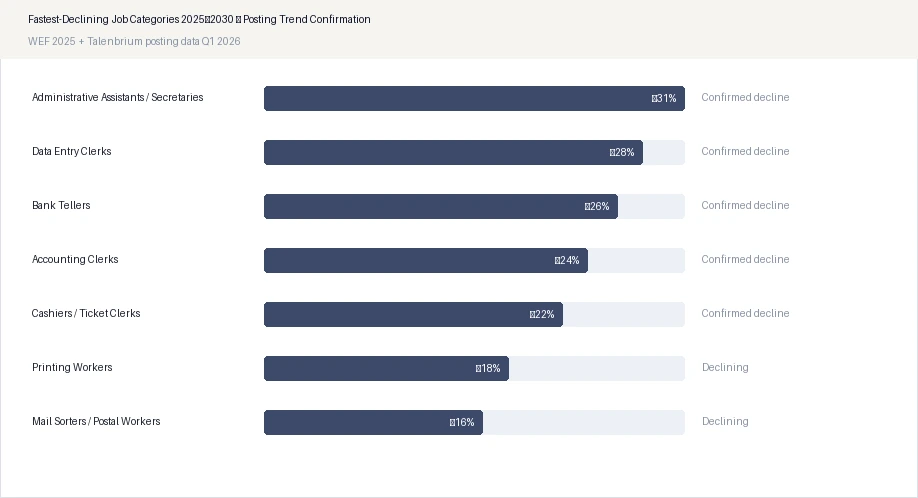
The WEF analysis finds that clerical and administrative roles face the steepest decline in absolute terms. Bank tellers, cashiers, administrative assistants, data entry clerks, accounting clerks, and postal workers are all on significant negative trajectories. Critically, this is not a prediction — it is already visible in posting data. Talenbrium's analysis of 2.4M+ weekly job postings shows a 31% decline in administrative assistant postings and a 28% decline in data entry roles over the 24-month period to Q1 2026. The automation of these functions is accelerating, not slowing.
"On average, workers can expect two-fifths of their existing skill sets to be transformed or become outdated over the 2025–2030 period." — World Economic Forum, Future of Jobs Report 2025
Fastest-Declining Job Categories 2025–2030 — Posting Trend ConfirmationAI and Big Data Skills: Demand Growth by Industry — % of Respondents Expecting Increase
The full report includes: role-level workforce planning implications for 40 specific job titles across the growth and decline spectra; skills transition mapping — what capabilities declining-role populations already hold and which are transferable to growth roles; supply-demand forecast by role cluster for 2026, 2028, and 2030; sector-by-sector impact assessment for HR planning purposes; reskilling investment priorities based on adjacency analysis; compensation evolution forecasts for the 15 fastest-growing roles; and a structured workforce scenario planning toolkit for HR leadership teams.
Full data available to purchasers
Table of Contents
01Executive Summary and Key FindingsPreview
02Macro Context: WEF Future of Jobs 2025 — What It Means for HR PlannersPreview
03Fastest-Growing Roles: 20 Categories with Planning IntelligenceGated
04Fastest-Declining Roles: 15 Categories with Posting ConfirmationGated
05Skills Transition Analysis: Reskilling from Declining to Growing RolesGated
06AI and Automation Impact by Industry SectorGated
07Green Transition Workforce ImplicationsGated
08Care Economy Growth: Healthcare and Social RolesGated
09Supply-Demand Forecasts by Role: 2026, 2028, 2030Gated
10Compensation Evolution: What Fast-Growing Roles Will PayGated
11Workforce Scenario Planning ToolkitGated
12Strategic RecommendationsPreview
13MethodologyPreview
Report scope
Geography
Global · US, Europe, and APAC sub-analysis
Roles covered
40 specific job titles across growth and decline spectra
Data period
Q1 2026 current state · 2030 forward projection
Primary source
WEF Future of Jobs Report 2025 · 1,000+ employers, 22 industries
Talenbrium data
Posting velocity confirmation · supply-demand modelling
Industries
22 industry clusters · all major sectors
Survey validation
Workforce Pulse Survey Q1 2026 · n=284
Pages
~78 pages + planning toolkit
Assigned Author
Diptanjan Biswas

Diptanjan Biswas

Principal Head, Strategic Consulting

Diptanjan Biswas leads strategic consulting at Talenbrium, bringing nine years of experience across research, risk, and workforce intelligence in banking, technology, and advisory sectors.

Workforce Strategy Labour Market Intelligence Credit Risk Recoveries Strategy
View Full Author Profile Linked to Talenbrium's public author library

Ready to access the full intelligence?

Purchase directly, or speak with our team to discuss your requirements first.

Purchase
Buy this report — USD 1,999
Enquire
Speak with our research team
Custom
Commission a bespoke engagement
Home Reports Insights Contact