
Data science is a mature profession with an immature hiring process. Talenbrium's Q1 2026 Workforce Pulse Survey found that 44% of HR respondents reporting open data science requisitions had revised the role requirements at least once after initial posting — because the original specification produced either zero qualified applicants or a flood of mismatched applications. The structural demand signal is strong regardless of hiring execution quality. BLS classifies data scientists within computer and information research scientists, projecting 23% growth through 2033.
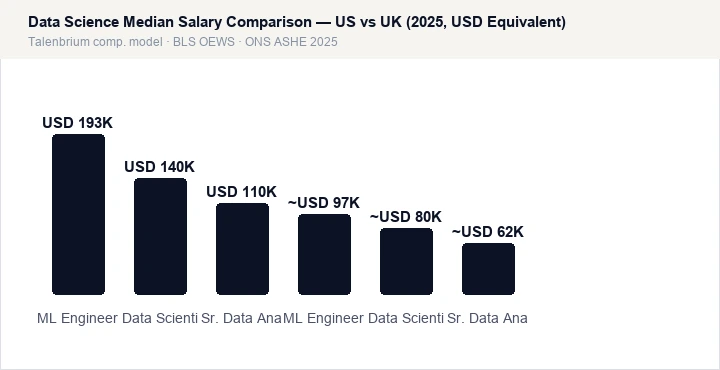
New York overtook California as the leading US location for data scientist and analyst postings in Talenbrium's 2025 tracker — driven by financial services analytics investment, media and advertising technology demand, and healthcare analytics expansion. In the UK, Talenbrium's model places the data scientist median at GBP 65,000. The US-UK compensation differential runs consistently at 55–65%, and 29% of UK data science professionals actively sought US employer remote roles in 2025 — a talent drain dynamic confirmed by declining tenure signals in UK postings.
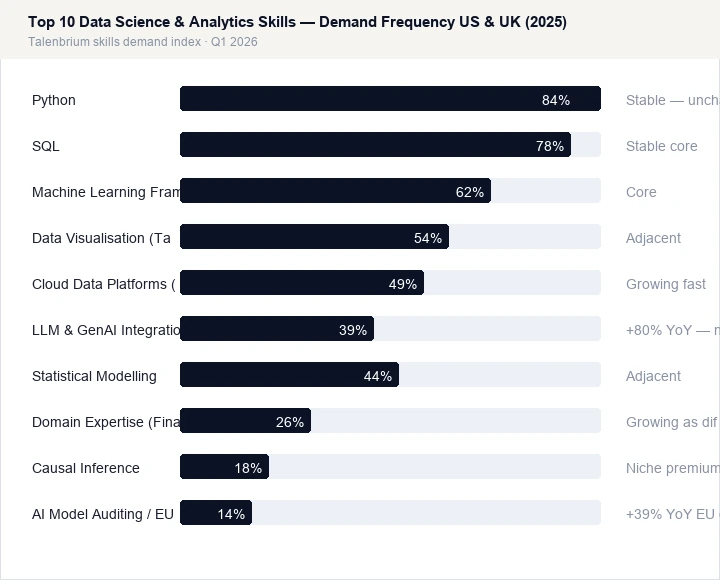
Snowflake, Databricks, and BigQuery collectively crossed a critical enterprise adoption threshold in 2024. Organisations with mature cloud data platform deployments post 2.7 times more data science requisitions per 1,000 employees than those on legacy infrastructure. The EU AI Act, entering enforcement in August 2026, requires documented model performance evidence, bias testing, and risk assessment for AI systems in high-risk decisions. Talenbrium's EU postings tracker identified a 39% year-on-year increase in 'AI model auditing,' 'algorithmic impact assessment,' and 'model documentation' skill specifications in data science postings across EU member states in 2025.

Customise the study to your target geography, role, skill cluster, or benchmark set, or request a sample before you proceed.