
Research CatalogueDemand & SupplyCybersecurity Workforce Supply Gap: Where the Unfilled Roles Will Come From
Research Report2026-07-0882 pages

Cybersecurity Workforce Supply Gap: Where the Unfilled Roles Will Come From

Talenbrium Research  |  2026-07-08  |  By Diptanjan Biswas  |  Talenbrium Proprietary Intelligence
4.8 million professional gap — and it is not closing

The cybersecurity workforce shortage has been declared a crisis for half a decade. What is different in 2026 is the nature of the gap. ISC2 and ISACA both document a shift: skills gaps have decisively overtaken raw headcount as the industry's top workforce challenge for the first time in their respective surveys' histories. The 2026 SANS Institute study — drawing on nearly 1,000 practitioners and HR professionals across six global regions — found that 95% of organisations report regulatory directives are affecting their hiring practices, up from 40% in 2025. That 55-point increase is the fastest acceleration of any metric in the report's three-year history.

This Talenbrium report maps the supply side of that equation: where qualified professionals exist, at what density, with what certification and skills profile, and how the market is shifting across US metro areas and European hubs.
4.8M
Global cybersecurity workforce gap (ISC2 2025)
ISC2 / Talenbrium validation
514K
US open cybersecurity positions (CyberSeek 2026)
CyberSeek · Talenbrium cross-ref
29%
BLS projected growth for infosec analysts 2024–2034
US Bureau of Labor Statistics
$124,910
US median annual salary, infosec analyst 2024
Bureau of Labor Statistics
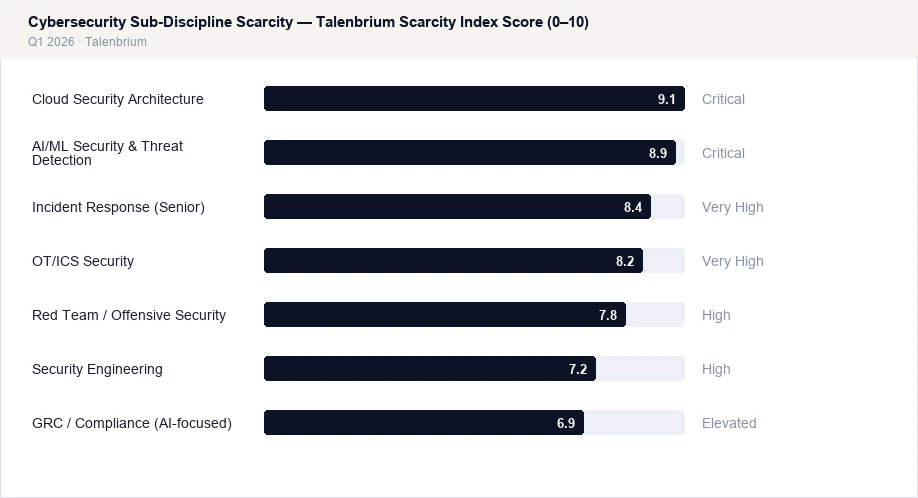
Cybersecurity Sub-Discipline Scarcity — Talenbrium Scarcity Index Score (0–10)
Talenbrium What We Do Strategic Workforce Planning Talent Supply & Demand Analytics Skills Architecture & Intelligence Compensation Benchmarking Location Strategy Diversity & Inclusion Intelligence Industries Technology & Digital Banking & Financial Services Healthcare & Life Sciences Energy, Oil & Gas Manufacturing & Engineering Construction & Infrastructure By Function CHRO & HR Leadership Talent Acquisition Compensation & Benefits Learning & Development Workforce Analytics Methodology Perspectives All Perspec...
Full data available to purchasers
The AI skills layer is reshaping every cybersecurity role

ISC2 identifies AI/ML as the number one skill need in cybersecurity for 2026, with 41% of security teams citing it as their top requirement. This is not a separate market segment — it is a new layer of capability being demanded on top of existing security expertise. The practical effect is that the supply of candidates who meet 2026 job requirements is smaller than the supply of cybersecurity professionals, because the credential-holding population has not yet broadly acquired the AI capability layer that employers now expect.

"Skills gaps have overtaken headcount shortages as the cybersecurity industry's top workforce challenge — for the first time in three years of tracking." — SANS Institute Cybersecurity Workforce Report 2026
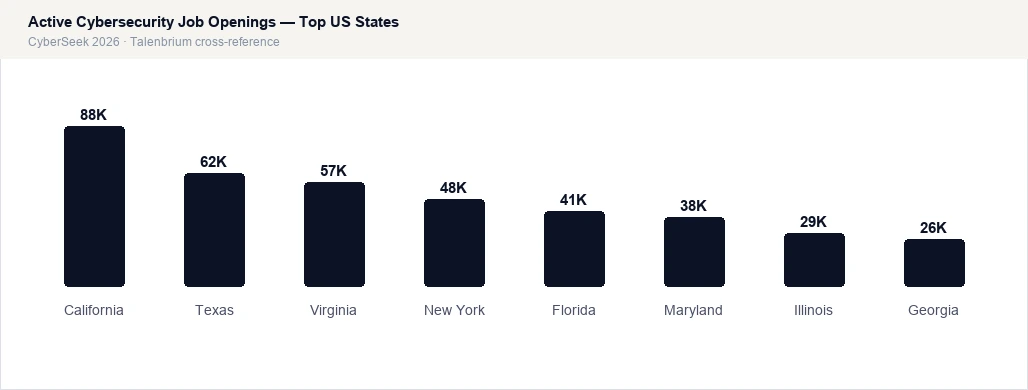
Active Cybersecurity Job Openings — Top US States
The full report delivers: supply-demand ratio by US state and 12 European markets, employer-level hiring velocity for the top 50 tracked security employers, certification demand analysis (CISSP, CEH, CompTIA, CISM) mapped against posting requirements, compensation band tables P25–P90 for 9 cybersecurity role clusters, gender representation analysis and pipeline diversity benchmarks, time-to-fill benchmarks by role and seniority level, and build vs. buy analysis for each role cluster incorporating reskilling pathway feasibility.
Full data available to purchasers
Table of Contents
01Executive Summary and Scarcity Heat MapPreview
02Market Context: AI, Regulation and Role Evolution 2025–2026Preview
03Role Taxonomy: 9 Cybersecurity Sub-Disciplines DefinedPreview
04US Supply Analysis: State and Metro LevelGated
05European Supply: UK, Germany, Netherlands, France, PolandGated
06Demand Trend: Posting Velocity and Employer ActivityGated
07Skills Shift: AI/ML Requirements Entering Security RolesGated
08Compensation Intelligence: P25–P90 by Role and MarketGated
09Certification Demand Analysis: What Employers Are RequiringGated
10Diversity and Pipeline IntelligenceGated
11Build vs. Buy vs. Train: Cost ComparisonGated
12Strategic RecommendationsPreview
13MethodologyPreview
Report scope
Geography
United States (state and metro) + UK, Germany, Netherlands, France, Poland
Role clusters
9 cybersecurity sub-disciplines from cloud security to GRC
Data period
Q1 2026 · trend data Q1 2024 – Q1 2026
Primary data
Talenbrium 2.4M+ weekly postings · 12,400+ employer tracking
External validation
CyberSeek 2026 · ISC2 2025 · BLS 2024 (benchmarks only)
Survey data
Workforce Pulse Survey Q1 2026 · n=284
Compensation model
Proprietary · P25–P90 by role, seniority, geography
Pages
~82 pages + data tables
Assigned Author
Diptanjan Biswas

Diptanjan Biswas

Principal Head, Strategic Consulting

Diptanjan Biswas leads strategic consulting at Talenbrium, bringing nine years of experience across research, risk, and workforce intelligence in banking, technology, and advisory sectors.

Workforce Strategy Labour Market Intelligence Credit Risk Recoveries Strategy
View Full Author Profile Linked to Talenbrium's public author library

Ready to access the full intelligence?

Purchase directly, or speak with our team to discuss your requirements first.

Purchase
Buy this report — USD 1,999
Enquire
Speak with our research team
Custom
Commission a bespoke engagement
Home Reports Insights Contact