
Talenbrium's Hiring Difficulty Score assigns cybersecurity its highest rating — 9.2 out of 10 — across all occupational clusters tracked in Talenbrium's US dataset. CyberSeek tracked 457,398 US cybersecurity job openings in the 12-month period to Q4 2025 — a 12% increase from the prior year. Talenbrium's own postings tracker identifies a matching 11.8% increase over the same period, providing a consistent independent validation. The BLS projects 33% growth in information security analyst employment through 2033 — roughly eight times the all-occupations average.
The ISC2 Cybersecurity Workforce Study 2025 (n=16,029 practitioners) found that skills shortages led to at least one significant cybersecurity incident in 88% of organisations. Talenbrium's Q1 2026 survey found that 79% of respondents with cybersecurity functions rated skills gap impact at 4 or 5 out of 5. The direction is consistent: the gap is not abstract. It is producing real incidents and real cost.
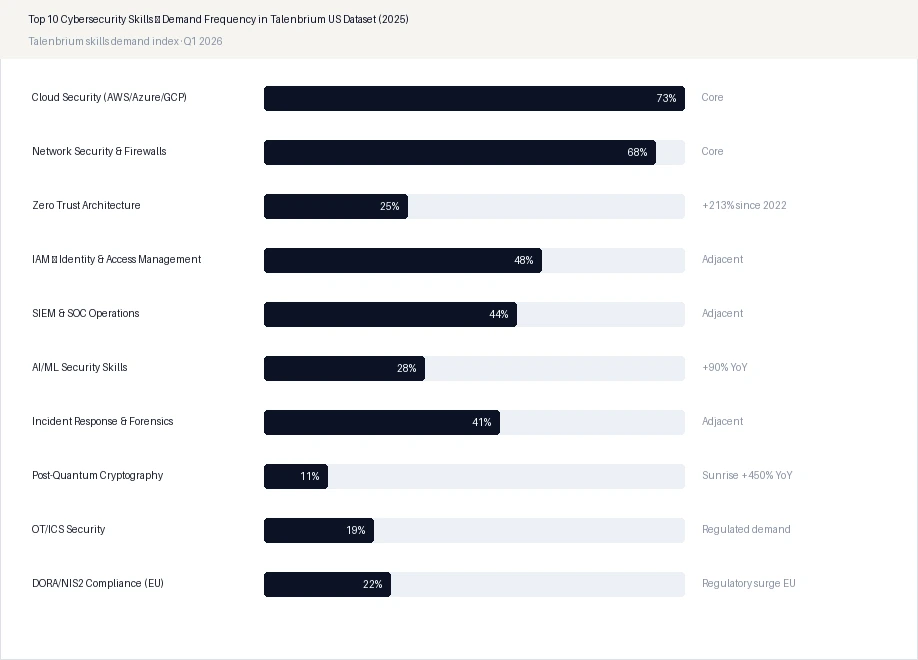
The EU's expanded Network and Information Security Directive entered enforcement in October 2024 across 18 critical infrastructure sectors. Talenbrium's EU postings tracker shows a 47% year-on-year increase in OT Security Engineer, Incident Response Coordinator, and Supply Chain Security Analyst postings across EU Member States in the 12 months following NIS2 enforcement. This hiring surge has no corresponding talent supply increase — organisations with no established cybersecurity recruiting capability, no talent pipeline, and compensation benchmarks set by legacy industrial pay scales that are systematically below what cybersecurity candidates expect.

Customise the study to your target geography, role, skill cluster, or benchmark set, or request a sample before you proceed.