
Skills shortage is the defining structural constraint on workforce capacity in every market Talenbrium tracks. Talenbrium's Q1 2026 Workforce Pulse Survey found that 71% of US HR respondents and 68% of European respondents reported active open requisitions for which no qualified candidates had been identified after 30 or more days of active sourcing. That is not a recruitment efficiency problem. It is a supply problem. Talenbrium's proprietary Hiring Difficulty Score identifies cybersecurity, AI and machine learning engineering, cloud infrastructure engineering, and clinical nursing as the four role families with the highest shortage severity across both the US and EU simultaneously.
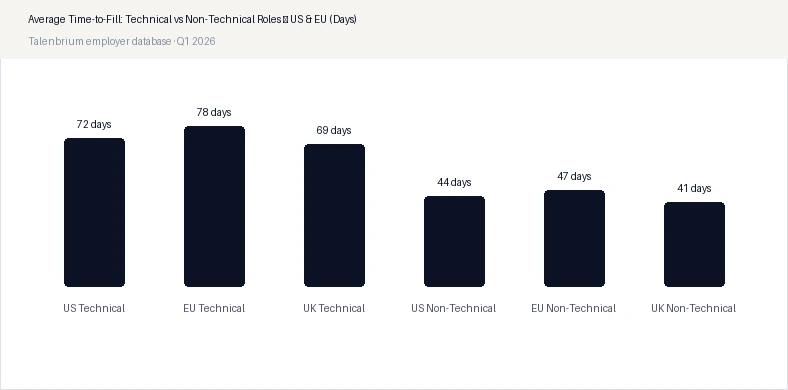
Talenbrium's analysis of 2.4 million+ job postings identified that STEM and technology role postings across the US grew at 3.1 times the rate of non-STEM postings between Q1 2024 and Q4 2025. The cost consequence is measurable: technical roles take an average of 72 days to fill in the US and 78 days in the EU — compared to 44 days for non-technical roles.
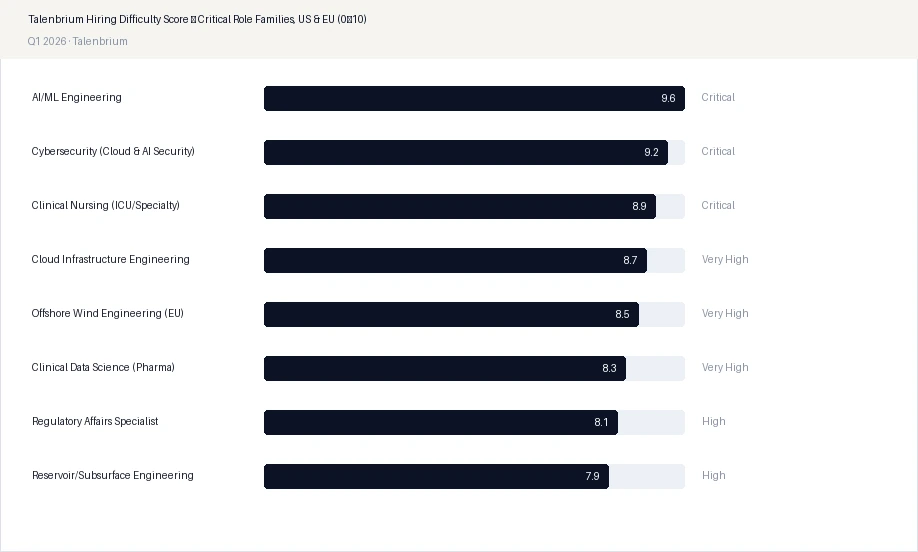
Talenbrium's European postings analysis — validated against Cedefop's 2025 Skills Forecast and the European Commission's Education and Training Monitor 2025 — confirms ICT professionals and electrical and civil engineers as the most persistently shortage-affected occupational groups across 19 of 27 EU member states simultaneously. The EU's ratio of STEM tertiary graduates per 1,000 young people stood at 14.3 in 2023, above the US at 13.1 but below the UK at 17.9 — a graduate pipeline gap that Talenbrium projects will not close meaningfully before 2030.

Customise the study to your target geography, role, skill cluster, or benchmark set, or request a sample before you proceed.