
Medical devices reached 48 percent of Costa Rican goods exports in 2025, up from 43 percent a year earlier. No other export category comes close. Agricultural products sit at 17 percent and food at 12 percent. Pineapple, the second single product, is 6 percent. A country of five million people has built the most concentrated medical device export economy in the world, and it is now the tenth largest exporter of medical devices globally and the largest on a per capita basis.
The workforce behind that sits at 58,884 specialised medical device jobs as at the end of 2024, of which roughly 58,000 are in foreign owned operations and about 5,700 in domestic ones. The state foreign trade promotion agency projects the sector will add around 5,000 direct roles each year. It also states plainly that the shortage of specialised talent is one of the industry's main constraints, and that the education pipeline is not producing people at the rate the expansion requires.
| 48% Medical devices as a share of Costa Rican goods exports, 2025 PROCOMER | 58,884 Specialised medical device jobs, 31 December 2024 PROCOMER | 41.8% Share of those jobs inside a single free zone in Alajuela PROCOMER | -38,000 Change in national manufacturing employment, year to Q1 2026 INEC |
The last figure is national manufacturing, not the device sector. The two move in opposite directions, and that divergence is the subject of this report.
Two official series point in opposite directions, and any workforce plan built on one without the other will be wrong.
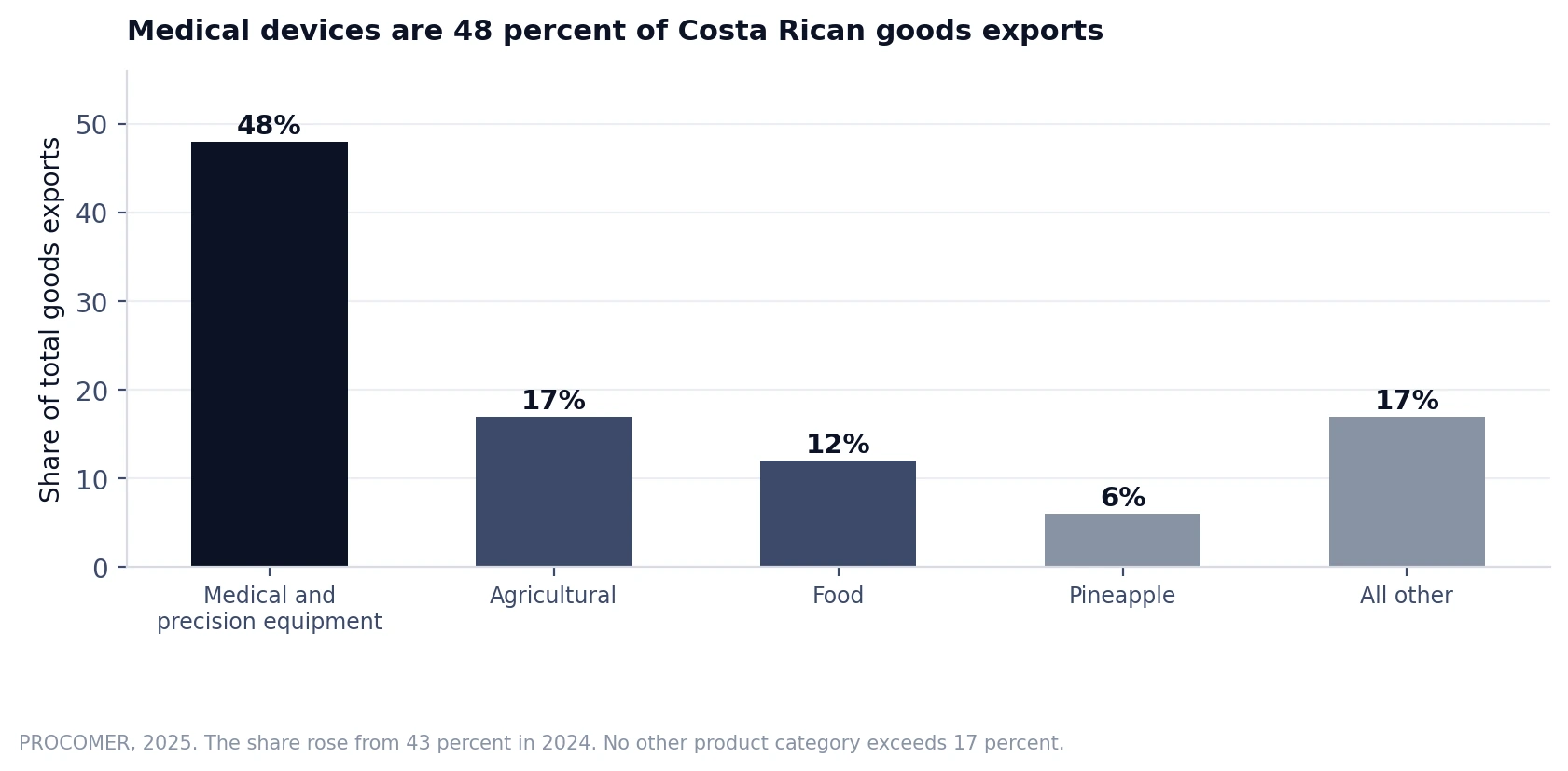
Source: PROCOMER, 2025
The export series shows acceleration. Goods exports reached 13.1 billion dollars by the end of July 2025, 17 percent above the same point a year earlier, led by the precision and medical equipment sector. The central bank recorded in August 2025 that free zone activity was expanding rapidly, that the sharp rise in device exports traced to a specific production line approval by the United States Food and Drug Administration, and that sales from the three largest device manufacturers were structural rather than temporary.
The employment series shows contraction. The national statistical office recorded a statistically significant fall of 38,000 people employed in manufacturing in the year to the first quarter of 2026. Financial intermediation and insurance lost a further 25,000. Employment in medium skilled occupations, the band that includes qualified manufacturing and assembly work, fell by 81,000 over a comparable period.
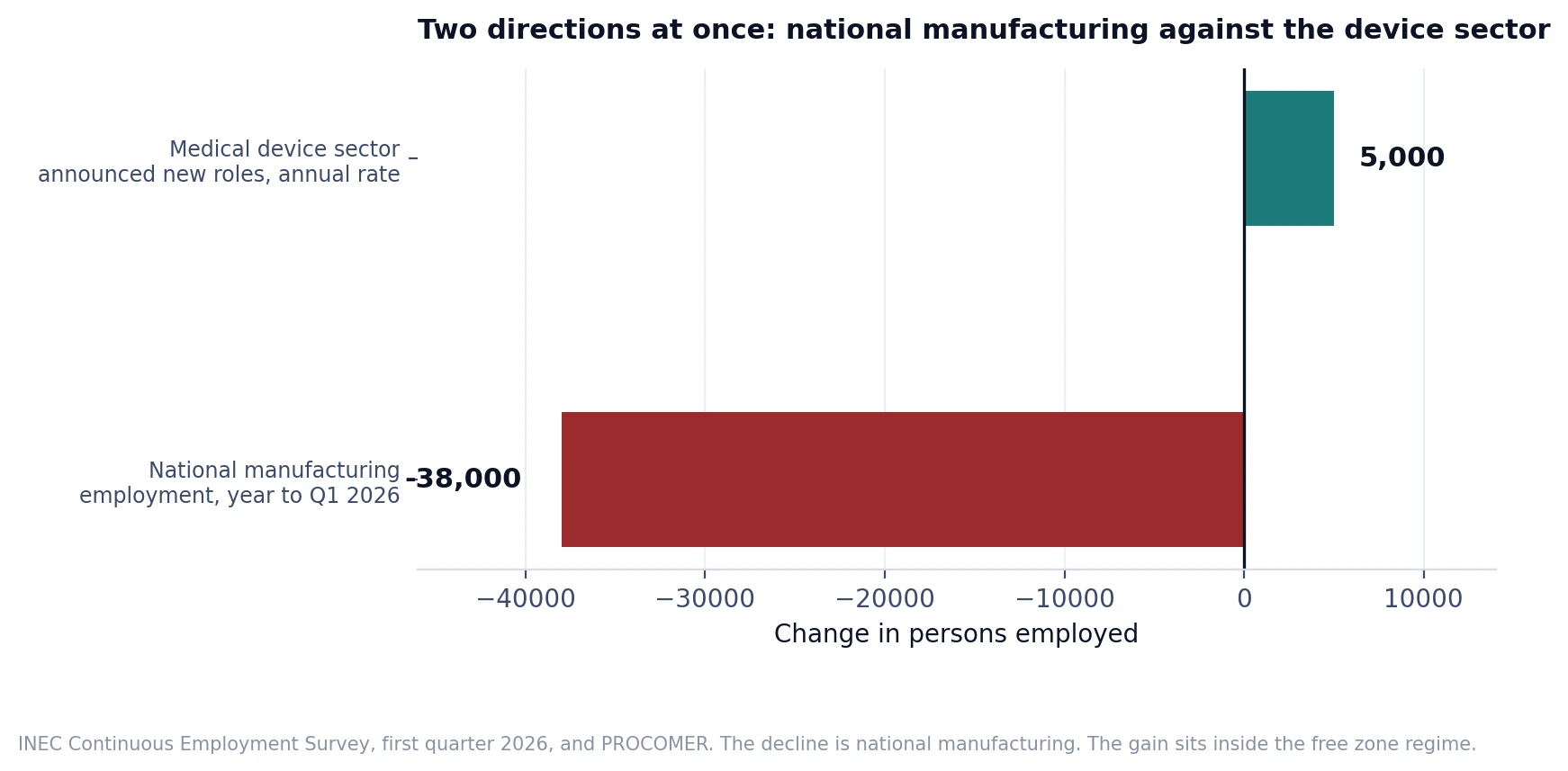
Source: INEC Continuous Employment Survey, first quarter 2026, and PROCOMER
The device sector sits almost entirely inside the free zone regime, which operates under a separate incentive structure and reports separately. That regime contributed 13.9 billion dollars to the economy in 2024, about 15 percent of gross domestic product, and supports more than 265,000 jobs. Manufacturing outside the regime is contracting while manufacturing inside it expands. The national aggregate hides the split.
For an employer, the practical consequence is that headline labour market softness does not mean device talent is easier to hire. It means the opposite. General manufacturing workers being released are not substitutes for cleanroom, validation and regulatory roles, and the pool for those roles is tightening while the national numbers loosen.
| Headline labour market softness does not mean device talent got easier to hire. The people being released are not the people the sector needs. Talenbrium Workforce Intelligence, Q3 2026 |
This report profiles emerging and future-driven roles only. Established assembly and bench roles with deep existing supply are excluded, because they do not constrain a hiring plan. Each description names what has changed about the work rather than what the job is called, since several of these titles read as familiar while the day to day content has moved.
Manufacturing Automation Technician
Runs and maintains robotic cleanroom cells rather than operating a single station. The skill that is scarce is fault diagnosis on an integrated line, not manual dexterity.
Machine Vision and Inspection Technician
Operates automated optical and dimensional inspection systems. Replaces visual bench inspection, and the work is now system calibration and false reject analysis.
Manufacturing Systems and MES Engineer
Owns the execution system that carries electronic batch records and line telemetry. A role that barely existed in Costa Rican plants five years ago and is now a condition of scaling.
Computer System Validation Engineer
Validates the software that runs regulated production. Demand comes directly from digitalisation of records, since every new system has to be qualified before it can be used.
Sterilisation and Process Validation Engineer
Designs and defends sterilisation and process qualification. The constraint is that the role requires both statistics and regulatory judgement, and the local pipeline produces one without the other.
Regulatory Affairs Specialist, digital submissions
Prepares submissions under the United States electronic template and the European Union medical device regulation. The role has moved from document assembly to structured data management.
Design Transfer Engineer
Takes a product from development into validated volume production. This is the role that decides whether the country's move from assembly toward development work succeeds, and it is the hardest of the nine to fill locally.
Software as a Medical Device Engineer
Builds regulated software that is itself the device, to the international software lifecycle standard rather than to general software practice.
Post-Market Surveillance and Complaint Analytics Specialist
Analyses field performance and complaint data to meet post-market obligations. The work has shifted from case handling to signal detection across large data sets.
The national statistical office classifies employment by broad skill band and by economic branch, not by occupation at this granularity. All nine roles fold into qualified manufacturing or into professional and scientific occupations. Official statistics therefore understate demand for every role in this list, and no government wage figure exists for any of them. That absence is a finding rather than a gap to paper over, and it is why the salary section is built on Talenbrium's compensation model rather than a borrowed citation.
A workforce plan that counts only rising roles overstates net hiring need. Four role types are contracting across the Costa Rican device sector, and in three of the four cases the people in them are the nearest internal supply for the roles above.
Manual visual inspection is being displaced by automated optical inspection, and the inspectors who understand defect modes convert well into vision system technicians. Manual assembly at single stations is being consolidated into automated cells, which reduces headcount per unit while raising the skill floor for those who remain. Paper batch record handling is disappearing as electronic records become the norm, and those roles convert into manufacturing systems work with modest training. Manual calibration and equipment servicing on legacy machines is the fourth, and it converts least well, because the replacement equipment requires a different diagnostic skill set rather than more of the same.
The report prices each conversion against the cost of an external hire for the receiving role in the same city.
Device employment in Costa Rica is unusually concentrated. A single free zone park in Alajuela with 34 companies holds 24,588 of the 58,884 specialised device jobs in the country, which is 41.8 percent of national sector employment inside one industrial estate.
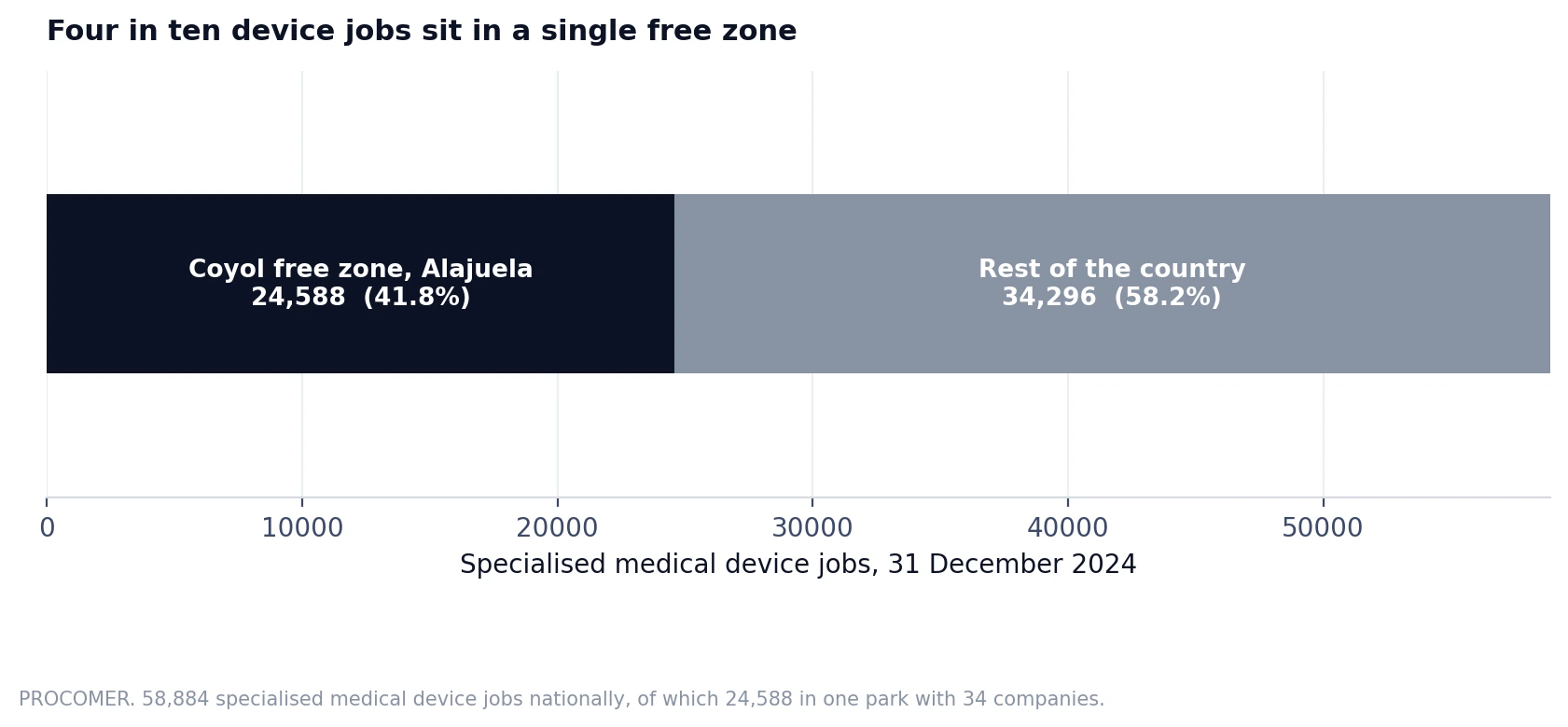
Source: PROCOMER, employment as at 31 December 2024
That concentration cuts both ways for an employer. It means a deep and genuinely specialised pool within commuting distance of one location, with suppliers, sterilisation services and trained people already present. It also means that every competitor for those people is within a few kilometres, that pay moves quickly when one large employer adjusts, and that a new entrant is bidding into the tightest labour market in the country rather than an open one.
The free zone regime has expanded outside the greater metropolitan area by 13 percent over five years, and park operators have grown from 27 in 2010 to 68 in 2023. That is the release valve, and the report assesses which secondary locations have enough depth to support a first operation rather than only an overflow site.
No official body publishes device employment or pay at city level. The location model is Talenbrium's own, built from employer presence, free zone park data and posting concentration. The table below is the format example. The full report carries the same structure for all five locations with depth ratings by role family, observed time to fill and a competitive intensity score.
| Location | Talent depth | Demand | Competitive intensity | Profile |
|---|---|---|---|---|
| Alajuela | Deep | High | Very high | The national anchor. Highest depth and the tightest competition in the country. |
| Heredia | Deep | High | High | Strong on quality, regulatory and shared service functions alongside production. |
| Cartago | Moderate | High | Moderate | Expanding production base, less saturated, growing supplier presence. |
| San Jose | Moderate | Moderate | High | Professional and engineering layer rather than volume production. |
| Grecia | Emerging | Rising | Low | Newest location. Thin today, and the release valve for Alajuela wage pressure. |
Format example. The full report adds role family depth, time to fill and pay index for each location.
Source: Talenbrium analysis
No government body publishes pay at role level for any of the nine designations. The national statistical office reports by skill band and economic branch only. Every role level figure in this report therefore comes from Talenbrium's compensation model, and is labelled as such rather than presented as an official series.
One official anchor does exist and it is a useful one. The state trade promotion agency reports that workers inside the free zone regime earn on average 918 dollars a month more than comparable workers outside it. That premium is the single most important number for an employer entering the market, because it sets the floor. A device manufacturer is not competing against the national wage. It is competing against a regime that already pays a substantial premium, and against the specific employers inside the Alajuela park.
The full report benchmarks all nine designations across all five locations, with junior, mid and senior bands for each, a total of 135 cells, together with an index against the national manufacturing average and against the free zone premium. It also models the pay differential between Alajuela and the secondary locations, which is the practical lever for an employer trying to enter without paying the anchor market rate.
It does not present modelled pay as a government figure. Where a cell rests on the compensation model, the report says so on the page rather than in a footnote. Where an official anchor exists, such as the free zone premium or the national manufacturing average, it is named and attributed.
Pay alone does not settle a hiring plan. The report sets median pay against available supply depth and observed time to fill for each of the nine roles in each of the five locations.
The pattern worth knowing in advance is that the cheapest location is not the fastest to fill, and the deepest location is not the least competitive. Alajuela has the most people and the shortest theoretical search, but the highest probability that a candidate is already being counter-offered. Grecia is cheaper and calmer, and considerably slower for anything above technician level.
Design Transfer Engineer runs longest of the nine in every location. That role requires production experience and development experience in the same person, and the country has historically built the first without the second. It is the clearest single constraint on the sector's stated move up the value chain.
The report sets out a market specific approach covering the channels that actually produce candidates in Costa Rica, realistic offer positioning against the free zone premium, and the constraints that change the arithmetic of a hiring plan.
Three points shape strategy here more than anywhere else in the region. First, technical institute and university partnerships produce more usable candidates than open advertising, because the specialised roles have no meaningful open market and employers are effectively competing for the same graduating cohorts. Second, entering at the Alajuela anchor rate sets a floor that is difficult to move later, so the sequencing of a first hire matters more than its cost. Third, English proficiency is a genuine differentiator in the professional layer and a filter on the technician layer, and the report quantifies how much it narrows each pool.
The report also covers statutory employment cost, mandatory social security contribution, the thirteenth month payment and notice requirements, since these change total cost of employment materially against a headline salary comparison.
Employer competition is described by employer type rather than by name. Four types set this market. Large United States headquartered device manufacturers with multi-plant Costa Rican operations set the pay ceiling and hold the deepest internal pipelines. European device manufacturers, principally German, Irish, Swedish and Spanish, compete on scope and stability rather than pay. Contract manufacturers and component specialists hire the widest range of technician roles and turn over fastest. Component, packaging and sterilisation suppliers form a fourth layer that competes for the same technician pool without competing for the professional one.
The report sets out the hiring posture of each type by location and by seniority band, and identifies where a new entrant faces the least direct competition for a given role.
Hiring is not the only route into these roles and in Costa Rica it is frequently not the fastest. The report maps the shortest internal conversion path into each of the nine designations, with the source role, the gap that has to close, realistic duration and cost against an external hire in the same location.
Three conversions are short. Visual inspectors convert into machine vision technicians in under four months because they already know the defect modes. Line technicians convert into automation technicians with structured controls training. Quality technicians convert into validation roles faster than engineers convert into them, because the documentation discipline is the harder half to teach.
One conversion is long and is attempted often. Production engineers do not become design transfer engineers inside a hiring cycle, because the missing element is development experience rather than training hours. The report says so rather than presenting a route that does not work.
Three regulatory frameworks shape hiring in this market and none of them is Costa Rican.
United States Food and Drug Administration requirements govern most of what is produced here, since the overwhelming majority of output is destined for the United States. Quality system requirements, electronic submission structure and the premarket cybersecurity mandate for connected devices all translate directly into named roles on a Costa Rican site. The central bank record from August 2025 attributing a sharp export increase to a single production line approval shows how directly a regulatory decision converts into local production volume and therefore into hiring.
European Union medical device regulation applies to output destined for Europe and carries its own documentation, database and post-market surveillance obligations. It is the primary driver of the regulatory affairs and post-market surveillance roles in the designation list.
The domestic framework is the free zone regime itself. The industry was declared of public and national interest in February 2012. The regime provides the incentive structure that made the sector possible and governs the conditions under which an employer operates, including location requirements and the reporting obligations that produce most of the official data used in this report.
Three things are worth watching before the next edition. The first is concentration risk. Almost half of national goods exports now come from one industry, and the central bank has noted that a large share of recent export growth traces to a small number of employers and in one case to a single production line. A workforce plan built on the assumption of uninterrupted sector expansion is exposed to decisions taken in a small number of boardrooms outside the country.
The second is the education pipeline. The trade promotion agency has named skills gaps and the education system as a principal competitiveness challenge. If specialised output does not rise, the projected 5,000 roles a year will be filled by moving people between existing employers rather than by net new entrants, which raises pay and attrition simultaneously without increasing sector capacity.
The third is trade policy. Tariff movements affecting North American supply chains change the relative case for Costa Rica against Mexico and against United States domestic production. The companion location analysis covers that comparison directly.
The report turns the role level pattern into a Costa Rican hiring, placement and reskilling plan.
| ROLE LEVEL DEMAND MODEL Year over year demand and median pay for all nine emerging designations across all five locations. | SALARY BENCHMARKS 135 role, location and seniority cells, indexed against the national manufacturing average and the free zone premium. |
| TOP FIVE LOCATIONS Talent depth by role family, observed time to fill, competitive intensity and pay index for each location. | TALENT ACQUISITION STRATEGY Channel guidance, offer positioning, English proficiency filters and total employment cost by location. |
| TALENT BENCHMARKING Supply depth and time to fill by role and location, set against cost. | PEER HIRING ANALYSIS Employer type competition map by location and seniority band. |
| RESKILLING AND CONVERSION MODEL Shortest internal route into each role, with duration and cost against an external hire. | REGULATORY READINESS VIEW How United States and European requirements translate into named roles on a Costa Rican site. |
| EDITABLE DATA TABLES Every exhibit supplied as an Excel workbook. | CUSTOMISATION 10 hours of free customisation included with every purchase. |
| ROLES IN SCOPE 9 emerging and future-driven medical device designations across 3 layers. Established assembly and bench roles excluded by design. | GEOGRAPHY Costa Rica. Alajuela, Heredia, Cartago, San Jose and Grecia. |
| INDUSTRIES Medical device manufacturing, contract manufacturing, components and packaging, sterilisation services, and device software. | DATA PERIOD Q3 2026 snapshot. Trend series 2020 to Q1 2026. |
| PRIMARY RESEARCH Talenbrium posting intelligence and Talenbrium compensation model. | SECONDARY VALIDATION PROCOMER, INEC, Banco Central de Costa Rica, Ministerio de Comercio Exterior, US Food and Drug Administration, European Commission. |
| STATED DATA GAPS No national occupational code exists for any of the 9 roles. No government wage series exists at role level. City level device employment is not published by any official body. | SOURCING POLICY Government and intergovernmental bodies are cited by name. Private companies, trade associations and press outlets are not named anywhere in this report. |
| CUSTOMISATION 10 hours free customisation included. Single location and single role family extensions available. | DELIVERY Within 2 to 4 business days of purchase. Report plus editable data tables. |

Customise the study to your target geography, role, skill cluster, or benchmark set, or request a sample before you proceed.