
Banking, financial services, and insurance is the sector that hires at the largest absolute scale outside technology — and simultaneously the sector where hiring managers report the most consistent failure to find qualified candidates. Talenbrium's Q1 2026 Workforce Pulse Survey found 93% of BFSI HR respondents facing challenges finding skilled candidates in data analytics, risk modelling, and cybersecurity. The global BFSI industry is projected to grow at 6% CAGR to reach USD 25.7 trillion by 2026, driven by rapid digitisation, rising cyber risk, embedded finance adoption, and fintech ecosystem maturity.
Four regulatory and commercial forces are compounding simultaneously. The EU's Digital Operational Resilience Act (DORA) entered enforcement in January 2025, mandating third-party risk management, ICT incident reporting, and operational resilience testing. Only 8% of BFSI firms in Talenbrium's EU employer database reported full DORA compliance as of Q1 2026 — a compliance gap directly translating into open headcount. Talenbrium's EU postings tracker identified a 52% year-on-year increase in DORA-specific role postings between Q1 2025 and Q1 2026.
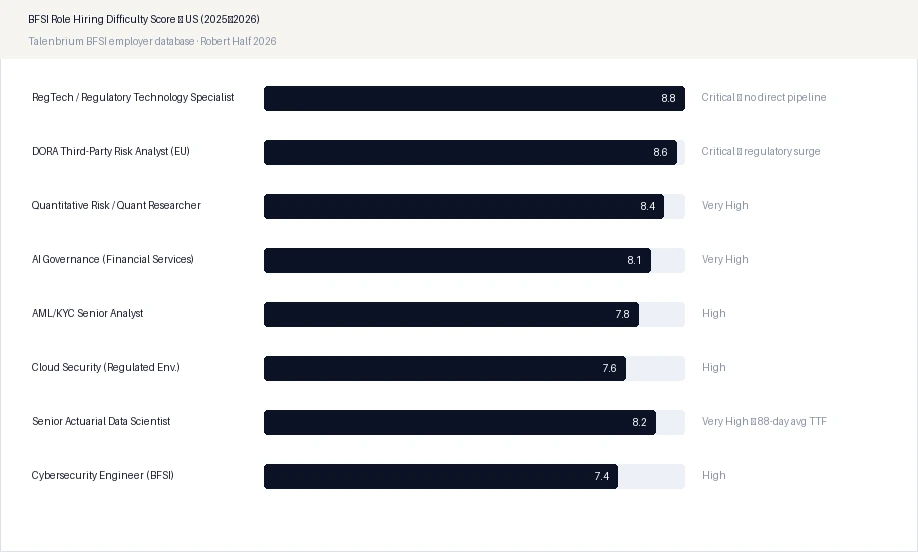
Talenbrium's Q1 2026 survey found that 61% of fintech firms planned workforce expansion in 2026, with the highest concentration of new hiring in compliance and AI-led product roles. Scaling fintech companies face the same regulatory obligations as traditional banks but without the legacy compliance infrastructure — they must hire their way into compliance capability quickly. 78% of US internet consumers now use at least one fintech service monthly. Traditional banks are competing with fintech firms that hire faster, offer more equity, and present a more innovation-forward employer brand.

Customise the study to your target geography, role, skill cluster, or benchmark set, or request a sample before you proceed.