
Research CatalogueBFSI: AI Adoption and Workforce Displacement Impact Report — Which Roles Are Actually Disappearing, and How Fast
Research Report2026-07-1550 pages

BFSI: AI Adoption and Workforce Displacement Impact Report — Which Roles Are Actually Disappearing, and How Fast

Talenbrium Research  |  2026-07-15  |  By Diptanjan Biswas  |  Talenbrium Proprietary Intelligence
BFSI is the leading indicator for AI-driven workforce change. What happens here in 2026 happens everywhere else in 2027 and 2028.

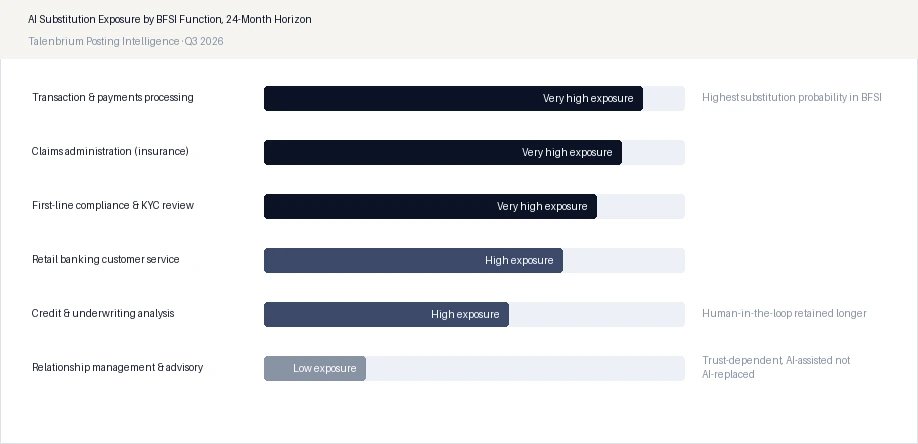
Banking, financial services, and insurance were the first sector to industrialise document-heavy, rules-based back-office work, which makes it the first sector where AI systems are displacing that same work at scale. Talenbrium's proprietary posting intelligence shows BFSI employers reducing headcount in transaction processing, claims administration, and first-line compliance review even as they expand headcount in AI oversight, model risk, and fraud detection — a substitution pattern, not a contraction. The functions disappearing and the functions growing are frequently inside the same department, which is why workforce planning built on net headcount alone misses what is actually happening.

This report separates genuine AI substitution from ordinary cyclical headcount change, function by function, and quantifies how fast each wave is moving. It is built for CHROs, workforce planning leads, and management consultants advising BFSI clients on where AI-driven restructuring is real, where it is overstated, and where it is about to accelerate.
81/100
Talenbrium AI Displacement Velocity Index — BFSI, highest of all sectors tracked
Talenbrium composite · posting intelligence
340,000+
BFSI roles in high-substitution-probability functions globally, 24-month horizon
Talenbrium posting intelligence · Q3 2026
2.9x
Ratio of AI oversight/model risk postings growth vs. transaction processing postings decline
Talenbrium proprietary modelling
63%
Share of surveyed BFSI HR leaders who say AI substitution is happening faster than their 2025 workforce plan assumed
Talenbrium Q1 2026 Pulse Survey · BFSI sub-sample
4.1:1
Demand-push ratio — open AI-adjacent roles per BFSI worker in a declining function
Talenbrium posting intelligence · trailing 12 months
AI Substitution Exposure by BFSI Function, 24-Month Horizon
BFSI is the leading indicator for AI-driven workforce change. What happens here in 2026 happens everywhere else in 2027 and 2028.Banking, financial services, and insurance were the first sector to industrialise document-heavy, rules-based back-office work, which makes it the first sector where AI systems are displacing that same work at scale. Talenbrium's proprietary posting intelligence shows BFSI employers reducing headcount in transaction processing, claims administration, and first-line compliance review ev...
Full data available to purchasers
The jobs disappearing and the jobs appearing are not the same jobs — and BFSI employers are underinvesting in the bridge between them.

Talenbrium's posting data shows a consistent pattern across major banks and insurers: postings for transaction processing, claims administration, and first-line compliance roles have fallen year-over-year, while postings for AI model risk, fraud detection engineering, and AI governance roles have grown substantially faster. The two skill sets do not overlap much. A claims administrator does not become a fraud detection engineer without a structured reskilling investment, and most BFSI employers have not built that pathway at the scale the displacement requires.

Talenbrium's Q1 2026 Pulse Survey found that only 34% of surveyed BFSI HR leaders have a formal internal mobility pathway mapping declining functions to growing ones. The remainder are managing this transition through attrition and external hiring for the growing roles, which is slower, more expensive, and forfeits institutional knowledge that a structured reskilling pathway would retain.
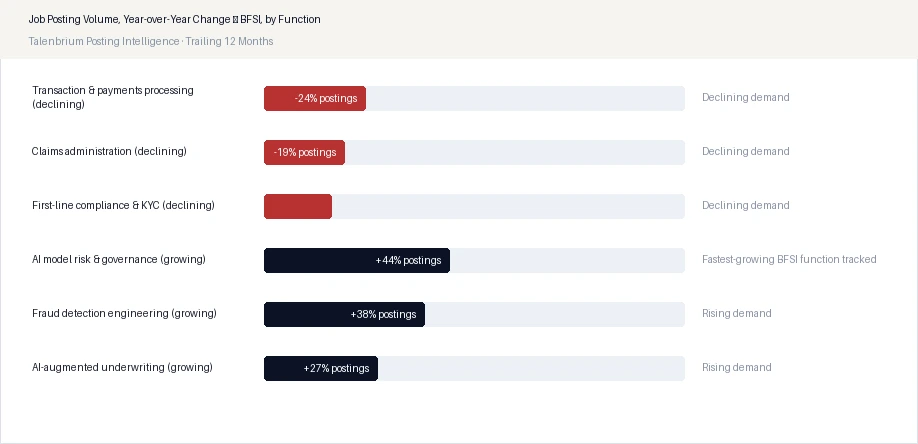
Job Posting Volume, Year-over-Year Change — BFSI, by Function
"BFSI HR teams are managing an AI transition with a workforce plan built for cyclical change. Cyclical change is temporary and symmetric. This is not. The functions declining are not coming back, and the functions growing require different skills entirely." — Talenbrium Workforce Intelligence, Q3 2026
Regional divergence is sharper than most global BFSI workforce strategies account for.

AI displacement velocity in BFSI is highest in the U.S. and UK, where labour law permits faster headcount adjustment, and structurally slower in the EU markets covered by Talenbrium's AI Labor Transition series, where works council consultation and redundancy law extend the timeline between AI deployment and completed headcount change by 6 to 14 months depending on jurisdiction. A global BFSI employer running a single displacement timeline across all regions will be wrong in most of them.
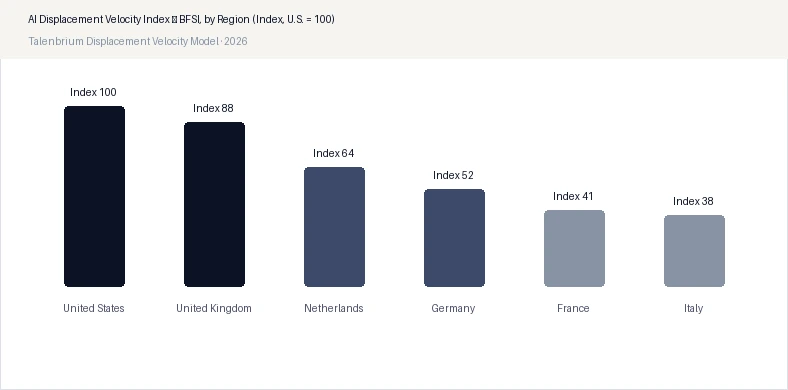

AI Displacement Velocity Index — BFSI, by Region (Index, U.S. = 100)
Table of Contents
01Executive Summary: The BFSI Substitution Pattern
02AI Substitution Exposure by Function — Global and Institution-Type
03Job Posting Trends: Declining vs. Growing Functions
04Regional Displacement Velocity: U.S., UK, EU Comparative
05Headcount-at-Risk Estimates by Institution Type
06Reskilling Pathways: Transaction Processing to AI Oversight Roles
07Salary Benchmarks: Declining Roles vs. Destination Roles
08Retail Banking, Commercial Banking, Insurance: Sub-Sector Comparison
09Case Pattern Analysis: How Leading BFSI Employers Are Sequencing This Transition
10Strategic Recommendations
11Methodology and Data Sources
Report scope
Sector
Banking, Financial Services, Insurance (BFSI) — retail, commercial, insurance sub-sectors
Geography
Global, with detailed U.S., UK, Germany, France, Italy, Netherlands benchmarks
Functions covered
6 declining and 6 growing function categories, mapped for reskilling viability
Primary research
Talenbrium Q1 2026 Pulse Survey · BFSI sub-sample
Model calibration
Talenbrium Displacement Velocity Model, cross-referenced with AI Labor Transition Index
Secondary validation
CompTIA 2025 · BLS OEWS 2025 · Eurostat Structure of Earnings
Customisation
10 hours free customisation included · institution-specific extensions available
Delivery
Within 2–4 business days of purchase · 50 pages
Assigned Author
Diptanjan Biswas

Diptanjan Biswas

Principal Head, Strategic Consulting

Diptanjan Biswas leads strategic consulting at Talenbrium, bringing nine years of experience across research, risk, and workforce intelligence in banking, technology, and advisory sectors.

Workforce Strategy Labour Market Intelligence Credit Risk Recoveries Strategy
View Full Author Profile Linked to Talenbrium's public author library

Ready to access the full intelligence?

Purchase directly, or speak with our team to discuss your requirements first.

Purchase
Buy this report — USD 4,999
Enquire
Speak with our research team
Custom
Commission a bespoke engagement
Home Reports Insights Contact