
Research CatalogueAI-Era Internal Mobility and Reskilling Pathways — Which Moves Actually Work, What They Cost, and How Long They Take
Research Report2026-07-1554 pages

AI-Era Internal Mobility and Reskilling Pathways — Which Moves Actually Work, What They Cost, and How Long They Take

Talenbrium Research  |  2026-07-15  |  By Diptanjan Biswas  |  Talenbrium Proprietary Intelligence
Every employer says they will reskill rather than replace. Almost none can say which move, at what cost, over what timeline.

Internal mobility is the stated answer to AI-driven displacement across nearly every large employer. It is also the least evidenced. Talenbrium's Q1 2026 Pulse Survey found that 71% of HR leaders name reskilling and redeployment as their primary response to AI substitution, while only 29% can identify the specific destination roles displaced workers would move into, and just 18% have costed those transitions. The gap between intent and infrastructure is where redundancy programmes become legally exposed, expensive, and slow.

This report closes that gap with data rather than aspiration. It maps 24 concrete transition pathways from AI-declining functions into AI-growing functions, scores each on viability, and attaches a reskilling duration and cost band to every one. Pathways are validated against live posting demand from Talenbrium's proprietary database, so a pathway only appears here if employers are actually hiring for the destination role today.
24
Transition pathways mapped, scored, and costed across five sectors
Talenbrium pathway model · Q3 2026
71% / 18%
Share of HR leaders naming reskilling as their AI response, versus share who have costed it
Talenbrium Q1 2026 Pulse Survey
4–11mo
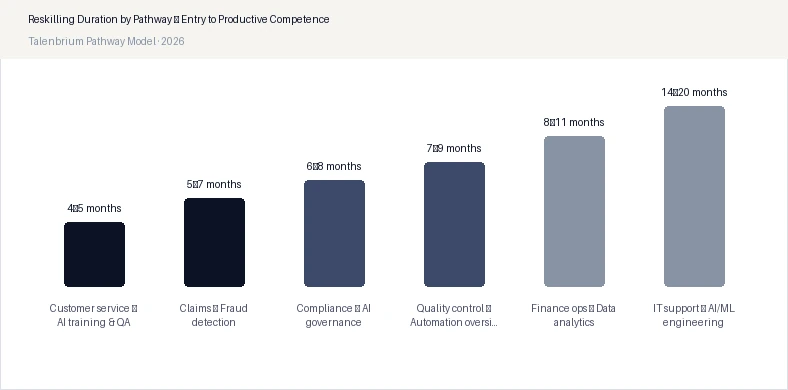
Reskilling duration range across viable pathways, entry to productive competence
Talenbrium pathway model · Cedefop 2025
62%
Cost advantage of a completed internal redeployment versus exit-plus-external-hire for the same role
Talenbrium redeployment cost model
9 of 24
Pathways scored as high-viability. The remainder require either long timelines or fail on demand
Talenbrium pathway viability scoring
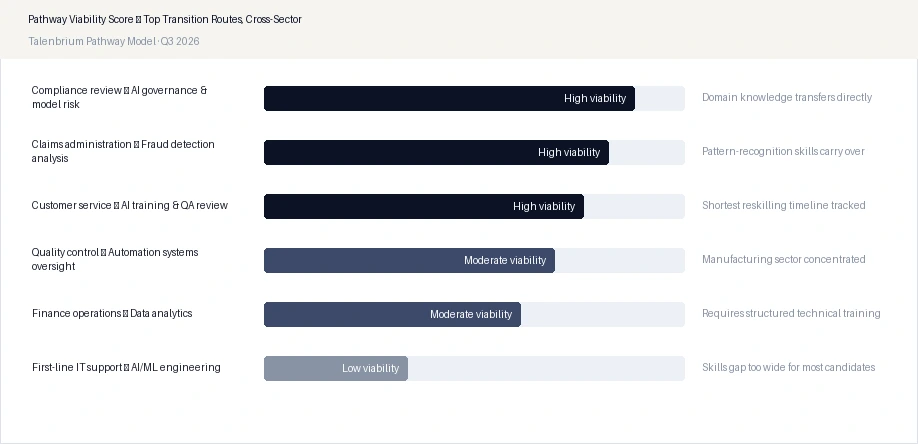
Pathway Viability Score — Top Transition Routes, Cross-Sector
Every employer says they will reskill rather than replace. Almost none can say which move, at what cost, over what timeline.Internal mobility is the stated answer to AI-driven displacement across nearly every large employer. It is also the least evidenced. Talenbrium's Q1 2026 Pulse Survey found that 71% of HR leaders name reskilling and redeployment as their primary response to AI substitution, while only 29% can identify the specific destination roles displaced workers would move into, and just 18% have costed...
Full data available to purchasers
The pathways that work share one trait: the destination role rewards domain knowledge the displaced worker already has.

The highest-viability pathways in Talenbrium's model are not the ones that move workers toward the most technical roles. They are the ones where the destination role requires deep familiarity with a process, a regulation, or a customer base that the displaced worker spent years acquiring, and where AI has automated the mechanical part of their old job but not the judgment part. A compliance reviewer moving into AI model risk governance already understands what a compliance failure looks like. That knowledge is expensive to hire and slow to build, and it is precisely what makes the pathway viable.

Conversely, the pathways that fail are those that treat displaced workers as generic reskilling candidates for whichever role is growing fastest. Talenbrium's data shows first-line IT support to AI/ML engineering as the most commonly attempted and least successful transition in the study: the destination demand is real, but the skills distance defeats most candidates and the programmes are abandoned partway, producing sunk cost and no redeployment.
"Reskilling fails when it is designed around where demand is hottest rather than around what the displaced worker already knows. The best pathway is rarely the most ambitious one." — Talenbrium Workforce Intelligence, Q3 2026
Reskilling Duration by Pathway — Entry to Productive Competence
Redeployment is cheaper than exit-and-rehire in every pathway that completes. The difficulty is knowing in advance which ones complete.

Talenbrium's redeployment cost model compares the fully-loaded cost of moving an existing employee into a destination role against exiting them and hiring externally for the same role. Across viable pathways, internal redeployment runs materially cheaper once severance, recruitment cost, and time-to-productivity for an external hire are all priced in. The cost advantage is largest in jurisdictions with high exit costs, which is why this report cross-references directly with Talenbrium's AI Labor Transition Index: in Germany, France, and Italy, a completed internal redeployment can be the single largest cost avoidance available to an employer restructuring under AI pressure.

The risk is programmes that do not complete. A failed reskilling attempt costs the training investment, delays the restructuring timeline, and still ends in an exit. This is why pathway selection, not reskilling budget, is the decision that determines whether an internal mobility strategy pays back. The full report scores all 24 pathways on completion probability so that budget is directed only at transitions that finish.

Table of Contents
01Executive Summary: The Intent-Infrastructure Gap in Reskilling
02Pathway Viability Scoring: Methodology and the 24-Pathway Map
03High-Viability Pathways: The Nine That Work
04Failed Pathways: Why Common Reskilling Bets Do Not Complete
05Reskilling Duration by Pathway, Entry to Productive Competence
06Cost Bands per Pathway and the Training Provider Landscape
07Redeployment vs. Exit-and-Rehire: Full Cost Comparison
08Sector Views: BFSI, Manufacturing, Retail, Technology, Healthcare
09Jurisdiction Overlay: Where Redeployment Carries Legal Weight
10Building an Internal Mobility Programme That Completes
11Strategic Recommendations
12Methodology and Data Sources
Report scope
Coverage
24 transition pathways, scored, costed, and duration-banded
Sectors
BFSI · Manufacturing · Retail · Technology · Healthcare
Geography
U.S., UK, and EU, with jurisdiction overlay for redeployment obligations
Primary research
Talenbrium Q1 2026 Pulse Survey · n=284 HR professionals
Demand validation
Every destination role validated against live posting demand, 2.4M+ postings/week
Secondary validation
Cedefop 2025 · ILO transition studies · national training authority data
Customisation
10 hours free customisation included · sector- or role-specific extensions available
Delivery
Within 2–4 business days of purchase · 54 pages + pathway scoring worksheet
Assigned Author
Diptanjan Biswas

Diptanjan Biswas

Principal Head, Strategic Consulting

Diptanjan Biswas leads strategic consulting at Talenbrium, bringing nine years of experience across research, risk, and workforce intelligence in banking, technology, and advisory sectors.

Workforce Strategy Labour Market Intelligence Credit Risk Recoveries Strategy
View Full Author Profile Linked to Talenbrium's public author library

Ready to access the full intelligence?

Purchase directly, or speak with our team to discuss your requirements first.

Purchase
Buy this report — USD 4,999
Enquire
Speak with our research team
Custom
Commission a bespoke engagement
Home Reports Insights Contact