Research CatalogueRole ClusterAI / Machine Learning Engineer Talent Cluster Report, 2026
Research Report0000-00-0054 pages

AI / Machine Learning Engineer Talent Cluster Report, 2026

Talenbrium Research  |  0000-00-00  |  By Diptanjan Biswas  |  Talenbrium Proprietary Intelligence
163% posting growth. USD 206,000 average salary. 72% of hiring managers extending offers above band.

AI and machine learning engineering is the single fastest-growing occupational cluster tracked across Talenbrium's US dataset. AI-related job postings in Talenbrium's database grew 163% between 2024 and 2025. The Bureau of Labor Statistics' classification of computer and information research scientists projects 23% employment growth through 2033 — six times the all-occupations average. The BLS figure is validated by Talenbrium's own demand trajectory data.

The salary consequence is direct. Talenbrium's compensation model shows average AI engineer base salary at USD 206,000 in 2025 — a USD 50,000 increase over 2024. Q1 2026 tracking shows a further 7% increase from that figure. Talenbrium's Q1 2026 Workforce Pulse Survey found that 72% of HR respondents with open AI/ML engineering requisitions had extended at least one offer above their pre-approved salary band in the prior quarter.
+163%
AI/ML engineering posting growth, US, 2024–2025
Talenbrium job postings engine
USD 206K
Average AI engineer base salary 2025 (+USD 50K vs 2024)
Talenbrium compensation model Q1 2026
+7%
Further salary increase Q1 2026 tracking above 2025 average
Talenbrium compensation model Q1 2026
72%
HR respondents with open AI/ML roles extending offers above pre-approved band
Talenbrium Q1 2026 Pulse Survey · n=284
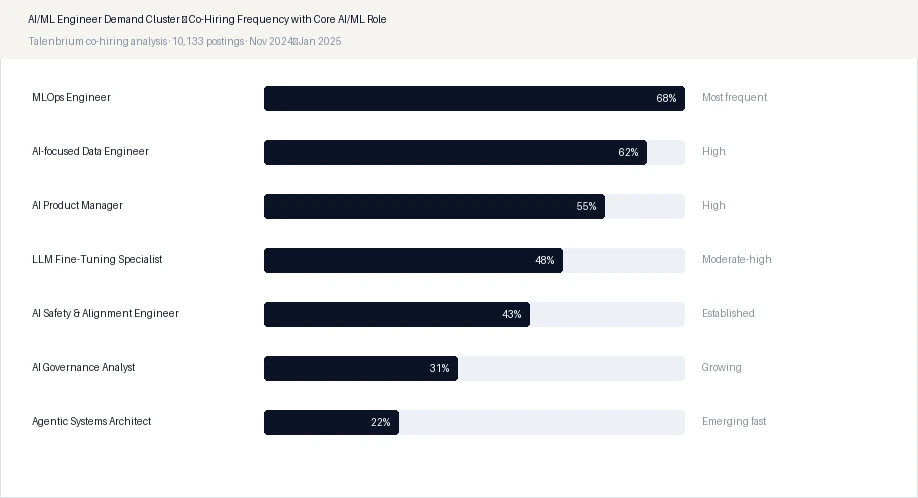
AI/ML Engineer Demand Cluster — Co-Hiring Frequency with Core AI/ML Role
163% posting growth. USD 206,000 average salary. 72% of hiring managers extending offers above band.AI and machine learning engineering is the single fastest-growing occupational cluster tracked across Talenbrium's US dataset. AI-related job postings in Talenbrium's database grew 163% between 2024 and 2025. The Bureau of Labor Statistics' classification of computer and information research scientists projects 23% employment growth through 2033 — six times the all-occupations average. The BLS figure is validated ...
Full data available to purchasers
Skills architecture: what the market is actually asking for in 2026

Talenbrium's skills classification uses a four-tier architecture: Core (60%+ of postings), Adjacent (30–59%), Sunrise (growing 30%+ YoY), and Sunset (declining 20%+ YoY). The most consequential finding in Talenbrium's 2025–2026 AI/ML skills tracker is the pace at which Sunrise skills are entering hiring requirements. AI governance skills grew 150% YoY in postings frequency. Agentic Systems Architect co-posting frequency grew 633% since Q4 2023. The market is not gradually evolving — it is being rewritten.
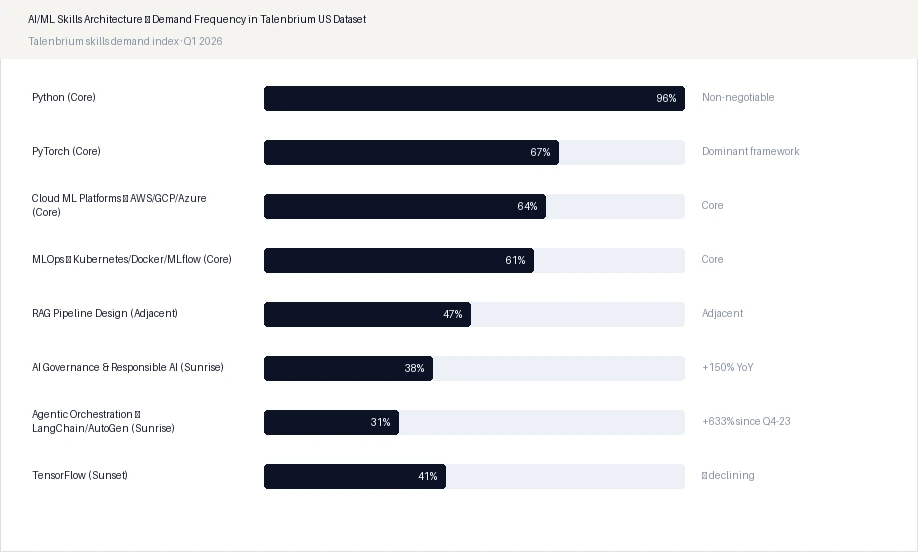
AI/ML Skills Architecture — Demand Frequency in Talenbrium US Dataset
"Firms that do not understand the sub-market differentials are systematically underbidding for the candidates they most need. LLM fine-tuning specialists earn 25–40% above generalist ML engineers at equivalent seniority in Talenbrium's benchmarking." — Talenbrium AI/ML Compensation Analysis, April 2026
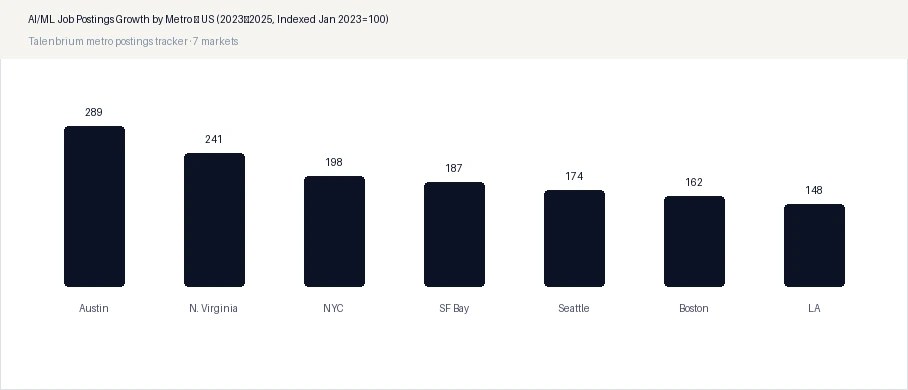
AI/ML Job Postings Growth by Metro — US (2023–2025, Indexed Jan 2023=100)
The full 54-page report delivers: full salary benchmark tables at P25/P50/P75/P90 for all seniority levels (junior USD 140K → senior USD 240K+); sub-speciality compensation premiums (LLM fine-tuning +25–40%, AI safety +45% vs 2023); detailed California, New York, Seattle, Boston, Austin, Chicago, Los Angeles supply-demand analysis; employer-type hiring strategy analysis (technology firms 46%, financial services 14%, healthcare fastest % growth); hiring velocity benchmarks (52 days well-compensated; 114 days sub-USD 200K band); and the full skills adjacency map.
Full data available to purchasers
Table of Contents
01Executive Summary & Market SnapshotPreview
02Role Overview: AI/ML Engineering in 2026Preview
03Demand Push: 163% Growth — Three Structural ForcesPreview
04Demand Cluster: Co-Hiring Frequency Analysis (10,133 postings)Gated
05Skills Architecture: Core/Adjacent/Sunrise/Sunset FrameworkGated
06Hiring by Company Type: Technology, Financial Services, HealthcareGated
07Supply & Demand Benchmarks: Velocity, Time-to-Fill, Offer OutcomesGated
08Salary Benchmarking: P25–P90 by Seniority (all gated)Gated
09Sub-Speciality Premiums: LLM, AI Safety, GovernanceGated
10Geographic Hotspots: 7 Metro Markets Deep-DiveGated
11Geographic Indexing: Austin, Northern Virginia EmergenceGated
12Strategic RecommendationsPreview
13MethodologyPreview
Report scope
Series & Price
Series B · Report 1 · USD 4,999 · 54 pages
Geography
US national · 7 metro: SF Bay, New York, Seattle, Boston, Austin, Chicago, LA
Deep-dive dataset
10,133 AI/ML engineering postings · Nov 2024–Jan 2025
Employer database
12,400+ organisations; technology (46%), financial services (14%), IT services (11%), healthcare (9%)
Skills taxonomy
8,500+ classified skills · 13-month rolling frequency tracker
Secondary validation
BLS Employment Projections 2024–34 · WEF Future of Jobs · 365 Data Science AI Outlook 2025
Customisation
10 hours free customisation & expert consultation included
Delivery
Within 24 hours of purchase
Assigned Author
Diptanjan Biswas

Diptanjan Biswas

Principal Head, Strategic Consulting

Diptanjan Biswas leads strategic consulting at Talenbrium, bringing nine years of experience across research, risk, and workforce intelligence in banking, technology, and advisory sectors.

Workforce Strategy Labour Market Intelligence Credit Risk Recoveries Strategy
View Full Author Profile Linked to Talenbrium's public author library

Ready to access the full intelligence?

Purchase directly, or speak with our team to discuss your requirements first.

Purchase
Buy this report — USD 4,999
Enquire
Speak with our research team
Custom
Commission a bespoke engagement
Home Reports Insights Contact