
AI and machine learning engineering sits at the intersection of the most powerful macrotrend in enterprise technology and the most structurally constrained talent supply in the professional labour market. ManpowerGroup's 2026 Talent Shortage Survey of 39,000 employers across 41 countries found that, for the first time, AI skills have surpassed all other capabilities to become the most difficult for employers to find globally. This report maps exactly where that scarcity sits, how deep it runs, and what it costs.
Talenbrium tracks AI/ML engineering demand across 3,200+ technology employers and 2.4 million weekly job postings. This report draws on that proprietary dataset to produce a city-level, role-specific, and compensation-resolved picture of the AI/ML talent market across the United States and Europe as of Q1 2026.
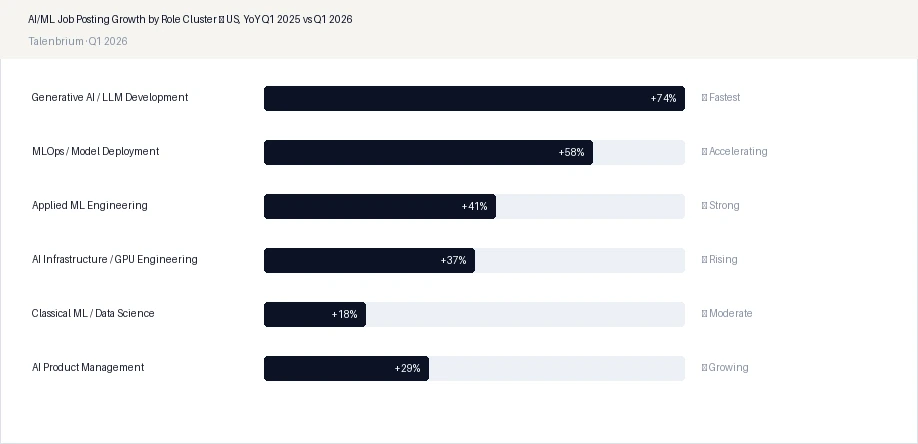
The fundamental problem is not that AI/ML talent does not exist. It is that the skills themselves are evolving faster than any training pipeline — academic, corporate, or self-directed — can follow. The capabilities that defined a strong generative AI practitioner twelve months ago are now baseline. The market has moved to agentic architectures, multi-modal systems, and production-grade LLM deployment at scale.
Stanford's HAI 2026 AI Index documents that AI-related skills now appear in 2.5% of all US job postings — a 297% increase over the past decade. That growth rate is roughly 20 times faster than the overall job market. Critically, the Stanford data shows this is no longer confined to technology companies: AI fluency requirements are appearing at scale across financial services, healthcare, manufacturing, and logistics.
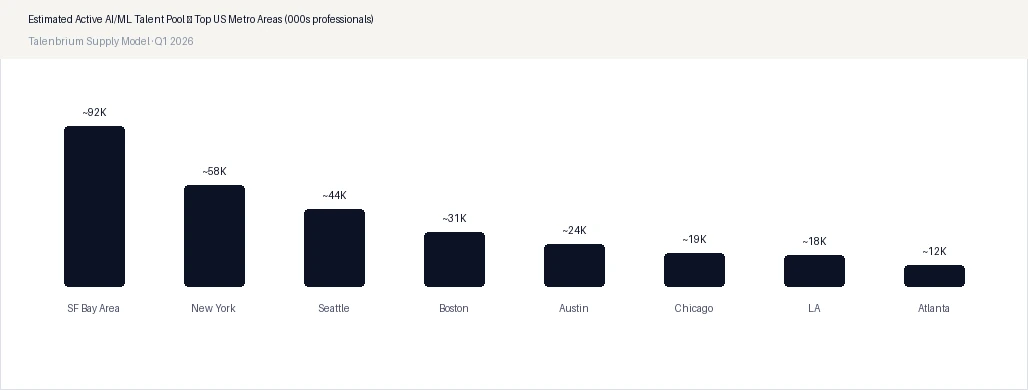
AI/ML talent remains highly geographically concentrated. In the United States, San Francisco Bay Area, Seattle, and New York together account for approximately 58% of active AI/ML candidates. Boston, Austin, and Chicago represent the next tier. This concentration creates a structural problem for employers outside these markets — they face compensation premiums to attract talent willing to relocate, or must compete in a remote hiring environment where the same candidates receive dozens of outreaches simultaneously.
This report is built on Talenbrium's proprietary four-layer data architecture. Job posting data is processed at 2.4M+ per week through our NLP classification engine, normalised across role, seniority, geography, and an 8,000+ skills taxonomy. AI/ML role identification uses a multi-signal classification methodology combining job title, required skills, and role description analysis — distinguishing genuine AI/ML engineering positions from roles that merely reference AI as a tool.
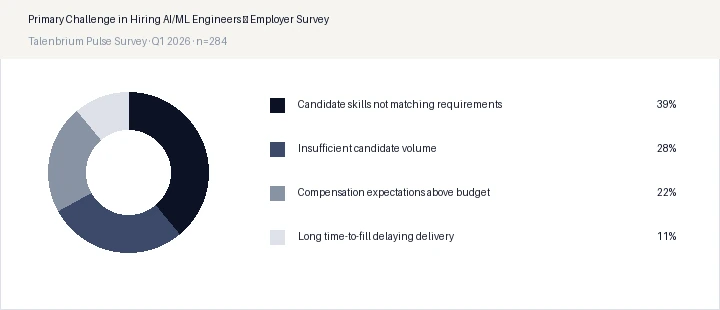
Employer-level intelligence covers 3,200+ technology organisations, with signals on hiring velocity, role composition, and skills demand. The compensation model derives salary band estimates from live posting data and is updated quarterly. The Workforce Pulse Survey (n=284 HR professionals, Q1 2026) provides primary practitioner validation. BLS, ONS, and Destatis data are used exclusively as validation benchmarks against Talenbrium's proprietary model outputs.

Customise the study to your target geography, role, skill cluster, or benchmark set, or request a sample before you proceed.