
SAP ends mainstream support for its older ECC software at the end of 2027, and most customers are not yet migrated. Around 43 percent are still in progress or have not started, and clearing the backlog would need about 75 percent more SAP resources than the market holds today. The scarce people are the S/4HANA architects, functional consultants and ABAP developers who run these programmes.
This report treats the roles as the unit of analysis. It profiles each designation, sets demand against supply, benchmarks pay across the United States, Germany and the United Kingdom, shows where the openings concentrate, and names the employers hiring the most.
The 2027 end of ECC support has moved the demand decisively to S/4HANA, cloud and the Business Technology Platform. Classic ECC configuration, custom ABAP and on-prem Basis work are being left behind as customers migrate to a clean-core, cloud model. The ten designations split into three forward-facing layers: the S/4HANA, cloud and BTP roles that carry the migration, the data, security and analytics roles that govern it, and the delivery and build roles that ship it.
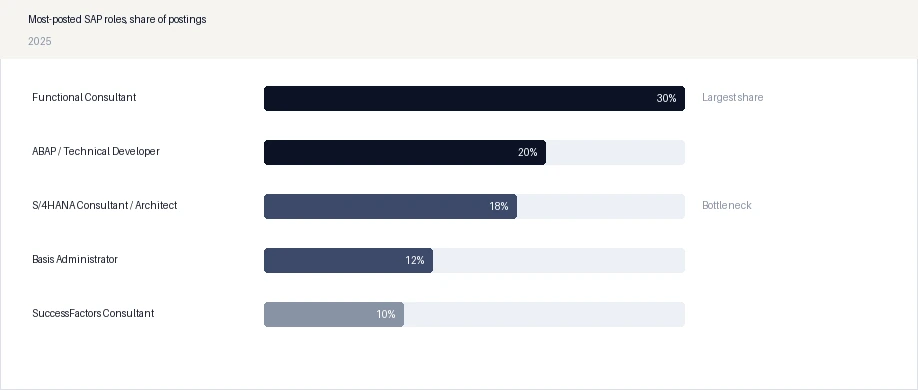
Functional consultants lead the postings at roughly 30 percent, followed by ABAP developers and S/4HANA specialists. The volume reflects the migration wave, but the true bottleneck is the S/4HANA solution architect who can design and govern a programme, a role that takes years of delivery experience to fill.
Supply cannot expand on the deadline. SAP talent is built through multi-year project experience, not short courses, so the pool grows slowly while the 2027 date pulls demand forward. Germany feels this most sharply, with more than 149,000 unfilled tech roles compounding the scarcity.
The 2027 deadline is not only creating demand, it is retiring a generation of roles. Mainstream support for ECC ends, so legacy ECC configuration, heavy custom ABAP and manual on-prem Basis work are being written out by clean-core S/4HANA, BTP extensions and RISE managed services. The people who move to the cloud stack are in high demand; the ones who stay on ECC are working on a shrinking base.
| Declining role | Why it is shrinking | What replaces it |
|---|---|---|
| Legacy ECC functional consultant | ECC mainstream support ends in 2027 and customers are moving to S/4HANA. | S/4HANA functional consultants who run the migration. |
| Classic custom-ABAP developer | Clean-core and RAP move extensions off custom Z-code onto BTP. | ABAP / RAP developers who build side-by-side extensions on BTP. |
| On-prem Basis administrator (manual) | RISE and cloud managed services automate installs, patching and tuning. | Cloud and HANA administrators who run managed S/4HANA systems. |
| Manual SAP GUI data-entry role | Fiori, automation and RPA remove manual transaction entry. | Functional consultants who design Fiori and automated processes. |
The decline is of the legacy, on-prem version of these roles. Reskilling routes from ECC and classic ABAP into S/4HANA, BTP and cloud administration are set out in the full report. Source: SAP; Basis Technologies; Talenbrium classification
US pay leads on base, with an enterprise architect around USD 166,000 and an S/4HANA solution architect around USD 157,000. Germany is the deepest SAP market as the vendor's home country, where senior architects reach EUR 110,000 to 120,000 and contractors command EUR 700 to 1,200 a day. The United Kingdom sits below both for most roles.
The table sets year-over-year demand and median base pay for each designation across the three markets, so an offer can be calibrated by role and country.
| Role | Demand, YoY | US median | Germany median | UK median |
|---|---|---|---|---|
| SAP Enterprise / Data Architect | +20% | $166,000 | €120,000 | £100,000 |
| S/4HANA Solution Architect | +30% | $157,000 | €110,000 | £95,000 |
| S/4HANA Functional Consultant | +18% | $136,000 | €72,000 | £58,000 |
| SAP ABAP / RAP Developer | +15% | $131,000 | €70,000 | £60,000 |
| SAP Security / GRC Consultant | +14% | $128,000 | €72,000 | £60,000 |
| SAP SuccessFactors / Cloud HR | +25% | $125,000 | €75,000 | £62,000 |
| SAP Basis / HANA Administrator (cloud) | +18% | $120,000 | €68,000 | £57,000 |
| SAP Programme Manager | +16% | $116,000 | €78,000 | £75,000 |
Median base pay, mid-level, in local currency. US and UK figures from 2025-2026 SAP salary guides; Germany reflects the deep DACH market, where senior architects reach EUR 110,000 to 120,000 and day rates run EUR 700 to 1,200. Demand is the Talenbrium year-over-year posting change. Source: Talenbrium posting intelligence and compensation model; Whitehall Resources; Qubit Labs; Glassdoor 2025-2026
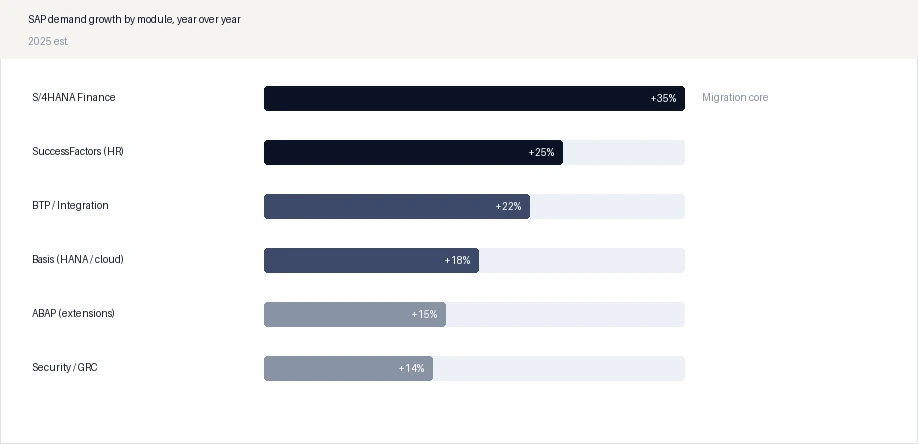
The steepest demand is for S/4HANA Finance as the core of most migrations, followed by SuccessFactors as employers move HR to the cloud and by the BTP integration layer that connects it all. Basis, ABAP and security follow as programmes move from design into build.
The push runs toward the roles that carry the migration, and it is concentrated in time. The 2027 deadline means many programmes compete for the same architects and consultants in the same window, which lifts both pay and day rates.
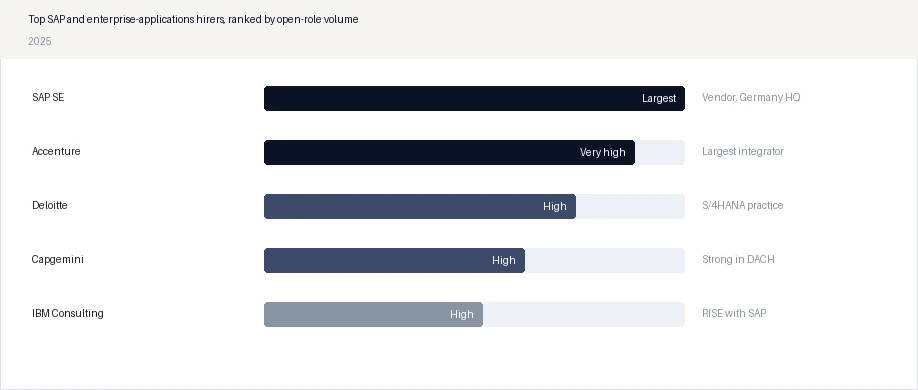
SAP itself is the largest single employer, followed by the global system integrators that run most migrations. Accenture leads the integrators, with Deloitte, Capgemini and IBM Consulting all operating large S/4HANA practices. Together they absorb much of the available senior talent.
For an end-user company this is the core challenge. The integrators pay top of market and can offer varied project work, so an in-house SAP team competes on stability, on domain depth and on the chance to own a system estate end to end.
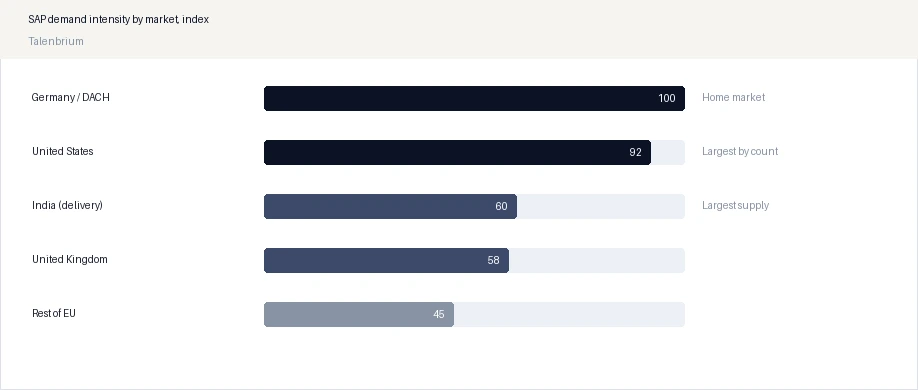
SAP demand concentrates where the vendor and its customers are densest. Germany and the wider DACH region carry the highest demand intensity as SAP's home market, the United States is the largest by absolute customer count and spend, and the United Kingdom leads Western Europe outside DACH. India holds the largest delivery and offshore talent pool.
The geography shapes sourcing. German programmes compete in the deepest but tightest market, US programmes draw on a large but expensive pool, and both increasingly blend onshore architects with offshore build capacity to make the 2027 timeline work.
Three forces hold the SAP shortage in place. The 2027 end of mainstream ECC support pulls a decade of migrations into a few years. SAP skills are built through multi-year project delivery and cannot be trained on a short timeline. And Germany, the deepest SAP market, is also the tightest labour market, with more than 149,000 unfilled tech roles. The result is intense, time-boxed demand for a slow-growing pool.
The report turns the role-level pattern into an SAP hiring and reskilling plan across the United States, Germany and the United Kingdom.
Year-over-year demand and median pay for every SAP designation across the US, Germany and the UK.
Median and senior pay by role in USD, EUR and GBP, including the specialist premium.
Full employer league table of who hires the most, by role and market.
Country and metro talent depth mapped to competition and pay.
Shortest reskilling routes into each role, with cost and duration.
Cost comparison of hiring, contracting and internal reskilling by role.
Projected demand and time-to-fill by role, from live pipeline data.
Every exhibit supplied as an Excel workbook.
The report is built on Talenbrium's four-layer data method: real-time job-posting intelligence, a proprietary skills taxonomy of more than 8,000 skills, employer hiring tracking, and a quarterly Workforce Pulse Survey, triangulated against external benchmarks. Role demand comes from posting analysis. Pay is drawn from posted and surveyed compensation and market salary data, and is reported at median and at the 90th percentile.

Customise the study to your target geography, role, skill cluster, or benchmark set, or request a sample before you proceed.