
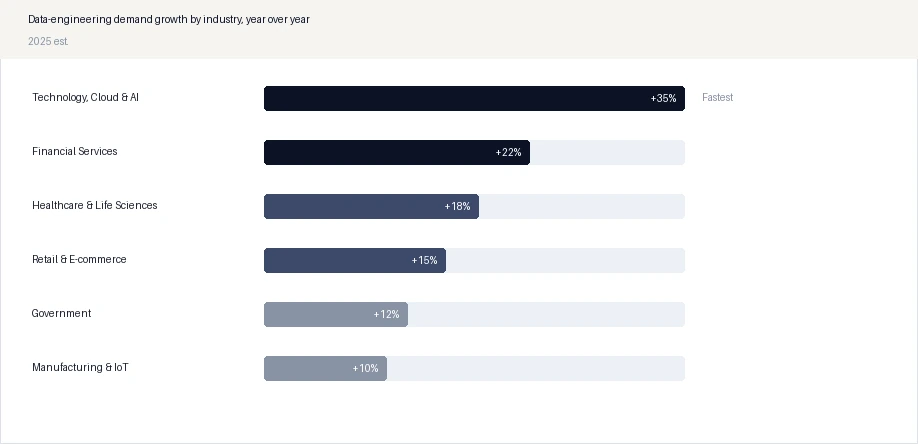
The move to AI and real-time analytics has put the data engineer at the centre of the plan. Postings for data-engineering roles have risen about 35 percent year over year, and the United States alone faces an estimated 260,000 open positions. The scarce skill is the engineer who can build reliable pipelines and a clean data platform, because without them the models and dashboards downstream do not run.
This report treats the roles as the unit of analysis. It profiles each designation, sets demand against supply, benchmarks pay across the United States, Germany and the United Kingdom, shows where the openings concentrate, and names the employers hiring the most.
Data work has moved up the stack. The hiring now concentrates on the platform, streaming and ML-pipeline roles that build cloud-native infrastructure, while dashboard and manual-analysis roles are being absorbed by self-serve and GenAI tools. The ten designations split into three forward-facing layers: the platform and pipeline engineers who build the estate, the cloud and lakehouse roles that run it, and the modeling and architecture roles that shape it.
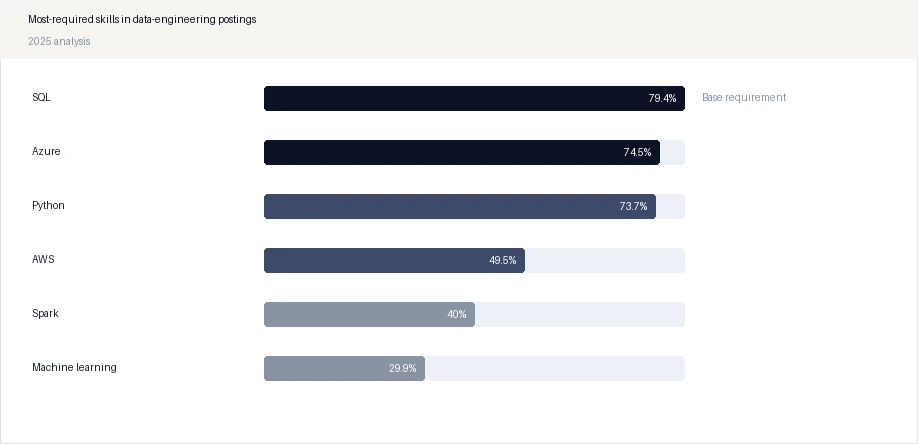
Demand is visible in what postings ask for. SQL appears in about 79 percent of data-engineering postings, Azure in 75 percent and Python in 74 percent, so the base profile is clear. The scarcity sits above that base, in the platform and streaming specialists who can run cloud-native infrastructure, and they command a 20 to 40 percent premium over generalist data engineers.
Supply is growing but uneven. The US Bureau of Labor Statistics projects 34 percent growth for data-science roles through 2034, well above average, yet database work is splitting, with architects rising about 9 percent while administrators decline. The market rewards the engineers who move up the stack toward platform and machine learning.
The bottom of the data org is being absorbed by tooling. Self-serve BI and GenAI analytics answer routine questions without a hand-built dashboard, managed cloud databases tune and scale themselves, and code-first ELT has replaced legacy drag-and-drop suites. The demand has moved up the stack toward platform, streaming and ML-pipeline engineering, and away from the report-and-maintain roles below it.
| Declining role | Why it is shrinking | What replaces it |
|---|---|---|
| BI / dashboard developer | Self-serve and GenAI analytics generate reports and dashboards on demand. | Analytics engineers who model data with dbt and own the semantic layer. |
| Manual / spreadsheet data analyst | Natural-language analytics answers routine business questions directly. | Analytics engineers and data product analysts who ship models. |
| Database administrator (manual tuning) | Managed cloud databases auto-scale, patch and tune themselves. | Platform and data-reliability engineers who run infrastructure as code. |
| Legacy ETL developer | Code-first pipelines and managed ELT replace drag-and-drop ETL suites. | Data engineers who build pipelines in code on cloud platforms. |
The decline is of the manual, report-and-maintain version of these roles. Reskilling routes from BI, analysis and administration into analytics, platform and ML-pipeline engineering are set out in the full report. Source: US Bureau of Labor Statistics; ElectroIQ; Talenbrium classification
US pay leads. A senior data engineer earns around USD 165,000 at median base and a platform engineer around USD 150,000, with a clear premium for cloud and machine-learning skills. Germany and the United Kingdom pay less in base terms for the equivalent roles, with London the strongest UK market and regional pay well below it.
The table sets year-over-year demand and median base pay for each designation across the three markets, so an offer can be calibrated by role and country.
| Role | Demand, YoY | US median | Germany median | UK median |
|---|---|---|---|---|
| Senior Data Engineer | +30% | $165,000 | €88,000 | £95,000 |
| ML Pipeline Engineer | +32% | $158,000 | €85,000 | £85,000 |
| Data Platform Engineer | +34% | $150,000 | €82,000 | £80,000 |
| Database Architect | +9% | $136,000 | €80,000 | £75,000 |
| Analytics Engineer | +28% | $130,000 | €68,000 | £65,000 |
| Data Engineer | +35% | $126,000 | €70,000 | £62,000 |
| BI Developer | +12% | $100,000 | €60,000 | £52,000 |
| Data Analyst | +10% | $85,000 | €55,000 | £42,000 |
Median base pay, mid-level, in local currency. US figures anchored to levels.fyi and BLS; Germany and UK to 2025-2026 country data. Platform and ML roles carry a 20 to 40 percent premium over generalist data engineers. Demand is the Talenbrium year-over-year posting change. Source: Talenbrium posting intelligence and compensation model; US Bureau of Labor Statistics; Optiveum 2025-2026
The steepest growth sits in technology, cloud and AI firms, where data engineering underpins every model, followed by financial services and healthcare. Retail, government and manufacturing follow as those sectors modernise their data estates.
The push is toward the platform end of the role. As employers standardise on cloud data platforms, demand concentrates on the engineers who can build and run that infrastructure rather than only query it.
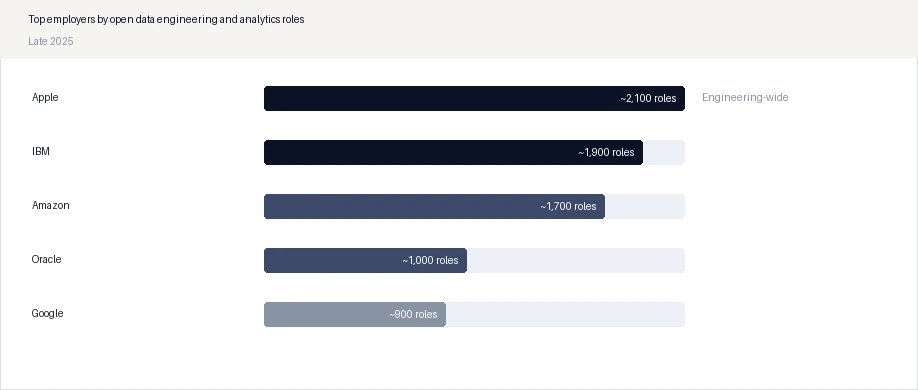
The largest hirers are the technology majors and the enterprise software firms. Apple, IBM, Amazon, Oracle and Google carry the deepest open pipelines, each with hundreds to thousands of live data and engineering roles across their cloud and data teams.
For a smaller employer this sets the competitive frame. When the platform majors hire data engineers at this scale, a mid-market firm has to compete on the interest of the data problem, on flexibility and on speed to offer.
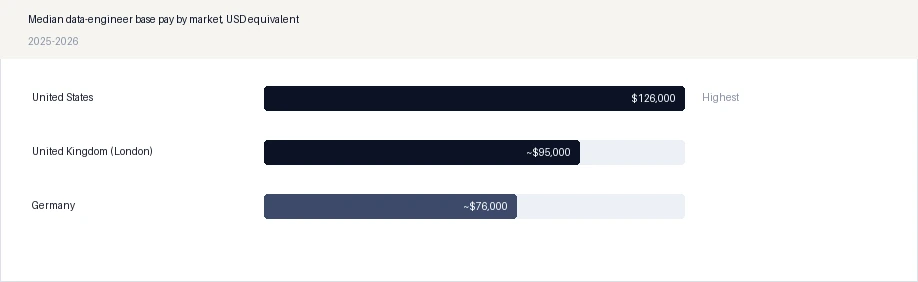
Pay for the same role varies sharply by market. A median data engineer earns about USD 126,000 in the United States, close to USD 95,000 equivalent in London, and about USD 76,000 equivalent in Germany. London leads the UK by a wide margin over regional cities such as Manchester and Birmingham.
The gap shapes sourcing strategy. US employers pay to keep talent onshore, while European employers increasingly draw on regional and offshore hubs where the same skills cost less, which is why location is now a lever in the data hiring plan rather than a fixed cost.
Three forces hold the data shortage in place. AI and real-time analytics have made reliable data pipelines a prerequisite rather than a nice-to-have. The skill bar has risen from SQL and reporting toward cloud platforms and streaming, which thins the qualified pool. And the database market is splitting, rewarding architects and platform engineers while generalist administration declines. The result is steady, structural demand for the higher end of the role.
The report turns the role-level pattern into a data hiring and reskilling plan across the United States, Germany and the United Kingdom.
Year-over-year demand and median pay for every data designation across the US, Germany and the UK.
Median and senior pay by role in USD, EUR and GBP, including the specialist premium.
Full employer league table of who hires the most, by role and market.
Country and metro talent depth mapped to competition and pay.
Shortest reskilling routes into each role, with cost and duration.
Cost comparison of hiring, contracting and internal reskilling by role.
Projected demand and time-to-fill by role, from live pipeline data.
Every exhibit supplied as an Excel workbook.
The report is built on Talenbrium's four-layer data method: real-time job-posting intelligence, a proprietary skills taxonomy of more than 8,000 skills, employer hiring tracking, and a quarterly Workforce Pulse Survey, triangulated against external benchmarks. Role demand comes from posting analysis. Pay is drawn from posted and surveyed compensation and market salary data, and is reported at median and at the 90th percentile.

Customise the study to your target geography, role, skill cluster, or benchmark set, or request a sample before you proceed.