
The role that once defined a GMP site, the manual quality-control bench analyst, is in structural decline. Real-time release testing and process analytical technology now verify product quality during manufacture rather than after it, and electronic batch records and automated inspection are removing the manual documentation and inspection work around it. The hiring energy has moved to a different set of roles: cell and gene therapy manufacturing, digital and automation engineering, data integrity, and Quality 4.0.
This report treats these forward-facing roles as the unit of analysis. It profiles each designation, sets demand against supply, names the roles being automated away and what replaces them, benchmarks pay across the United States, Germany and the United Kingdom, and names the employers hiring the most.
Regulated manufacturing has split into three forward-facing layers: the digital and automation roles that run the smart factory, the advanced-therapy and bioprocess roles that make the new modalities, and the Quality 4.0 and compliance roles that release product through data rather than paper. These are the roles that excite a modern pharma CHRO, and the roles the market is short of.
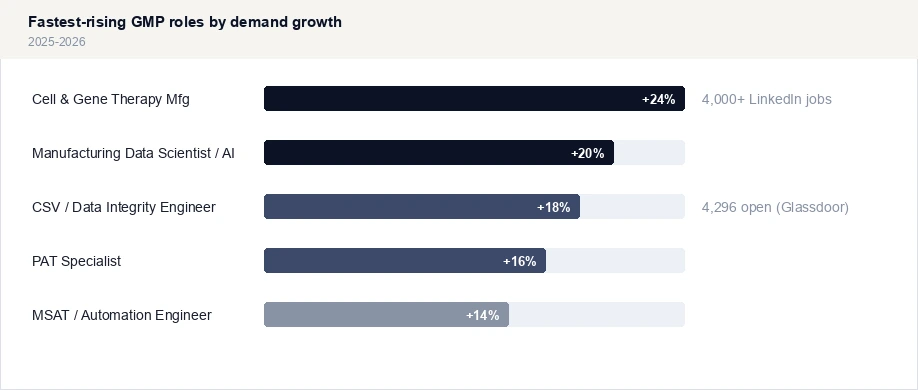
Demand is led by cell and gene therapy manufacturing, the sector's single biggest hiring bottleneck, with more than 4,000 open cell-therapy roles in the United States alone. Data integrity and CSV engineering follow, with over 4,000 roles open on one job board and a median US wage above most classic quality roles, then process analytical technology, MSAT and automation.
Supply is the constraint. These roles fuse GMP knowledge with data, automation or advanced-therapy experience, a combination that barely existed as a trained profile five years ago, so the qualified pool cannot grow on the timeline the build-out demands.
The classic manual quality-control bench analyst, once the core GMP hire, is the clearest declining role. It is not that quality is disappearing. The function is moving up-value, from the pipette to spectroscopy, data integrity and automation. The people who make that move are in high demand; the ones who do not are exposed.
| Declining role | Why it is shrinking | What replaces it |
|---|---|---|
| Manual QC bench analyst | End-point lab testing is being removed from the process. | PAT and real-time release testing (in-line Raman, NIR). |
| Paper batch-record reviewer | Paper records are disappearing from the floor. | MES and electronic batch records, review by exception. |
| Manual QA data checker | Line-by-line human review is too slow. | Automated audit trails and AI anomaly detection. |
| Manual visual inspection operator | Human inspection is error-prone at scale. | Automated and AI-driven visual inspection systems. |
The decline is of the manual, routine version of these roles. Reskilling routes from manual QC into PAT, data integrity and automation are set out in the full report. Source: PharmaNow; ISPE Pharma 4.0; Talenbrium classification
Pay has shifted with demand. Data-integrity and manufacturing-data roles now sit at the top, with a US median around USD 147,000 for CSV engineers, ahead of the classic quality roles they are replacing. Cell and gene therapy roles carry a 15 to 25 percent premium in the United Kingdom, where post-Brexit regulatory divergence has lifted workload.
The table sets year-over-year demand and median base pay for each designation across the three markets, so an offer can be calibrated by role and country.
| Role | Demand, YoY | US median | Germany median | UK median |
|---|---|---|---|---|
| CSV / Data Integrity Engineer | +18% | $147,000 | €68,000 | £58,000 |
| Manufacturing Data Scientist / AI | +20% | $135,000 | €80,000 | £70,000 |
| Cell & Gene Therapy Mfg Specialist | +24% | $120,000 | €72,000 | £75,000 |
| Digital Manufacturing (Pharma 4.0) | +16% | $120,000 | €75,000 | £65,000 |
| Contamination Control / Sterility Lead | +12% | $118,000 | €78,000 | £65,000 |
| PAT Specialist | +16% | $115,000 | €74,000 | £62,000 |
| CAR-T Process Specialist | +22% | $115,000 | €70,000 | £72,000 |
| Automation / Controls Engineer | +14% | $110,000 | €65,000 | £58,000 |
| Bioprocess Engineer (single-use) | +16% | $105,000 | €82,000 | £70,000 |
| MSAT Engineer | +15% | $103,000 | €70,000 | £62,000 |
Median base pay, mid-level, in local currency. CSV and data-integrity engineers are now among the best-paid quality-adjacent roles; cell and gene therapy roles carry a 15 to 25 percent premium in the UK. Demand is the Talenbrium year-over-year posting change. Source: Talenbrium posting intelligence and compensation model; LinkedIn; Glassdoor; StepStone; PayScale 2025-2026
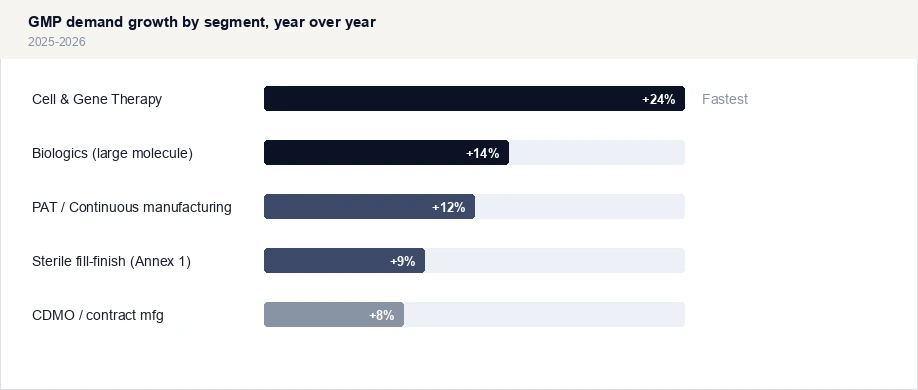
The steepest demand sits in cell and gene therapy, growing around 24 percent a year as advanced therapies move from clinic to commercial scale, followed by biologics. Continuous manufacturing with process analytical technology is the fastest-changing process, and sterile fill-finish is being reshaped by the new EU Annex 1 contamination-control rules.
The push concentrates on the roles that build, automate and qualify these plants, so advanced-therapy, data-integrity and PAT specialists are the tightest part of an already tight market.
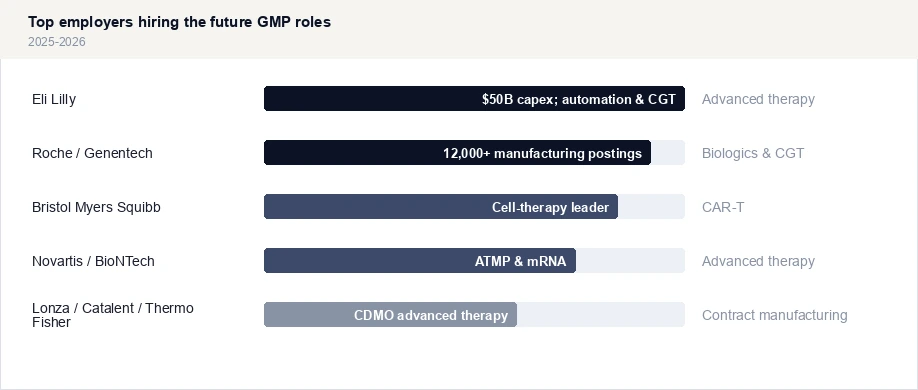
The largest hirers are the drugmakers building advanced-therapy and digital capacity, led by Eli Lilly on a 50 billion dollar expansion, Roche with more than 12,000 manufacturing postings, Bristol Myers Squibb in cell therapy, and Novartis and BioNTech in advanced therapies and mRNA. The contract manufacturers Lonza, Catalent and Thermo Fisher hire hard for advanced-therapy work.
For a smaller manufacturer this sets the frame. The UK cell-and-gene cluster around Stevenage, with GSK, AstraZeneca, Oxford Biomedica and Autolus, is a distinct and deep talent pool worth targeting rather than competing head to head with the majors.
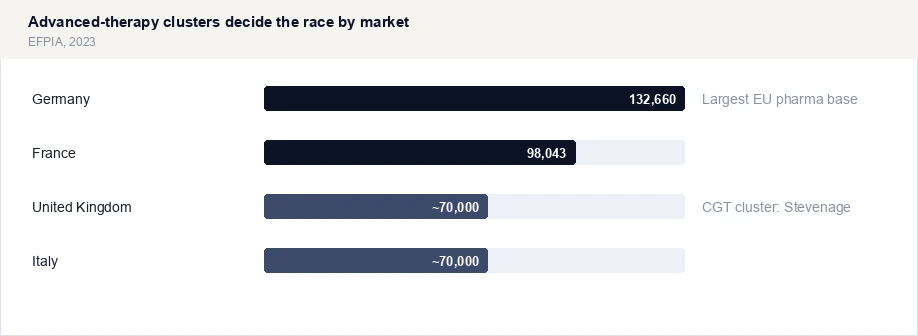
European pharma employment concentrates in a few countries. Germany leads with about 132,660 direct pharma employees, ahead of France near 98,000 and the United Kingdom and Italy each around 70,000, out of a European total of 940,555. The United States dwarfs all of them with life sciences employment near 2.1 million.
For the future roles, the clusters matter more than the totals. The United Kingdom punches far above its weight in cell and gene therapy around Stevenage, Oxford and Cambridge, the United States concentrates advanced-therapy manufacturing in Boston, and Germany anchors mRNA and biologics around BioNTech in Mainz.
Three forces are rewriting the GMP org chart. Automation, real-time release testing and electronic records are removing the manual quality and documentation roles. The advanced-therapy build-out is creating a wave of cell, gene and biologics manufacturing roles that did not exist at scale five years ago. And data integrity, still a top regulator citation, is making CSV and Quality 4.0 roles non-negotiable. The result is a workforce that must be reskilled, not just rehired.
The report turns the shift into a GMP hiring and reskilling plan across the United States, Germany and the United Kingdom. It names the rising roles, the declining ones, and the routes between them.
Year-over-year demand and median pay for every future GMP role across the US, Germany and the UK.
Median and senior pay by role in USD, EUR and GBP, including the advanced-therapy premium.
Which roles are growing, which are being automated, and the reskilling routes between them.
Full employer league table of who hires the most, by role and market.
Shortest reskilling routes from manual QC into PAT, data integrity and automation.
Cost comparison of hiring, contracting and internal reskilling by role.
Projected demand and time-to-fill by role, from live pipeline data.
Every exhibit supplied as an Excel workbook.
The report is built on Talenbrium's four-layer data method: real-time job-posting intelligence across LinkedIn, Indeed and Glassdoor, a proprietary skills taxonomy of more than 8,000 skills, employer hiring tracking, and a quarterly Workforce Pulse Survey, triangulated against external benchmarks and industry bodies such as ISPE. Role demand comes from posting analysis. Pay is drawn from posted and surveyed compensation and market salary data, and is reported at median and at the 90th percentile.

Customise the study to your target geography, role, skill cluster, or benchmark set, or request a sample before you proceed.