
Almost every enterprise now runs on the cloud, and the workforce that builds and operates it is in constant demand. The United States sees roughly 317,000 cloud openings a year, and cloud roles grow about six times faster than the average job. The scarce skill is the platform and reliability engineer who can run a large cloud estate securely and at cost.
This report treats the roles as the unit of analysis. It profiles each designation, sets demand against supply, benchmarks pay across the United States, Germany and the United Kingdom, shows where the openings concentrate, and names the employers hiring the most.
Cloud work splits into three layers: the cloud roles that build and secure workloads, the platform and reliability roles that keep them running, and the DevOps roles that automate delivery. Pay rises as the work moves from building toward reliability and security.
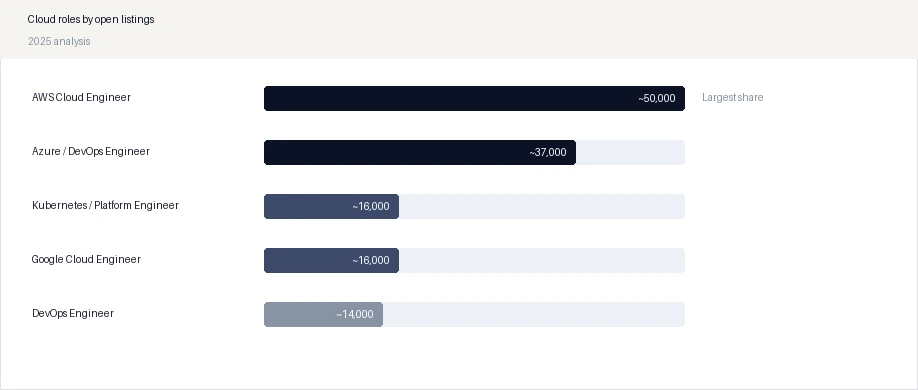
Demand splits by provider. Postings naming AWS lead at around 50,000 listings, ahead of Azure near 37,000, with Kubernetes and Google Cloud each near 16,000. The base cloud engineer is well supplied, but the platform, reliability and security specialists above that base are not, and certification demand for cloud security has risen more than 70 percent in a year.
Supply grows with training but lags on the senior end. The market rewards the engineers who can run reliability at scale and control cost, the skills that only come with operating a large estate through real incidents.
US pay leads. A site reliability engineer earns around USD 150,000 at median base and a cloud architect around USD 155,000, with a premium for machine-learning and security specialisation. Germany pays solidly for architects and reliability roles, while the United Kingdom sits below both, with DevOps base pay near GBP 50,000.
The table sets year-over-year demand and median base pay for each designation across the three markets, so an offer can be calibrated by role and country.
| Role | Demand, YoY | US median | Germany median | UK median |
|---|---|---|---|---|
| AI / ML Cloud Engineer | +28% | $160,000 | €80,000 | £78,000 |
| Cloud Architect | +20% | $155,000 | €82,000 | £75,000 |
| Site Reliability Engineer | +22% | $150,000 | €78,000 | £72,000 |
| Platform Engineer | +26% | $145,000 | €75,000 | £65,000 |
| Cloud Security Engineer | +24% | $140,000 | €72,000 | £70,000 |
| DevSecOps Engineer | +22% | $138,000 | €70,000 | £68,000 |
| DevOps Engineer | +20% | $130,000 | €68,000 | £50,000 |
| Cloud Engineer | +25% | $120,000 | €65,000 | £55,000 |
Median base pay, mid-level, in local currency. US figures anchored to Glassdoor and levels.fyi; Germany and UK to 2025-2026 country data. Machine-learning and security specialisation carry a premium. Demand is the Talenbrium year-over-year posting change. Source: Talenbrium posting intelligence and compensation model; Glassdoor; levels.fyi 2025-2026
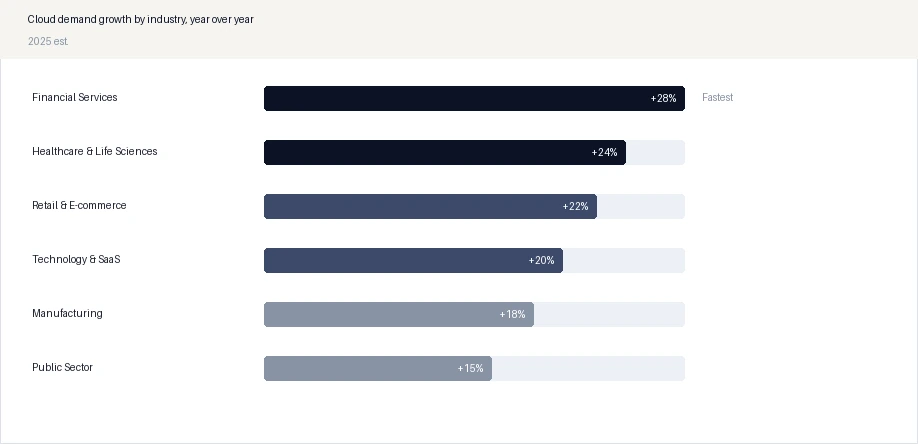
The steepest growth sits in financial services and healthcare, where regulation and legacy estates make cloud migration both urgent and complex. Retail, technology and manufacturing follow as those sectors modernise and adopt platform engineering.
The push is toward the platform and reliability end of the role. As estates grow, employers need the engineers who can run them reliably and control spend, not only those who can stand up a new service.
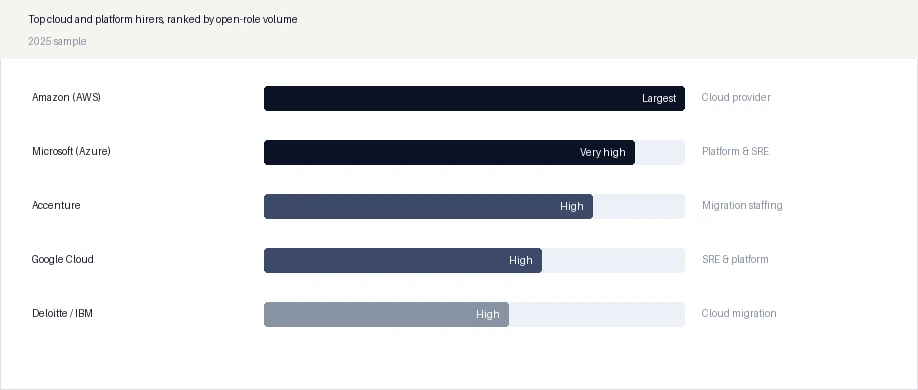
The hyperscalers and the large consultancies dominate. Amazon leads through AWS as the single largest cloud employer, followed by Microsoft on Azure, then Accenture staffing migrations at scale, Google Cloud, and the Deloitte and IBM services practices.
For a smaller employer the message is clear. The providers and integrators can offer the deepest platforms and the widest problems, so a commercial firm competes on the interest of the work, on flexibility and on speed to offer.
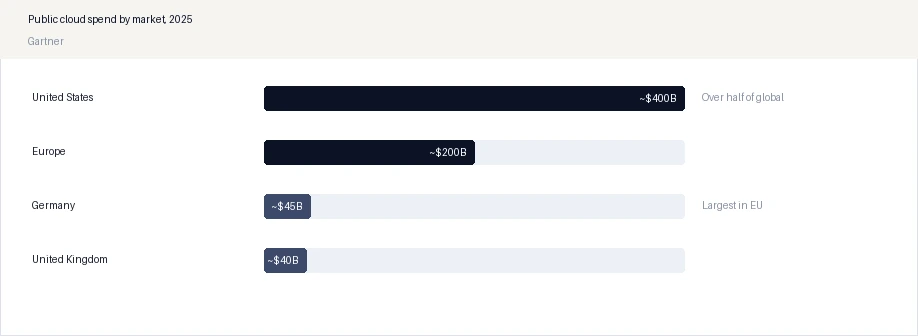
Cloud spend concentrates in the United States, which accounts for well over half of the worldwide public cloud market of USD 723 billion in 2025. Europe follows near USD 200 billion, with Germany the largest single European market around USD 45 billion and the United Kingdom close behind near USD 40 billion.
Spend tracks hiring. The markets that spend the most on cloud also compete hardest for the engineers to run it, so US pay leads and European employers increasingly draw on regional and nearshore hubs to fill the gap.
Three forces hold the cloud shortage in place. Almost every enterprise now runs on the cloud, so demand is broad and permanent. The skill bar has risen from basic administration toward platform engineering, reliability and cost control, which thins the qualified pool. And the build-out of AI infrastructure has added a new draw on the same GPU and platform talent. None of these eases inside a hiring cycle.
The report turns the role-level pattern into a cloud hiring and reskilling plan across the United States, Germany and the United Kingdom.
Year-over-year demand and median pay for every cloud designation across the US, Germany and the UK.
Median and senior pay by role in USD, EUR and GBP, including the specialist premium.
Full employer league table of who hires the most, by role and market.
Country and metro talent depth mapped to competition and pay.
Shortest reskilling routes into each role, with cost and duration.
Cost comparison of hiring, contracting and internal reskilling by role.
Projected demand and time-to-fill by role, from live pipeline data.
Every exhibit supplied as an Excel workbook.
The report is built on Talenbrium's four-layer data method: real-time job-posting intelligence, a proprietary skills taxonomy of more than 8,000 skills, employer hiring tracking, and a quarterly Workforce Pulse Survey, triangulated against external benchmarks. Role demand comes from posting analysis. Pay is drawn from posted and surveyed compensation and market salary data, and is reported at median and at the 90th percentile.

Customise the study to your target geography, role, skill cluster, or benchmark set, or request a sample before you proceed.