
Public money has put new fabs on the map, yet the workforce to run them is the binding constraint. The Semiconductor Industry Association projects about 67,000 unfilled US semiconductor jobs by 2030 out of roughly 115,000 new roles, and critical fab roles need 18 to 36 months of training after hire. The scarce people are the process, integration, design and equipment engineers who bring a fab to yield.
This report treats the roles as the unit of analysis. It profiles each designation, sets demand against supply, benchmarks pay across the United States, Germany and the United Kingdom and Europe, shows where the openings concentrate, and names the employers hiring the most.
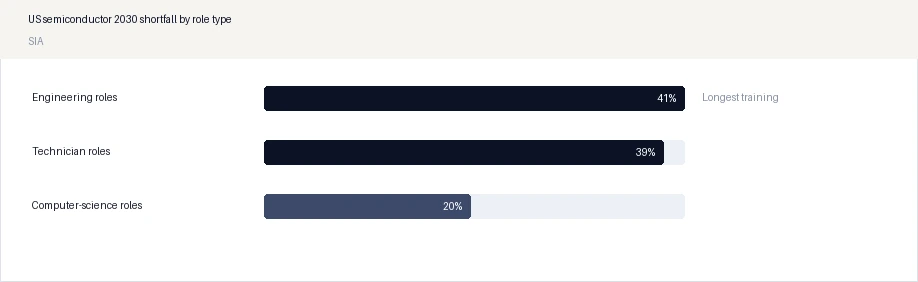
The demand has concentrated at the leading edge. AI accelerators and high-bandwidth memory have pulled hiring toward chip design, verification and advanced packaging, while the manual operator and bench-test work on the floor is being automated. The ten designations split into three forward-facing layers: the design and AI-hardware roles that create the chip, the process, yield and equipment roles that bring it to yield, and the fab-operations roles that run an increasingly automated line. About 41 percent of the projected shortfall is in engineering roles and 39 percent in technicians.
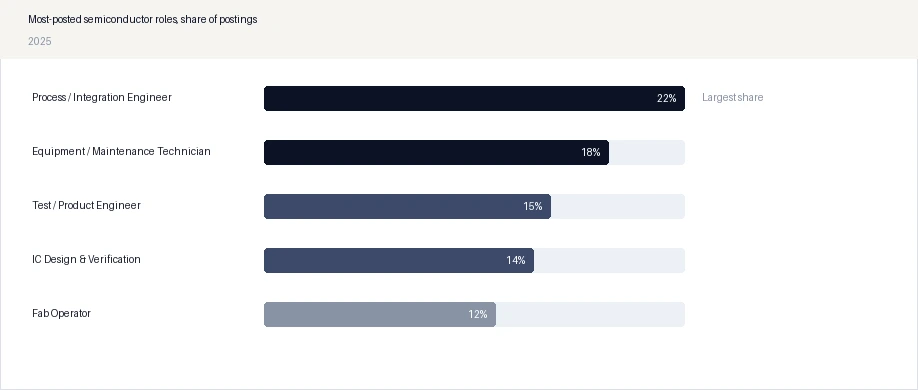
Process and integration engineers lead the postings at roughly 22 percent, followed by equipment and maintenance technicians and test engineers. The demand reflects the fab build-out, but the roles cannot be filled quickly because critical positions need one to three years of training on live tools after hire.
Supply is the constraint the money cannot solve. US semiconductor headcount actually fell from its 2023 peak despite active hiring, as churn and a thin pipeline offset new demand, which is why the projected shortfall keeps widening even as fabs open.
A modern fab is one of the most automated workplaces there is, and the automation keeps climbing. Automated material handling moves the wafers, computer vision inspects them, and automated test equipment runs the volume test that bench technicians once did by hand. The shortfall the industry worries about is in engineering, not in the manual floor roles that automation is steadily removing.
| Declining role | Why it is shrinking | What replaces it |
|---|---|---|
| Manual fab operator / line tender | Automated material-handling systems run wafer movement across the fab. | Process technicians who supervise and maintain automated tools. |
| Manual wafer inspection operator | AI and computer-vision defect detection replace manual inspection. | Yield engineers who run AI-driven defect analysis. |
| Manual bench-test technician | Automated test equipment and AI test programs cover volume test. | Test and ATE engineers who build automated test programs. |
| Reactive tool-maintenance technician | Predictive maintenance on tools reduces reactive break-fix. | Equipment engineers who run predictive tool maintenance. |
The decline is of the manual floor version of these roles, not of fab work itself, where the engineering shortfall is acute. Reskilling routes from operator and manual-test roles into process, yield and equipment engineering are set out in the full report. Source: SIA; SEMI; Talenbrium classification
US pay leads. An IC or physical design engineer earns around USD 140,000 at median base and a process engineer around USD 118,000, with device and verification roles close behind. Germany pays strongly around the Dresden cluster, while the UK is smaller and design-heavy around Newport and Bristol.
The table sets year-over-year demand and median base pay for each designation across the three markets, so an offer can be calibrated by role and country.
| Role | Demand, YoY | US median | Germany median | UK median |
|---|---|---|---|---|
| Advanced Packaging / 3D Integration Engineer | +25% | $145,000 | €80,000 | £80,000 |
| IC / Physical Design Engineer | +18% | $140,000 | €78,000 | £80,000 |
| Verification Engineer | +16% | $135,000 | €75,000 | £70,000 |
| Device / Reliability Engineer | +11% | $130,000 | €76,000 | £75,000 |
| Yield / Integration Engineer | +14% | $122,000 | €73,000 | £65,000 |
| Process Engineer | +15% | $118,000 | €72,000 | £60,000 |
| Test / ATE Engineer | +12% | $110,000 | €68,000 | £58,000 |
| Automated Fab / Process Technician | +6% | $62,000 | €48,000 | £38,000 |
Median base pay, mid-level, in local currency. US figures anchored to Glassdoor and employer bands; Germany to Dresden-cluster data; UK to national job-advert medians. Demand is the Talenbrium year-over-year posting change. Source: Talenbrium posting intelligence and compensation model; Glassdoor; SalaryExpert; UK semiconductor job data 2025-2026
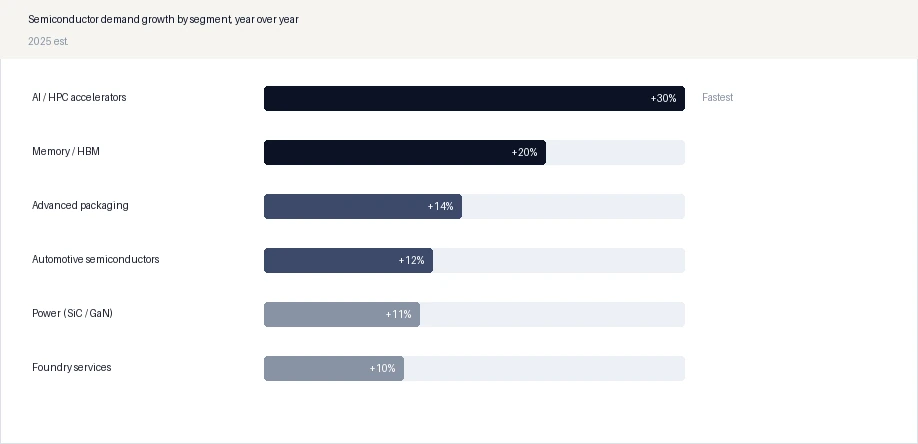
The steepest demand sits in AI and high-performance computing accelerators, up around 30 percent, followed by memory and high-bandwidth memory as data-centre build-out accelerates. Advanced packaging, automotive and power semiconductors follow as electrification and edge computing spread.
The push concentrates on the leading-edge process and packaging roles, exactly where the training is longest and the pool is thinnest, which is why the demand does not translate quickly into filled seats.
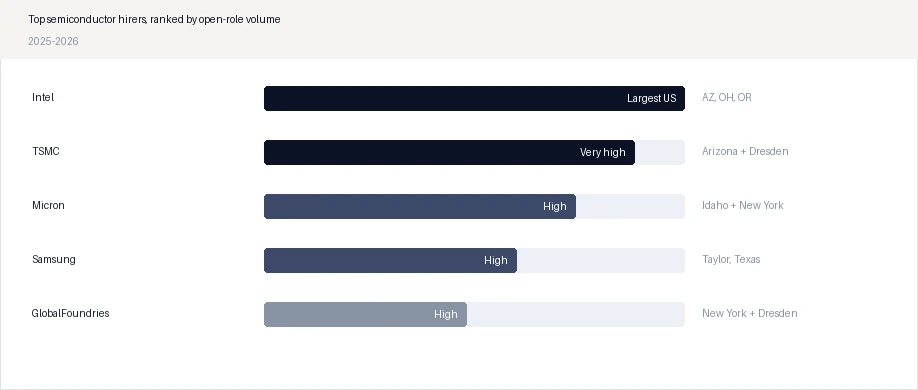
The largest fab operators lead the hiring. Intel is the largest US employer with expansions in Arizona, Ohio and Oregon, followed by TSMC across its Arizona fabs and Dresden, Micron in Idaho and New York, Samsung in Texas, and GlobalFoundries in New York and Dresden.
For a smaller design house or supplier this sets the competitive frame. The megafab operators pay top of market and hire in waves around each new site, so competing means targeting different metros or specialised niches rather than head-to-head bidding.
The projected US shortfall is not evenly spread. About 41 percent of the 67,000 gap is in engineering roles and 39 percent in technicians, with the remaining fifth in computer-science roles. That mix matters, because engineering and technician roles carry the longest training times and cannot be filled by hiring alone.
Europe faces its own version of the gap. Germany anchors the European industry around Dresden, with Infineon and the TSMC joint venture adding capacity, but the cancellation of the Intel Magdeburg project in 2025 put the EU target of doubling its chip share by 2030 under pressure.
Three forces hold the semiconductor shortage in place. Industrial policy has funded fabs faster than the workforce can be trained. Critical roles need one to three years of on-the-job training that cannot be shortened. And the pipeline of process, integration and equipment engineers has stayed thin while demand surged. The result is a shortfall that widens even as new capacity comes online.
The report turns the role-level pattern into a fab hiring and reskilling plan across the United States, Germany and Europe.
Year-over-year demand and median pay for every semiconductor designation across the US, Germany and the UK.
Median and senior pay by role in USD, EUR and GBP, including the specialist premium.
Full employer league table of who hires the most, by role and market.
Country and metro talent depth mapped to competition and pay.
Shortest reskilling routes into each role, with cost and duration.
Cost comparison of hiring, contracting and internal reskilling by role.
Projected demand and time-to-fill by role, from live pipeline data.
Every exhibit supplied as an Excel workbook.
The report is built on Talenbrium's four-layer data method: real-time job-posting intelligence, a proprietary skills taxonomy of more than 8,000 skills, employer hiring tracking, and a quarterly Workforce Pulse Survey, triangulated against external benchmarks. Role demand comes from posting analysis. Pay is drawn from posted and surveyed compensation and market salary data, and is reported at median and at the 90th percentile.

Customise the study to your target geography, role, skill cluster, or benchmark set, or request a sample before you proceed.