
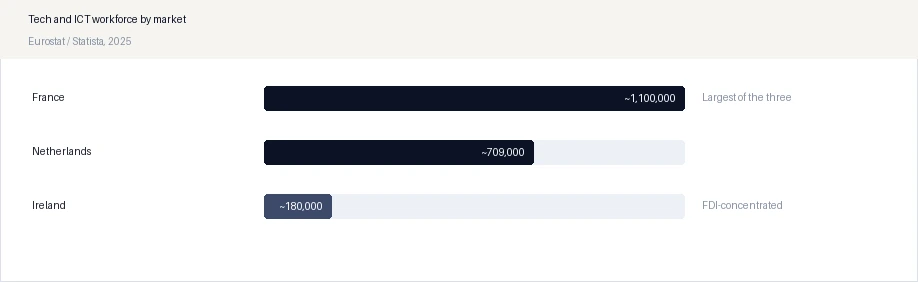
France, the Netherlands and Ireland all run AI and analytics programmes that depend on reliable data platforms, and all three are short of the engineers to build them. France brings the largest pool at more than 1.1 million ICT professionals, the Netherlands adds about 709,000 with a structural technical shortfall, and Ireland concentrates data teams inside its multinational cluster.
This report treats the roles as the unit of analysis across the three markets. It profiles each designation, sets demand against supply, benchmarks pay in euros, names the employers hiring the most, and maps the top five talent cities in each country.
Data work splits into three layers: the pipeline roles that move and shape data, the analytics roles that turn it into insight, and the platform roles that run the infrastructure. All three markets are deep on analytics and pipeline talent, with platform engineering the scarce, higher-paid tier.
Data engineering demand is broad across all three markets, so pipeline talent is reasonably supplied. The scarcity sits in the platform and streaming specialists who run cloud-native infrastructure, and they command a premium, sharpest in Ireland and the Netherlands.
The Dutch structural shortfall of technical professionals keeps the senior tier especially tight, even as graduate pipelines grow.
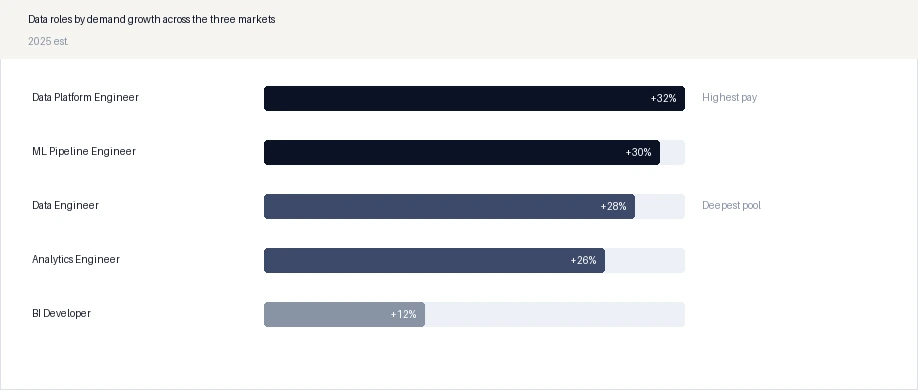
Pay is high and Ireland and the Netherlands lead on the platform end, with senior and platform engineers around 80,000 euros or more, while France sits lower on base. All three run well above Central and Eastern Europe.
The table sets year-over-year demand and median base pay in euros for each designation across the three markets.
| Role | Demand, YoY | France (EUR) | Netherlands (EUR) | Ireland (EUR) |
|---|---|---|---|---|
| Database Architect | +9% | €66,000 | €80,000 | €82,000 |
| Data Platform Engineer | +32% | €68,000 | €78,000 | €82,000 |
| Senior Data Engineer | +30% | €70,000 | €78,000 | €82,000 |
| ML Pipeline Engineer | +30% | €68,000 | €76,000 | €80,000 |
| Analytics Engineer | +26% | €58,000 | €66,000 | €68,000 |
| Data Engineer | +28% | €63,000 | €68,000 | €70,000 |
| BI Developer | +12% | €48,000 | €58,000 | €60,000 |
| Data Analyst | +10% | €45,000 | €55,000 | €55,000 |
Median base pay, mid-level, in euros. Ireland and the Netherlands lead on the platform end; France lower on base. Platform and ML roles carry a premium. Demand is the Talenbrium year-over-year posting change. Source: Talenbrium posting intelligence and compensation model; levels.fyi; Morgan McKinley; Hays 2025-2026
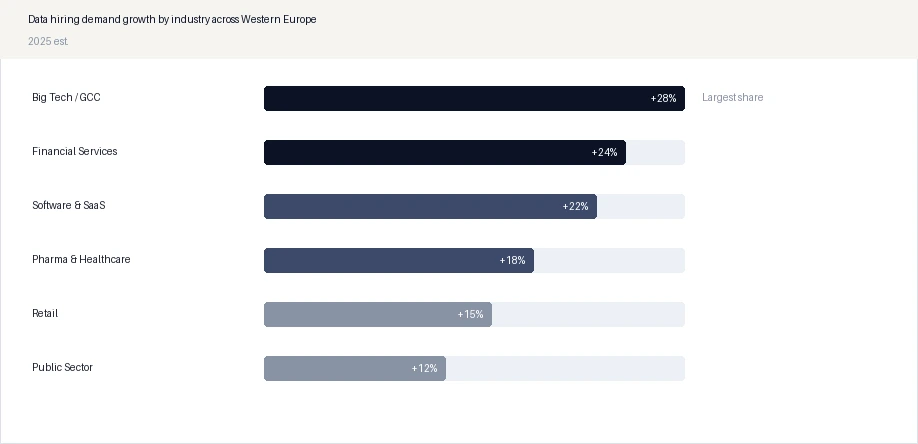
The steepest demand comes from the big-technology and capability centres in Dublin and Amsterdam, followed by financial services and product software. Pharma and healthcare add a data pull in Ireland.
The push runs toward the platform end of the role, where all three markets need engineers who can build and run cloud data infrastructure, not only query it.
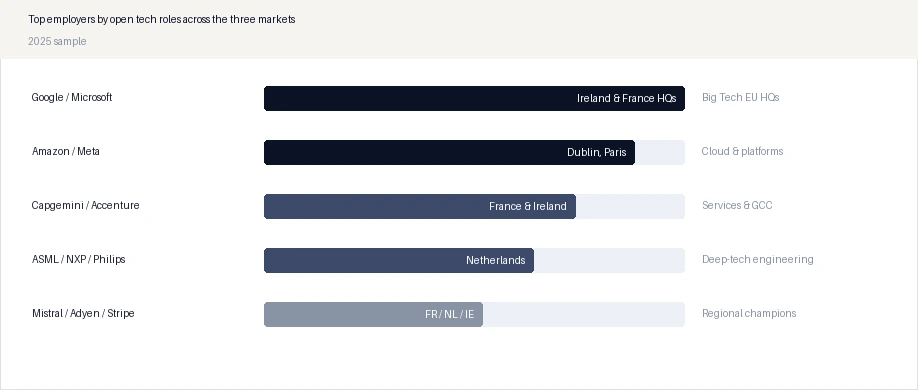
The largest hirers are the technology and enterprise firms running data and capability centres, led by Google, Microsoft, Amazon and the Dutch scale-ups Booking and Adyen, with Capgemini and Accenture staffing data programmes at scale and ASML and Philips hiring deep-tech data talent in the Netherlands.
For a Western firm hiring in the region, this sets the frame. The majors set the pay ceiling in the main hubs, so a new entrant competes on the interest of the data problem and on speed.
Data talent concentrates in the main tech hubs, with Amsterdam and Dublin especially deep. These are the fifteen cities where a data hire is realistic today.
France offers the deepest data hiring options on its 1.1 million-strong ICT pool. The Netherlands adds about 709,000 but runs a structural shortfall that keeps its market tight, and Ireland concentrates data teams inside its multinational cluster.
Depth shapes strategy. France suits large data platforms, the Netherlands suits deep-tech and finance data, and Ireland suits multinational and product data teams.
Three forces drive Western European data demand. AI and real-time analytics make reliable pipelines a prerequisite. The skill bar has risen toward cloud platforms and streaming, thinning the senior tier. And a structural technical shortfall, sharpest in the Netherlands, keeps the market tight. The result is broad supply and a contested platform tier.
The report turns the role-level pattern into a Western European data hiring and reskilling plan across France, the Netherlands and Ireland.
Year-over-year demand and median pay for every data role across France, the Netherlands and Ireland.
Median and senior pay by role in euros for all three markets.
Full employer league table of who hires the most, by role and country.
The five leading talent cities per country, with pool depth, demand and salary.
Shortest reskilling routes into each role, with cost and duration.
Cost comparison of hiring, contracting and internal reskilling by role.
Projected demand and time-to-fill by role, from live pipeline data.
Every exhibit supplied as an Excel workbook.
The report is built on Talenbrium's four-layer data method: real-time job-posting intelligence, a proprietary skills taxonomy of more than 8,000 skills, employer hiring tracking, and a quarterly Workforce Pulse Survey, triangulated against external benchmarks. Role demand comes from posting analysis. Pay is drawn from posted and surveyed compensation and market salary data in euros, and is reported at median and at the 90th percentile. City figures draw on Eurostat, IDA Ireland and Brainport talent-hub data.

Customise the study to your target geography, role, skill cluster, or benchmark set, or request a sample before you proceed.